


Peer smoking, other peer attributes, and adolescent cigarette smoking: a social network analysis
- PMID: 18404380
- PMCID: PMC3809895
- DOI: 10.1007/s11121-008-0087-8
Peer smoking, other peer attributes, and adolescent cigarette smoking: a social network analysis
Abstract
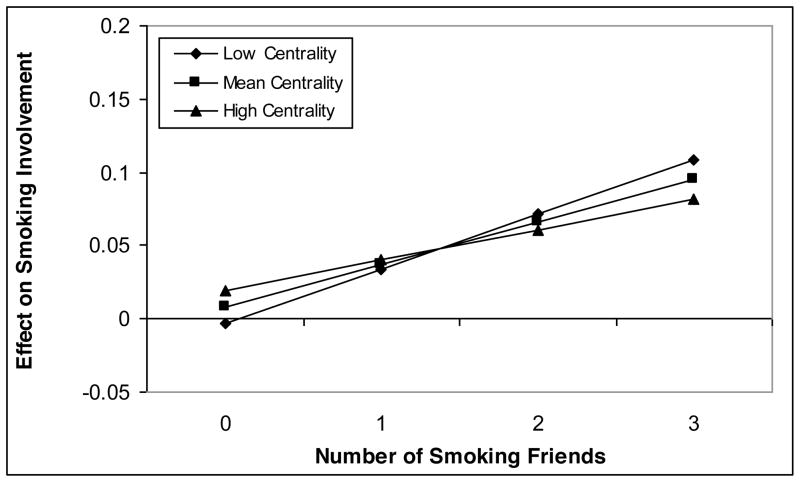
Peer attributes other than smoking have received little attention in the research on adolescent smoking, even though the developmental literature suggests the importance of multiple dimensions of adolescent friendships and peer relations. Social network analysis was used to measure the structure of peer relations (i.e., indicators of having friends, friendship quality, and status among peers) and peer smoking (i.e., friend and school smoking). We used three-level hierarchical growth models to examine the contribution of each time-varying peer variable to individual trajectories of smoking from age 11 to 17 while controlling for the other variables, and we tested interactions between the peer structure and peer smoking variables. Data were collected over five waves of assessment from a longitudinal sample of 6,579 students in three school districts. Findings suggest a greater complexity in the peer context of smoking than previously recognized.
Figures
References
-
- Abel G, Plumridge L, Graham P. Peers, networks or relationships: Strategies for understanding social dynamics as determinants of smoking behaviour. Drugs: Education, Prevention and Policy. 2002;9:325–338.
-
- Alexander C, Piazza M, Mekos D, Valente T. Peers, school, and adolescent cigarette smoking. Journal of Adolescent Health. 2001;29:22–30. - PubMed
-
- Allison PD. Missing Data. Thousand Oaks, CA: Sage; 2002.
-
- Bauman KE, Ennett ST. On the importance of peer influence for adolescent drug use: commonly neglected considerations. Addiction. 1996;91:185–198. - PubMed
Publication types
MeSH terms
Grants and funding
LinkOut - more resources
Full Text Sources
Medical
