. 2006 Jun;2(2):351-60.
doi: 10.1007/s11302-005-5302-5. Epub 2006 Jun 1.

Physiological roles for ecto-5'-nucleotidase (CD73)

Affiliations

Physiological roles for ecto-5'-nucleotidase (CD73)

Sean P Colgan et al. Purinergic Signal. 2006 Jun.

Abstract

Nucleotides and nucleosides influence nearly every aspect of physiology and pathophysiology. Extracellular nucleotides are metabolized through regulated phosphohydrolysis by a series of ecto-nucleotidases. The formation of extracellular adenosine from adenosine 5'-monophosphate is accomplished primarily through ecto-5'-nucleotidase (CD73), a glycosyl phosphatidylinositol-linked membrane protein found on the surface of a variety of cell types. Recent in vivo studies implicating CD73 in a number of tissue protective mechanisms have provided new insight into its regulation and function and have generated considerable interest. Here, we review contributions of CD73 to cell and tissue stress responses, with a particular emphasis on physiologic responses to regulated CD73 expression and function, as well as new findings utilizing Cd73-deficient animals.


Figures
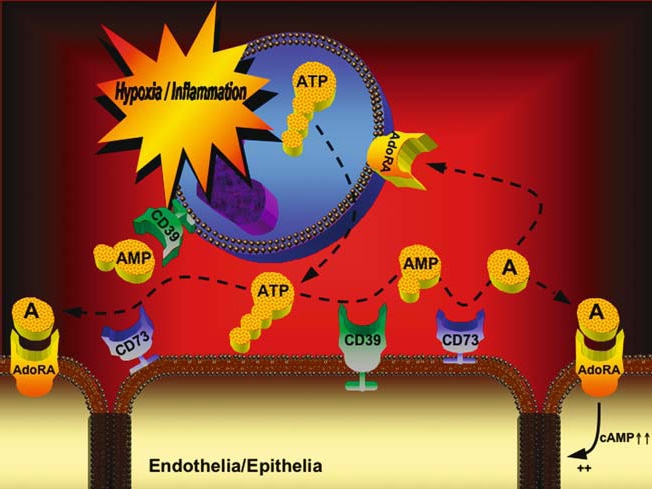
Figure 1
Figure 1
Model of coordinated nucleotide metabolism and nucleoside signaling in hypoxia and inflammation. In areas of ongoing inflammation, diminished oxygen supply coordinates the induction of CD39, CD73, and the adenosine A2B receptor. At such sites, activated neutrophils provide a readily available extracellular source of ATP, that through two enzymatic steps is converted to extracellular adenosine. Activation of surface adenosine receptors promotes a variety of protective physiologic responses (see text). Abbreviations: A, adenosine; AdoRA A2, adenosine receptor; AMP, adenosine monophosphate; ATP, adenosine triphosphate; cAMP, cyclic AMP.

References

    1. Zimmerman H. 5’-nucleotidase: Molecular structure and functional aspects. Biochem J 1992; 285: 345–65. - PMC - PubMed
    1. Linden J. Molecular approach to adenosine receptors: Receptor-mediated mechanisms of tissue protection. Annu Rev Pharmacol Toxicol 2001; 41: 775–87. - DOI - PubMed
    1. Hunsucker SA, Mitchell BS, Spychala J. The 5’-nucleotidases as regulators of nucleotide and drug metabolism. Pharmacol Ther 2005; 107: 1–30. - DOI - PubMed
    1. Gamba G. Molecular physiology and pathophysiology of electroneutral cation-chloride cotransporters. Physiol Rev 2005; 85: 423–93. - DOI - PubMed
    1. Madara JL, Patapoff TW, Gillece-Castro B et al. 5’-adenosine monophosphate is the neutrophil-derived paracrine factor that elicits chloride secretion from T84 intestinal epithelial cell monolayers. J Clin Invest 1993; 91: 2320–5. - DOI - PMC - PubMed
