


The exploratory behaviour of rats in the hole-board apparatus: is head-dipping a valid measure of neophilia?
- PMID: 18406075
- PMCID: PMC2396234
- DOI: 10.1016/j.beproc.2008.02.019
The exploratory behaviour of rats in the hole-board apparatus: is head-dipping a valid measure of neophilia?
Abstract
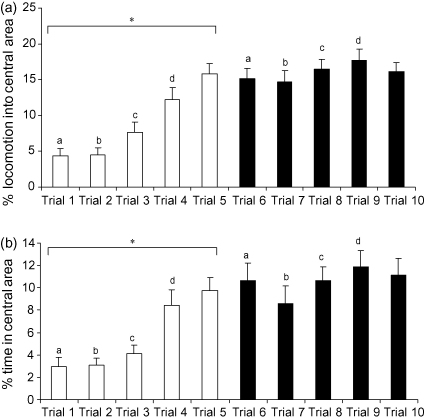
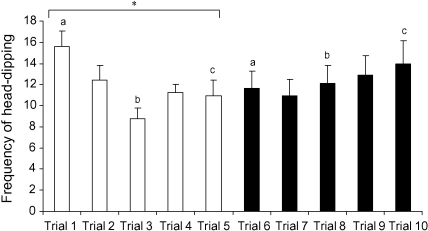
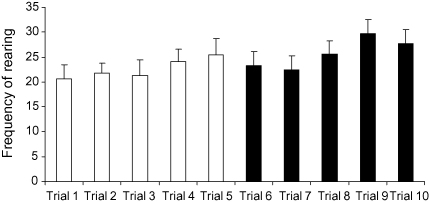
The exploratory behaviour of laboratory rodents is of interest within a number of areas of behavioural pharmacology. However, how best to measure exploratory behaviour in rodents remains a contentious issue. Many unconditioned tests, such as the open field, potentially confound general locomotor activity with exploration. The hole-board apparatus appears to avoid this confound, as head-dipping into holes in the floor is assumed to be a valid measure of the subject's attraction towards novelty (neophilia). This study aimed to investigate whether head-dipping should be considered a valid measure of neophilia by comparing performance of adult male and female Lister hooded rats on the hole-board task (a) over repeated sessions and (b) when novel objects were absent or present underneath the holes. The results show that head-dipping initially decreased across repeated exposures, while time spent in the aversive central area increased. No change in head-dipping was seen in response to objects being placed underneath the holes. Rather than being a measure of neophilia, these results support the hypothesis that head-dipping represents an escape response, which declines as the subject becomes less fearful. These results are compared with previous studies of repeated exposure to other novel environments.
Figures
References
-
- Abel E.L. Further evidence for the dissociation of locomotor activity and head dipping in rats. Physiol. Behav. 1995;57:529–532. - PubMed
-
- Aguilar R., Gil L., Gray J.A., Driscoll P., Flint J., Dawson G.R., Gimenez-Llort L., Escorihuela R.M., Fernandez-Teruel A., Tonena A. Fearfulness and sex in F2 Roman rats: males display more fear though both sexes share the same fearfulness traits. Physiol. Behav. 2003;78:723–732. - PubMed
-
- Bardo M.T., Donohew R.L., Harrington N.G. Psychobiology of novelty seeking and drug seeking behaviour. Behav. Brain Res. 1996;77:23–43. - PubMed
-
- Belzung C., Griebel G. Measuring normal and pathological anxiety-like behaviour in mice: a review. Behav. Brain Res. 2001;125:141–149. - PubMed
-
- Berlyne D.E. Novelty and curiosity as determinants of exploratory behavior. Br. J. Psychol. 1950;41:68–80.
Publication types
MeSH terms
Grants and funding
LinkOut - more resources
Full Text Sources
