


In vitro evaluations of antimalarial drugs and their relevance to clinical outcomes
- PMID: 18406409
- PMCID: PMC2430068
- DOI: 10.1016/j.ijpara.2008.03.004
In vitro evaluations of antimalarial drugs and their relevance to clinical outcomes
Abstract
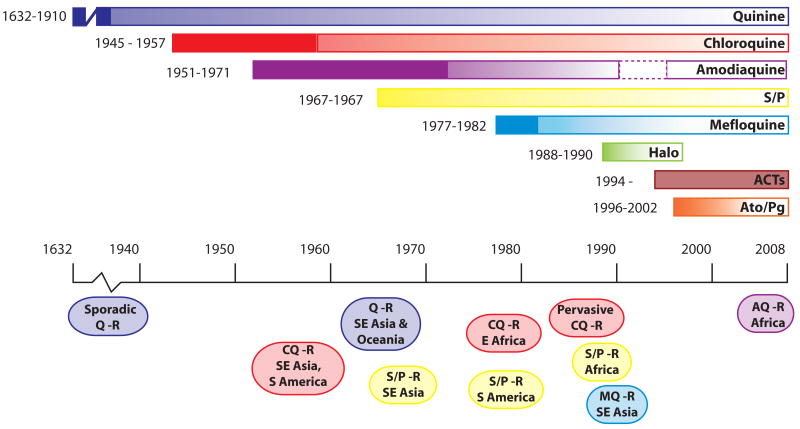
Plasmodium falciparum resistance to the former first-line antimalarials chloroquine and sulfadoxine/pyrimethamine has reached critically high levels in many malaria-endemic regions. This has spurred the introduction of several new artemisinin-based combination therapies (ACTs) that display excellent potency in treating drug-resistant malaria. Monitoring for the emergence of drug resistant P. falciparum is important for maximising the clinically effective lifespan of ACTs. Here, we provide a commentary on the article by Kaddouri et al., published in this issue of the International Journal of Parasitology, which documents the levels of susceptibility to ACT drugs and chloroquine in P. falciparum isolates from Mali. These authors report that some isolates approached a proposed in vitro threshold of resistance to monodesethyl-amodiaquine (the principal effective metabolite of amodiaquine, an important ACT partner drug), and establish baseline levels of susceptibility to the ACT drugs dihydroartemisinin and lumefantrine. The majority of clinical isolates manifested in vitro resistance to chloroquine. The authors also show good concordance between field-based assays employing a non-radioactive lactate dehydrogenase-based method of determining in vitro drug IC(50) values and the well-established [(3)H]hypoxanthine-based radioactive method. This work illustrates a good example of drug resistance surveillance, whose global coordination is being championed by the World Antimalarial Resistance Network. Our current opinion also more generally discusses the complexities inherent to conducting in vitro investigations with P. falciparum patient isolates and correlating these findings with treatment outcome data.
Figures
Comment on
-
Baseline in vitro efficacy of ACT component drugs on Plasmodium falciparum clinical isolates from Mali.Int J Parasitol. 2008 Jun;38(7):791-8. doi: 10.1016/j.ijpara.2007.12.002. Epub 2008 Jan 3. Int J Parasitol. 2008. PMID: 18249407
References
-
- Afonso A, Hunt P, Cheesman S, Alves AC, Cunha CV, do Rosario V, Cravo P. Malaria parasites can develop stable resistance to artemisinin but lack mutations in candidate genes atp6 (encoding the sarcoplasmic and endoplasmic reticulum Ca2+ ATPase), tctp, mdr1, and cg10. Antimicrob Agents Chemother. 2006;50:480–489. - PMC - PubMed
-
- Ashley EA, White NJ. Artemisinin-based combinations. Curr Opin Infect Dis. 2005;18:531–536. - PubMed
-
- Bathurst I, Hentschel C. Medicines for Malaria Venture: sustaining antimalarial drug development. Trends Parasitol. 2006;22:301–307. - PubMed
-
- Brasseur P, Kouamouo J, Moyou-Somo R, Druilhe P. Multi-drug resistant falciparum malaria in Cameroon in 1987-1988. I. Stable figures of prevalence of chloroquine- and quinine-resistant isolates in the original foci. Am J Trop Med Hyg. 1992;46:1–7. - PubMed
Publication types
MeSH terms
Substances
Grants and funding
LinkOut - more resources
Full Text Sources
Medical
