. 2008 Jun;147(2):886-96.
doi: 10.1104/pp.107.115469. Epub 2008 Apr 11.

Regulation of dormancy in barley by blue light and after-ripening: effects on abscisic acid and gibberellin metabolism

Affiliations

Regulation of dormancy in barley by blue light and after-ripening: effects on abscisic acid and gibberellin metabolism

Frank Gubler et al. Plant Physiol. 2008 Jun.

Abstract

White light strongly promotes dormancy in freshly harvested cereal grains, whereas dark and after-ripening have the opposite effect. We have analyzed the interaction of light and after-ripening on abscisic acid (ABA) and gibberellin (GA) metabolism genes and dormancy in barley (Hordeum vulgare 'Betzes'). Analysis of gene expression in imbibed barley grains shows that different ABA metabolism genes are targeted by white light and after-ripening. Of the genes examined, white light promotes the expression of an ABA biosynthetic gene, HvNCED1, in embryos. Consistent with this result, enzyme-linked immunosorbent assays show that dormant grains imbibed under white light have higher embryo ABA content than grains imbibed in the dark. After-ripening has no effect on expression of ABA biosynthesis genes, but promotes expression of an ABA catabolism gene (HvABA8'OH1), a GA biosynthetic gene (HvGA3ox2), and a GA catabolic gene (HvGA2ox3) following imbibition. Blue light mimics the effects of white light on germination, ABA levels, and expression of GA and ABA metabolism genes. Red and far-red light have no effect on germination, ABA levels, or HvNCED1. RNA interference experiments in transgenic barley plants support a role of HvABA8'OH1 in dormancy release. Reduced HvABA8'OH1 expression in transgenic HvABA8'OH1 RNAi grains results in higher levels of ABA and increased dormancy compared to nontransgenic grains.


Figures
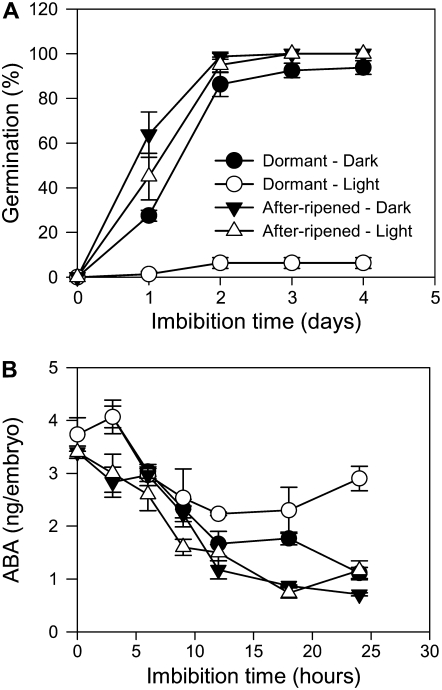
Figure 1.
Figure 1.
Effect of white light and dark on germination and ABA content of D and AR barley grains during imbibition. A, Germination of D and AR barley grains irradiated with continuous white light or in dark: Measurements are averages of four replicates with error bars representing the se of the mean. B, Changes in embryo ABA content in D and AR grains imbibed under continuous white light or dark. Measurements are averages of three replicates with error bars representing the se of the mean.
Figure 2.
Figure 2.
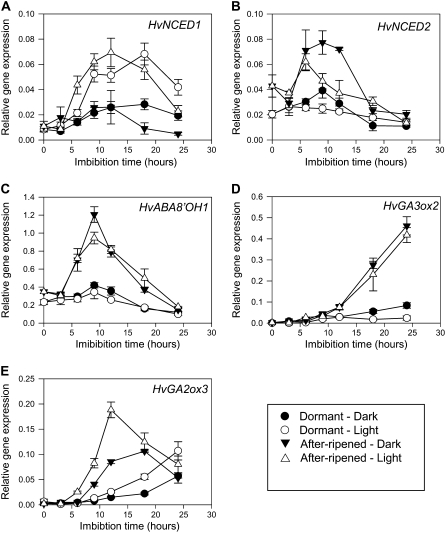
Effect of white light and dark on expression of ABA and GA metabolism genes in embryos of D and AR barley grains during imbibition. Measurements are averages of three replicates with error bars representing the se of the mean. A, HvNCED1. B, HvNCED2. C, HvABA8OH1. D, HvGA3ox2. E, HvGA2ox3.
Figure 3.
Figure 3.
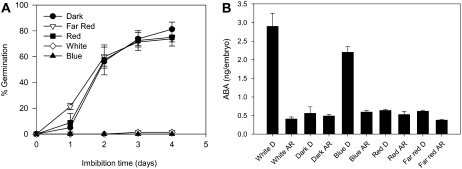
Effect of light quality on dormancy and embryo ABA content in barley grains during imbibition. A, Germination of D barley grains in dark and irradiated with continuous far-red, red, and blue light. Measurements are averages of four replicates with error bars representing the se of the mean. B, ABA content in embryos from D and AR grains imbibed for 24 h in dark and under continuous blue, red, far-red, and white light. Measurements are averages of three replicates with error bars representing the se of the mean.
Figure 4.
Figure 4.
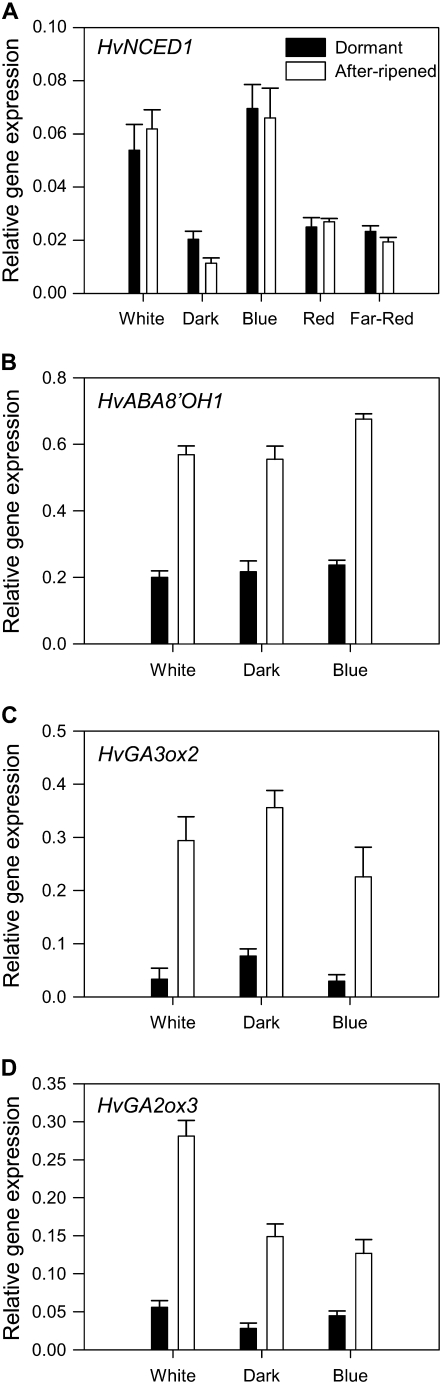
Effect of light quality on expression of ABA and GA metabolism genes in embryos of D and AR grains during imbibition. Gene expression was measured in embryos from grains that had been imbibed for 24 h under continuous blue, red, far-red, and white light and dark. Measurements are averages of three replicates with error bars representing the SE of the mean. A, HvNCED1. B, HvABA89OH1. C, HvGA3ox2. D, HvGA2ox3.
Figure 5.
Figure 5.
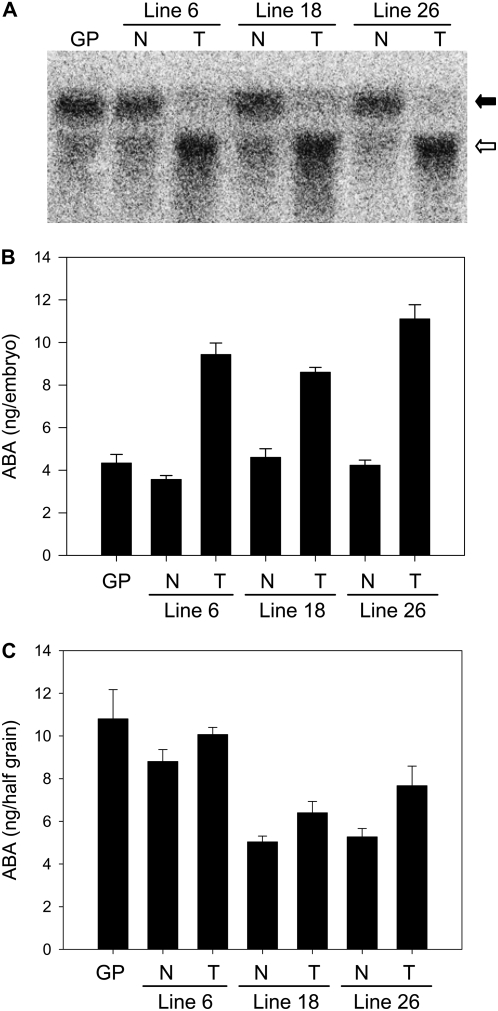
Effect of RNAi-directed silencing of HvABA8OH1 on gene expression and ABA content of barley grains. A, RNA-blot analysis of HvABA8OH1 expression in embryos of wild-type Golden Promise (GP), and null (N) and transgenic (T) grains from HvABA8OH1 RNAi lines 6, 18, and 26 imbibed for 18 h. The HvABA8OH1 transcripts have a slower mobility (black arrow) than the RNAi transcripts (white arrow). B, ABA content in embryos from dry wild-type (GP), and null (N) and transgenic (T) grains from HvABA8OH1 RNAi lines 6, 18, and 26. Measurements are averages of three biological replicates with error bars representing the se of the mean. C, ABA content in endosperm half-grains from dry wild-type (GP), and null (N) and transgenic (T) grains from HvABA8OH1 RNAi lines 6, 18, and 26. Measurements are averages of three biological replicates with error bars representing the se of the mean.
Figure 6.
Figure 6.
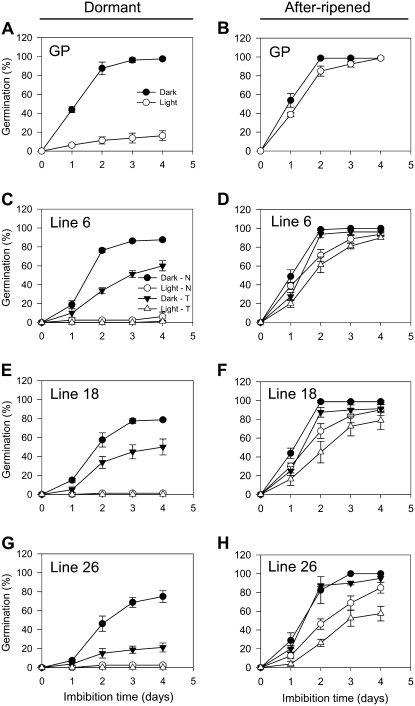
Effect of after-ripening on dormancy release of wild-type and HvABA8OH1 RNAi transgenic grains. D (A, C, E, and G) and AR (B, D, F, and H) grains from wild-type (A and B) and RNAi lines (C–H) were imbibed for 4 d under continuous white light or dark. The AR grains had been AR for 1 month at 37°C. Measurements are averages of four replicates with error bars representing the se of the mean. A and B, Wild-type Golden Promise grains (GP). C and D, Null (N) and transgenic (T) grains from line 6. E and F, Null (N) and transgenic (T) grains from line 18. G and H, Null (N) and transgenic (T) grains from line 26.
Figure 7.
Figure 7.
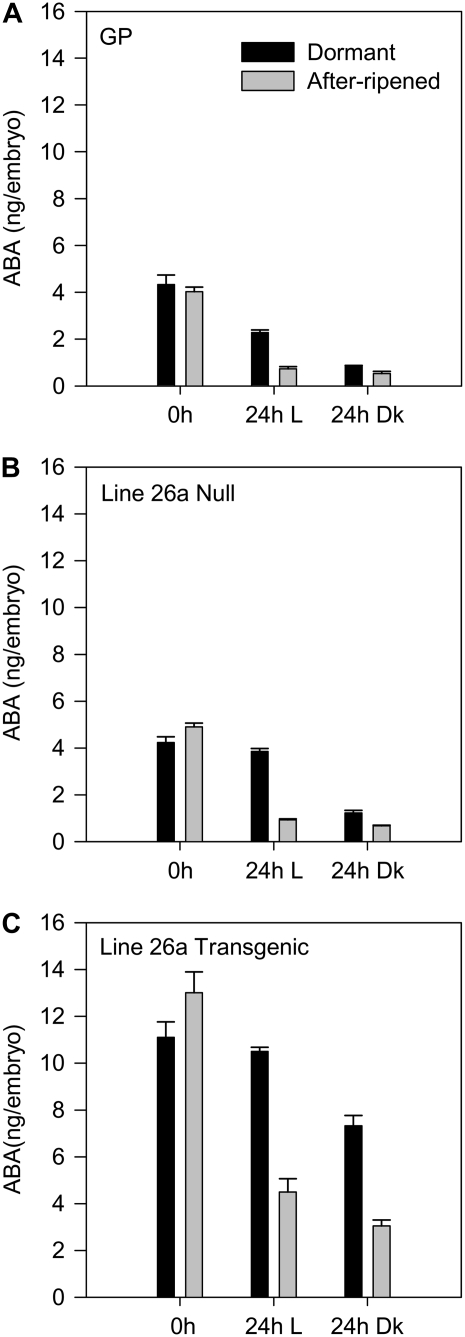
Effect of after-ripening and light on ABA content of D and 1-month AR grains from wild-type and HvABA8OH1 RNAi plants. The embryos were isolated from dry grains (0 h) and grains imbibed for 24 h under white light (L) and dark (Dk). ABA measurements are averages of four biological replicates with error bars representing the se of the mean. A, Golden Promise (GP). B, Null grains from HvABA8OH1 RNAi line 26. C, Transgenic grains from HvABA8OH1 RNAi line 26.

References

    1. Banerjee R, Batschauer A (2005) Plant blue-light receptors. Planta 220 498–502 - PubMed
    1. Baskin CC, Baskin JM (1998) Seeds; Ecology, Biogeography, and Evolution of Dormancy and Germination. Academic Press, San Diego
    1. Benech-Arnold RL, Giallorenzi MC, Frank J, Rodriguez V (1999) Termination of hull-imposed dormancy is correlated with changes in embryonic ABA content and sensitivity. Seed Sci Res 9 39–47
    1. Benech-Arnold RL, Gualano N, Leymarie J, Côme D, Corbineau F (2006) Hypoxia interferes with ABA metabolism and increases ABA sensitivity in embryos of dormant barley grains. J Exp Bot 57 1423–1430 - PubMed
    1. Bewley JD (1997) Seed germination and dormancy. Plant Cell 9 1055–1066 - PMC - PubMed

Publication types

LinkOut - more resources