. 2008 Apr 15;105(15):5803-8.
doi: 10.1073/pnas.0800981105. Epub 2008 Apr 11.

The genome of Bacillus coahuilensis reveals adaptations essential for survival in the relic of an ancient marine environment

Affiliations

The genome of Bacillus coahuilensis reveals adaptations essential for survival in the relic of an ancient marine environment

Luis David Alcaraz et al. Proc Natl Acad Sci U S A. .

Abstract

The Cuatro Ciénegas Basin (CCB) in the central part of the Chihuahan desert (Coahuila, Mexico) hosts a wide diversity of microorganisms contained within springs thought to be geomorphological relics of an ancient sea. A major question remaining to be answered is whether bacteria from CCB are ancient marine bacteria that adapted to an oligotrophic system poor in NaCl, rich in sulfates, and with extremely low phosphorus levels (<0.3 microM). Here, we report the complete genome sequence of Bacillus coahuilensis, a sporulating bacterium isolated from the water column of a desiccation lagoon in CCB. At 3.35 Megabases this is the smallest genome sequenced to date of a Bacillus species and provides insights into the origin, evolution, and adaptation of B. coahuilensis to the CCB environment. We propose that the size and complexity of the B. coahuilensis genome reflects the adaptation of an ancient marine bacterium to a novel environment, providing support to a "marine isolation origin hypothesis" that is consistent with the geology of CCB. This genomic adaptation includes the acquisition through horizontal gene transfer of genes involved in phosphorous utilization efficiency and adaptation to high-light environments. The B. coahuilensis genome sequence also revealed important ecological features of the bacterial community in CCB and offers opportunities for a unique glimpse of a microbe-dominated world last seen in the Precambrian.


Conflict of interest statement

The authors declare no conflict of interest.

Figures
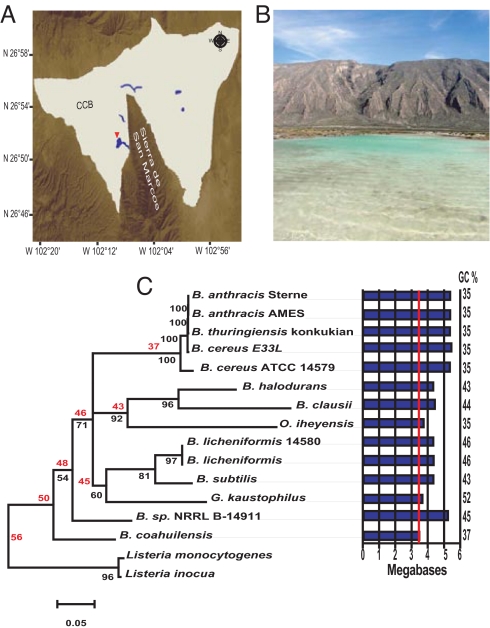
Fig. 1.
Fig. 1.
Marine origin of B. coahuilensis, isolated from a pond in the Chihuahuan desert. (A) Sierra de San Marcos is a prominent mountain system in the middle of CCB where >400 ponds sustain most of the biodiversity. The geomorphological origin of CCB has been recently reviewed (2). (B) Churince system (shown with a red triangle in A) consists of a springhead that feeds a 2-km-long stream with an intermediate lagoon terminating at a large shallow desiccation lagoon. (C) Phylogenomic reconstruction. Maximum likelihood phylogenomic reconstruction by using Tree-Puzzle (29) was carried out with 20 universally conserved COGs from the sequenced Bacillus spp. and closely related species (Table S3). Maximum likelihood bootstrap percentage support values are only indicated for major nodes; numbers in red represent tentative timescale, in million years, calculated with the method proposed by Battistuzzi et al. (30). Genome size (represented as bars) and GC content of each Bacillus spp. genome is shown to the right.
Fig. 2.
Fig. 2.
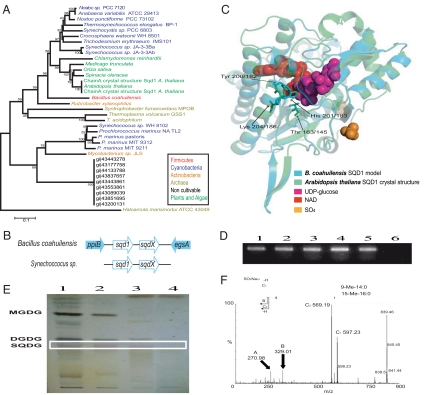
Acquisition of sulfoquinovose synthesis capabilities through HGT, an adaptation of B. coahuilensis to a phosphorus-limiting environment. (A) Neighbor-joining phylogenetic reconstruction of SQD1 (31). (B) The operon structure of the sqd1 and sqdX resembles that of the Synecchococcus genes (9). Flanking genes are ppi (peptidyl-prolyl cis-trans isomerase B) and egsA (glycerol-1-phosphate dehydrogenase) (not to scale). (C) Modeling (32) to the A. thaliana SQD (PDB ID code 1I24) protein shows conservation of the NAD and UDP-glucose-binding residues. Diagrammic representation was done by using PyMol (http://www.pymol.org). (D) Expression of the sqd1 gene. RT-PCR was carried out from RNA of B. coahuilensis grown under different phosphate concentrations (lanes 1 to 5, RT-PCR products obtained from cells cultured with 0.001, 0.005, 0.05, 0.5, and 5 mM phosphate, respectively; lane 6, control without reverse transcriptase). (E) TLC analysis reveals the presence of a probable SQDG band in B. coahuilensis, A. thaliana, Cyanobacteria sp. (lanes 1 to 3) but absent in Bacillus sp. NRRL B-14911 (lane 4). (F) Mass spectroscopic analysis confirmed the identity of the sulfoquinovoside (Fig. S3).
Fig. 3.
Fig. 3.
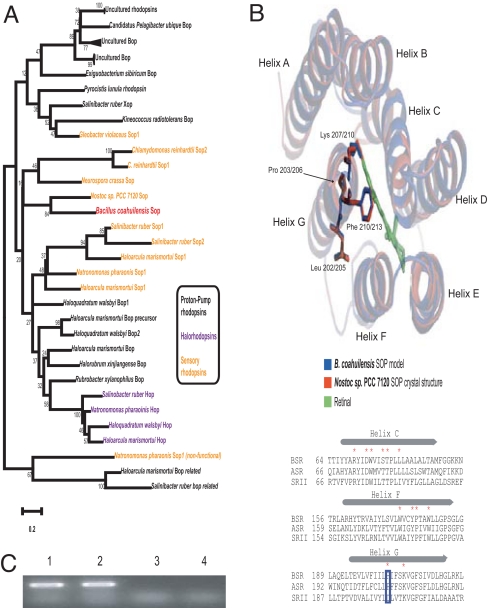
B. coahuilensis contains a sensory bacteriorhodopsin possibly acquired from cyanobacteria through an ancient HGT event. (A) Neighbor-joining tree showing the phylogenetic diversity of rhodopsins (31). (B) Bsr possesses all of the residues involved in retinal binding and was modeled (32) to the predicted structures of Anabaena and Natronomonas pharaonis. Alignment of segments of SR from B. coahuilensis (BSR, BM4401574), Anabaena sp. PCC7120 (ASR, PDB ID code 1XIO), and Natronomonas pharaonis DSM2160 (SRII, PDB ID code 1JGJ) show conservation of residues in the retinal-binding pocket (marked with asterisks) except for a Pro residue (positions BSR203 and ASR206), which is an Asp residue in all other microbial rhodopsins (blue rectangle; alignment adapted from ref. 10). Diagrammatic representation was done by using PyMol (http://www.pymol.org). (C) bsr is expressed in B. coahuilensis grown either under white light or in the dark. RT-PCR was carried out by using RNA obtained from bacteria grown under dark or white-light conditions (lanes 1 and 2, respectively). Lanes 3 and 4 are controls without reverse transcriptase.
Fig. 4.
Fig. 4.
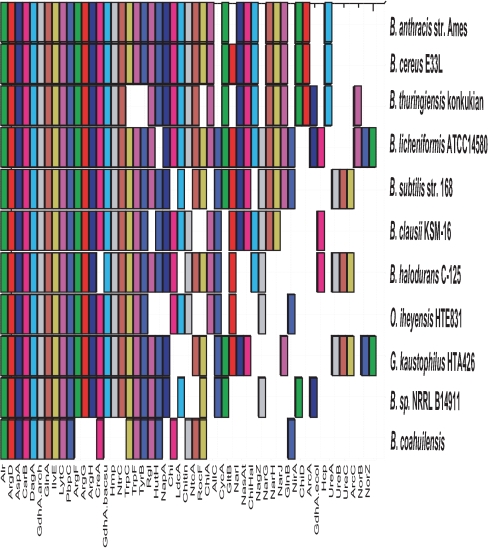
B. coahuilensis lacks many of the genes coding for enzymes involved in nitrogen metabolism. Hidden Markov models for the bacterial enzymes involved in N2 metabolism were constructed to detect these genes in all of the sequenced Bacillus spp. Bars in different colors denote the presence of a gene predicted to code for a given enzyme.

References

    1. Minckley WL. Environments of the Bolson of Cuatro Ciénegas, Coahuila, México, with Special Reference to the Aquatic Biota. El Paso, TX: Texas Western Press; 1969. University of Texas: El Paso Science Series.
    1. Souza V, et al. An endangered oasis of aquatic microbial biodiversity in the Chihuahuan desert. Proc Natl Acad Sci USA. 2006;103:6565–6570. - PMC - PubMed
    1. Elser JJ, et al. Effects of phosphorus enrichment and grazing snails on modern stromatolitic microbial communities. Freshwater Biol. 2005;50:1808–1825.
    1. Cerritos R, et al. Bacillus coahuilensis sp. nov. a new moderately halophilic species from different pozas in the Cuatro Ciénegas Valley in Coahuila, México. Int J Syst Evol Microbiol. 2008;58:919–923. - PubMed
    1. Van Domselaar GH, et al. BASys: A web server for automated bacterial genome annotation. Nucleic Acids Res. 2005;33:W455–W459. - PMC - PubMed

Publication types

Associated data

LinkOut - more resources