


Respiratory viruses in laryngeal croup of young children
- PMID: 18410770
- PMCID: PMC7094409
- DOI: 10.1016/j.jpeds.2007.10.043
Respiratory viruses in laryngeal croup of young children
Erratum in
- J Pediatr. 2008 Jul;153(1):151. Anne, Lahtinen [corrected to Beng, Anne Lahtinen]
Abstract
Objectives: To determine the viral cause of laryngeal croup by use of highly sensitive methods, and including recently recognized viruses in the analysis.
Study design: One hundred forty-four consecutive children with hoarse voice and inspiratory stridor attending the emergency department were enrolled. Age- and season-matched children presenting with a wheezing illness served as control subjects (n = 76). Nasopharyngeal swabs were analyzed by polymerase chain reaction for rhinovirus and enterovirus, coronavirus, respiratory syncytial virus (RSV), parainfluenza virus (PIV), influenza A and B virus, human bocavirus, human metapneumovirus, adenovirus, and Mycoplasma pneumoniae.
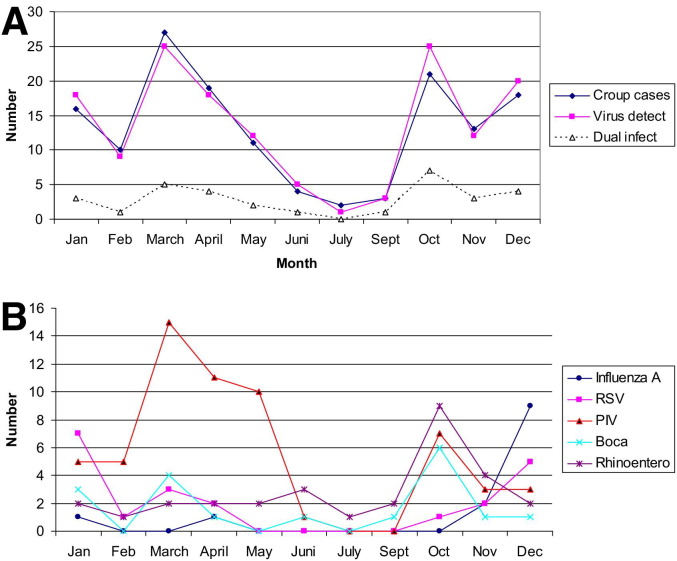
Results: Virus infection was documented in 80% of patients with croup and 71% of control subjects. Children with croup had significantly more positive test results for PIV 1 and 2 (31% vs 4% and 6% vs 0%, respectively) and significantly fewer positive test results for RSV (15% vs 28%) than wheezing children. Rhinoviruses and enteroviruses were present equally in both groups (21% vs 25%). There was no significant difference in the frequency of influenza A virus or human bocavirus. Few subjects with adenovirus or M. pneumoniae were detected.
Conclusion: Acute laryngeal croup is most often associated with PIV, RSV, rhinovirus, and enterovirus. Rhinovirus and enterovirus appeared equally often in croup and in wheezing illness. During late fall, they were found in 39% and 40%, respectively, of the tested samples.
Figures
References
-
- Weigl J.A., Puppe W., Belke O., Neususs J., Bagci F., Schmitt H.J. The descriptive epidemiology of severe lower respiratory tract infections in children in Kiel, Germany. Klin Paediatr. 2005;217:259–267. - PubMed
-
- Henrickson K.J., Hoover S., Kehl K.S., Hua W. National disease burden of respiratory viruses detected in children by polymerase chain reaction. Pediatr Infect Dis J. 2004;23:S11–S18. - PubMed
-
- Zamberi S., Zulkifli I., Ilina I. Respiratory viruses detected in hospitalised paediatric patients with respiratory infections. Med J Malaysia. 2003;58:681–687. - PubMed
-
- Andreoletti L., Lesay M., Deschildre A., Lambert V., Dewilde A., Wattre P. Differential detection of rhinoviruses and enteroviruses RNA sequences associated with classical immunofluorescence assay detection of respiratory virus antigens in nasopharyngeal swabs from infants with bronchiolitis. J Med Virol. 2000;61:341–346. - PMC - PubMed
Publication types
MeSH terms
Substances
LinkOut - more resources
Full Text Sources
Medical
