


The clinical spectrum of homozygous HOXA1 mutations
- PMID: 18412118
- PMCID: PMC3517166
- DOI: 10.1002/ajmg.a.32262
The clinical spectrum of homozygous HOXA1 mutations
Abstract
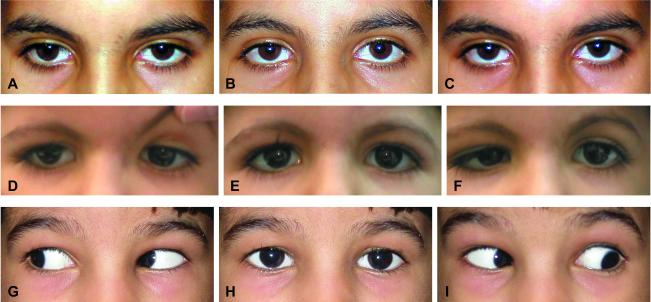
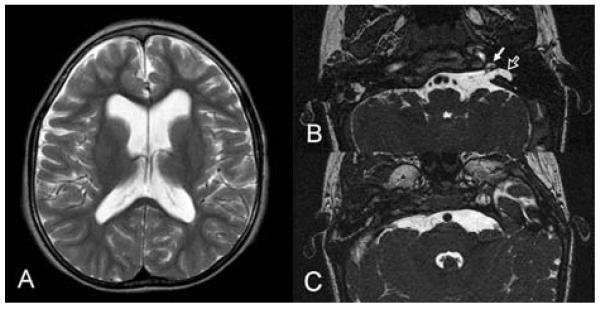
We describe nine previously unreported individuals from six families who have homozygous mutations of HOXA1 and either the Bosley-Salih-Alorainy syndrome (BSAS) or the Athabascan brainstem dysgenesis syndrome (ABDS). Congenital heart disease was present in four BSAS patients, two of whom had neither deafness nor horizontal gaze restriction, thus raising the possibility that cardiovascular malformations might be a clinically isolated, or relatively isolated, manifestation of homozygous HOXA1 mutations. Two ABDS probands had relatively mild mental retardation. These individuals blur the clinical distinctions between the BSAS and ABDS HOXA1 variants and broaden the phenotype and genotype of the homozygous HOXA1 mutation clinical spectrum.
2008 Wiley-Liss, Inc.
Figures
References
-
- Tischfield MA, Bosley TM, Salih MA, et al. Homozygous HOXA1 mutations disrupt human brainstem, inner ear, cardiovascular and cognitive development. Nat Genet. 2005;37:1035–1037. - PubMed
-
- Chisaka O, Musci TS, Capecchi MR. Developmental defects of the ear, cranial nerves and hindbrain resulting from targeted disruption of the mouse homeobox gene Hox-1.6. Nature. 1992;355:516–520. - PubMed
-
- Lufkin T, Dierich A, LeMeur M, et al. Disruption of the Hox-1.6 homeobox gene results in defects in a region corresponding to its rostral domain of expression. Cell. 1991;66:1105–1119. - PubMed
-
- Holve S, Friedman B, Hoyme HE, et al. Athabascan brainstem dysgenesis syndrome. Am J Med Genet A. 2003;120:169–173. - PubMed
Publication types
MeSH terms
Substances
Grants and funding
LinkOut - more resources
Full Text Sources
Molecular Biology Databases
