Case Reports
. 2008 Apr;65(4):520-4.
doi: 10.1001/archneur.65.4.520.

Lack of spartin protein in Troyer syndrome: a loss-of-function disease mechanism?

Affiliations
Case Reports

Lack of spartin protein in Troyer syndrome: a loss-of-function disease mechanism?

Joanna C Bakowska et al. Arch Neurol. 2008 Apr.

Abstract

Background: Hereditary spastic paraplegias (SPG1-SPG33) are characterized by progressive spastic weakness of the lower limbs. A nucleotide deletion (1110delA) in the (SPG20; OMIM 275900) spartin gene is the origin of autosomal recessive Troyer syndrome. This mutation is predicted to cause premature termination of the spartin protein. However, it remains unknown whether this truncated spartin protein is absent or is present and partially functional in patients.

Objective: To determine whether the truncated spartin protein is present or absent in cells derived from patients with Troyer syndrome.

Design: Case report.

Setting: Academic research.

Patients: We describe a new family with Troyer syndrome due to the 1110delA mutation.

Main outcome measures: We cultured primary fibroblasts and generated lymphoblasts from affected individuals, carriers, and control subjects and subjected these cells to immunoblot analyses.

Results: Spartin protein is undetectable in several cell lines derived from patients with Troyer syndrome.

Conclusions: Our data suggest that Troyer syndrome results from complete loss of spartin protein rather than from the predicted partly functional fragment. This may reflect increased protein degradation or impaired translation.


Figures
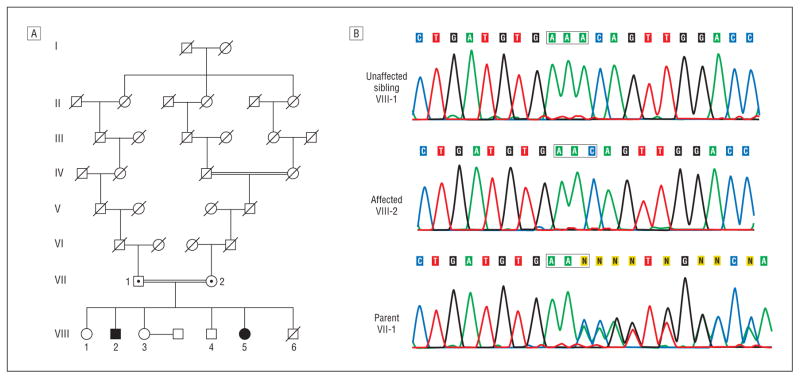
Figure 1
Figure 1
Pedigree and sequence analysis. A, Partial pedigree of Old Order Amish family with Troyer syndrome. Square indicates male; circle, female; central dot, obligate carrier and confirmed heterozygote; slash mark, deceased individual; double line, consanguinity; and solid symbol, homozygous for the 1110delA mutation. B, Sequencing chromogram. Sequence traces spanning the 1110delA mutation for an unaffected sibling, a homozygous affected subject, and a heterozygous parent.
Figure 2
Figure 2
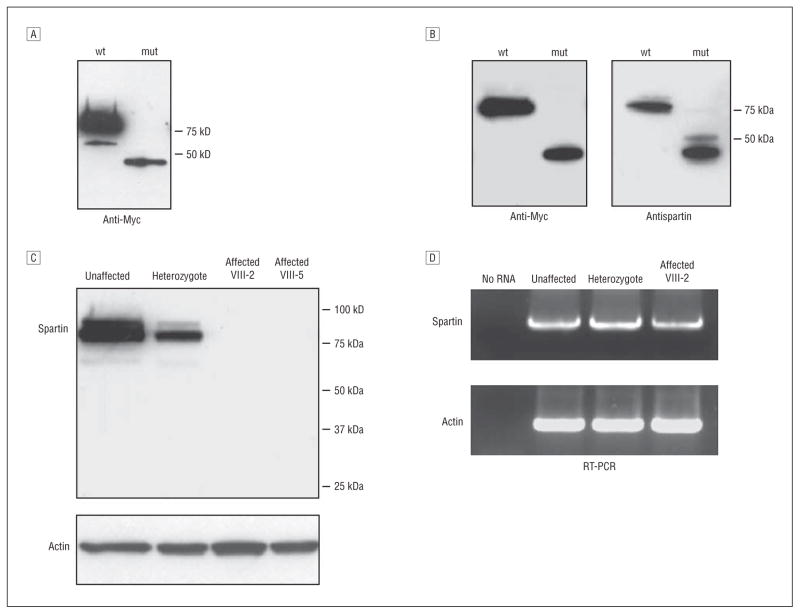
Expression analysis of the spartin protein in primary fibroblasts. A, Expression of mutant (mut) spartin is lower than wild-type (wt) in heterologous cells. Extracts (20 μg of protein per lane) of HeLa cells overexpressing Myc-tagged wt and fs369-398x399 mut spartin were immunoblotted with anti-Myc antibodies. B, Antispartin antibodies detect overexpressed mut spartin protein. HeLa cells were transfected with expression vectors for wt spartin (10-fold less DNA to lower expression) and mut spartin and were then immunoblotted with anti-Myc and antispartin antibodies. C, Mutant spartin is degraded in affected subjects’ fibroblasts. Cell lysates of fibroblasts (20 μg of protein per lane) from unaffected heterozygous (VII-2 in Figure 1) and affected (VIII-2 and VIII-5) individuals were immunoblotted with antispartin antibodies. Actin levels were monitored by immunoblotting to ensure equal protein loading. D, Reverse transcription–polymerase chain reaction (RT-PCR) analysis of spartin messenger RNA expression in fibroblasts. Total RNA prepared from fibroblasts derived from the indicated heterozygous (VII-2) and affected (VIII-5) individuals was subjected to RT-PCR for spartin and actin. There were no significant differences in products obtained from unaffected, heterozygous, and affected individuals.

References

    1. Harding AE. Hereditary spastic paraplegias. Semin Neurol. 1993;13(4):333–336. - PubMed
    1. Crosby AH, Proukakis C. Is the transportation highway the right road for hereditary spastic paraplegia? Am J Hum Genet. 2002;71(5):1009–1016. - PMC - PubMed
    1. Reid E. Science in motion: common molecular pathological themes emerge in the hereditary spastic paraplegias. J Med Genet. 2003;40(2):81–86. - PMC - PubMed
    1. Fink JK. Hereditary spastic paraplegia. Curr Neurol Neurosci Rep. 2006;6(1):65–76. - PubMed
    1. Soderblom C, Blackstone C. Traffic accidents: molecular genetic insights into the pathogenesis of the hereditary spastic paraplegias. Pharmacol Ther. 2006;109(1–2):42–56. - PubMed

Publication types

MeSH terms