


Cytogenetic features in myelodysplastic syndromes
- PMID: 18414863
- PMCID: PMC2413090
- DOI: 10.1007/s00277-008-0483-y
Cytogenetic features in myelodysplastic syndromes
Abstract
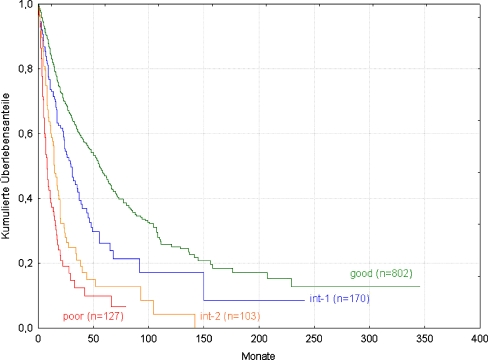
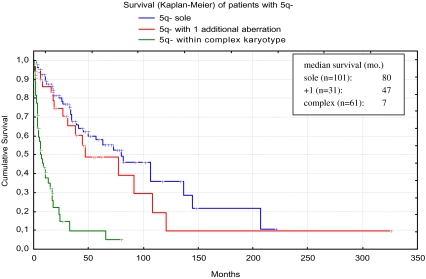
Myelodysplastic syndromes (MDS) comprise a group of bone marrow diseases characterized by profound heterogeneity in morphologic presentation, clinical course, and cytogenetic features. Roughly 50% of patients display clonal chromosome abnormalities. In several multicentric studies, the karyotype turned out to be one of the most important prognostic parameters and was incorporated into statistical models aiming for a better prediction of the individual prognosis like the International Prognostic Scoring System. However, due to the profound cytogenetic heterogeneity, the impact of many rare abnormalities as well as combinations of anomalies occurring in a substantial portion of patients with MDS is still unknown and can only be delineated on the basis of large international multicentric cooperations. Recently, the German-Austrian MDS Study Group presented cytogenetic findings in 2,072 patients with MDS, which serve as a basis for the characterization of the cytogenetic subgroups discussed in this article. The availability of new therapeutic options for low- and high-risk MDS targeted against distinct entities characterized by specific chromosome abnormalities, like 5q-deletions, monosomy 7, and complex abnormalities underlines the important role of cytogenetics for the clinical management of MDS. This article thus focuses on the clinical and prognostic relevance, the molecular background, and therapeutic perspectives in these three cytogenetic subgroups.
Figures

References
-
- {'text': '', 'ref_index': 1, 'ids': [{'type': 'DOI', 'value': '10.1182/blood-2007-03-082404', 'is_inner': False, 'url': 'https://doi.org/10.1182/blood-2007-03-082404'}, {'type': 'PubMed', 'value': '17726160', 'is_inner': True, 'url': 'https://pubmed.ncbi.nlm.nih.gov/17726160/'}]}
- Haase D, Germing U, Schanz J, Pfeilstocker M, Nosslinger T, Hildebrandt B, Kundgen A, Lubbert M, Kunzmann R, Giagounidis AA, Aul C, Trumper L, Krieger O, Stauder R, Muller TH, Wimazal F, Valent P, Fonatsch C, Steidl C (2007) New insights into the prognostic impact of the karyotype in MDS and correlation with subtypes: evidence from a core dataset of 2124 patients. Blood 110:4385–4395 - PubMed
-
- {'text': '', 'ref_index': 1, 'ids': [{'type': 'PubMed', 'value': '9058730', 'is_inner': True, 'url': 'https://pubmed.ncbi.nlm.nih.gov/9058730/'}]}
- Greenberg P, Cox C, LeBeau MM, Fenaux P, Morel P, Sanz G, Sanz M, Vallespi T, Hamblin T, Oscier D, Ohyashiki K, Toyama K, Aul C, Mufti G, Bennett J (1997) International scoring system for evaluating prognosis in myelodysplastic syndromes. Blood 89:2079–2088 - PubMed
-
- {'text': '', 'ref_index': 1, 'ids': [{'type': 'PubMed', 'value': '16154839', 'is_inner': True, 'url': 'https://pubmed.ncbi.nlm.nih.gov/16154839/'}]}
- Solé F, Luno E, Sanzo C, Espinet B, Sanz GF, Cervera J, Calasanz MJ, Cigudosa JC, Milla F, Ribera JM, Bureo E, Marquez ML, Arranz E, Florensa L (2005) Identification of novel cytogenetic markers with prognostic significance in a series of 968 patients with primary myelodysplastic syndromes. Haematologica 90:1168–1178 - PubMed
-
- {'text': '', 'ref_index': 1, 'ids': [{'type': 'PubMed', 'value': '3860707', 'is_inner': True, 'url': 'https://pubmed.ncbi.nlm.nih.gov/3860707/'}]}
- Knapp RH, Dewald GW, Pierre RV (1985) Cytogenetic studies in 174 consecutive patients with preleukemic or myelodysplastic syndromes. Mayo Clin Proc 60:507–516 - PubMed
-
- {'text': '', 'ref_index': 1, 'ids': [{'type': 'DOI', 'value': '10.1002/1097-0142(19861215)58:12<2571::AID-CNCR2820581202>3.0.CO;2-O', 'is_inner': False, 'url': 'https://doi.org/10.1002/1097-0142(19861215)58:12<2571::aid-cncr2820581202>3.0.co;2-o'}, {'type': 'PubMed', 'value': '3779606', 'is_inner': True, 'url': 'https://pubmed.ncbi.nlm.nih.gov/3779606/'}]}
- Nowell PC, Besa EC, Stelmach T, Finan JB (1986) Chromosome studies in preleukemic states. Cancer 58:2571–2575 - PubMed
Publication types
MeSH terms
LinkOut - more resources
Full Text Sources
Other Literature Sources
Medical
Research Materials
Miscellaneous
