


Review
doi: 10.1007/s00418-008-0424-9.
Epub 2008 Apr 16.
Tight junctions and the modulation of barrier function in disease
Affiliations
- PMID: 18415116
- PMCID: PMC2413111
- DOI: 10.1007/s00418-008-0424-9
Item in Clipboard
Review
Tight junctions and the modulation of barrier function in disease
Histochem Cell Biol.
2008 Jul.
Abstract
Tight junctions create a paracellular barrier in epithelial and endothelial cells protecting them from the external environment. Two different classes of integral membrane proteins constitute the tight junction strands in epithelial cells and endothelial cells, occludin and members of the claudin protein family. In addition, cytoplasmic scaffolding molecules associated with these junctions regulate diverse physiological processes like proliferation, cell polarity and regulated diffusion. In many diseases, disruption of this regulated barrier occurs. This review will briefly describe the molecular composition of the tight junctions and then present evidence of the link between tight junction dysfunction and disease.
Figures
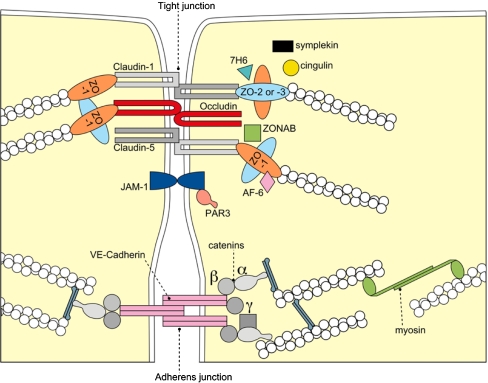
Molecular composition of tight junctions. The transmembrane proteins occludin, the claudin(s) and junctional adhesion molecule-1 (JAM-1) constitute the barrier formed by TJs sealing the paracellular space. They appear to be interacting in a homophilic manner, and occludin seems to co-polymerase into claudin-based TJ strands. Claudins adhere with each other in a homotypic as well as a heterotypic manner. ZO-1, -2, and -3 bind the cytoplasmic tail of occludin and link the TJ to the actin cytoskeleton. Proteins of the ZO family can shuttle to the nucleus to influence transcriptional processes in cellular proliferation and differentiation. The ZO-proteins have also been shown to interact with claudins and provide molecular scaffolds for TJ assembly. Cingulin is a 140 kDa TJ plaque protein which assoicates with the actomyosin cytoskeleton. Its putative function is transduction of the mechanical force generated by the actomyosin cytoskeleton important for cellular differentiation. The Ras target AF-6 interacts with ZO-1 and serves as a. peripheral component of tight junctions in epithelial cells. Symplekin is a 126 kDa protein that occurs and probably functions in the nucleus as well as in the TJ plaques. Tyrosine phosphorylated Par3 regulates tight junction assembly and promotes cellular polarity by intracellular signalling. Localization of 7H6 TJ-associated antigen along the cell border of vascular endothelial cells has been shown to correlate with paracellular barrier function. Additional proteins have been localised to the TJs but a function has presently not been assigned. Moreover diverse signaling proteins are detected at the apical junctional complex but they are not uniquely confined to the TJ
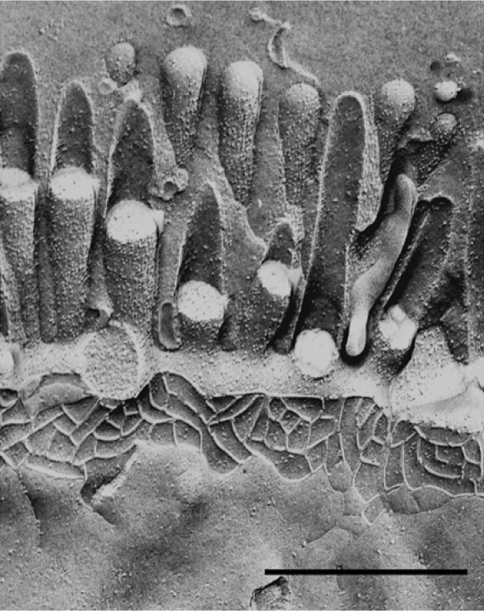
Freeze–fracture image of the rat intestinal epithelium. The freeze fracture electron micrograph showns the apical brush border, the intramembraneous particle strands of the TJs and the lateral cell surface. The replica shows a continous network of TJ strands. Adapted from (Achler et al. 1989) with permission from D. Drenckhahn, Universität Würzburg. Bar 0.5 μm
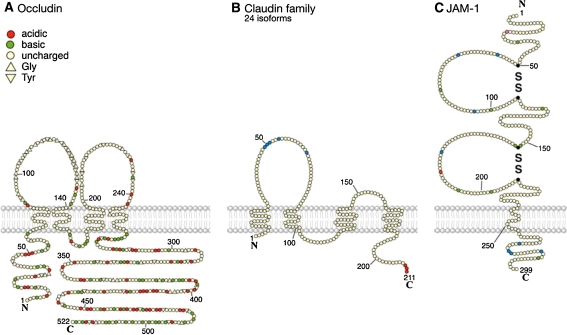
Transmembrane proteins of the tight junction. a Murine occludin is a 521 amino acid protein. The first extracellular domain may be involved in cell–cell interaction containing a high tyrosine and glyine domain (triangles), acidic amino acids (orange-red), basic amino acids (green), neutral amino acids (cream). A second functional domain was assigned to the carboxy terminal 150 amino acids which appears to be responsible for the association of occludin with ZO-1. The occludin amino acid sequence is highly conserved between species (Ando-Akatsuka et al. 1996). b Claudins are four transmembrane domain proteins, containing two extracellular and one intracellular loop and a N- and C-terminal cytoplasmic domain. Claudins are a multigene family with so far 24 members identified in diverse species. In the first extracellular loop, claudins have a conserved common motif, GLWxxC(8–10aa)C (blue). Claudins further contain a PDZ-binding motif at the C terminus (orange) capable of bining to TJ plaque proteins like ZO-1. The claudins show a isotype-specific tissue expression pattern. c JAM-1 is an integral membrane protein expressed in endothelial and epithelial cells. Its extracellular domain can dimerize and bind homophilically. The intracellular domain (and in particular a PDZ-binding motif) enable JAM-1 to interact with structural and signaling proteins. JAM-1 is localized at the tight junctions of epithelial and endothelial cells and is involved in the regulation of junctional integrity and permeability. The polypeptide sequence of 299 amino acids has the typical feature observed in a type I integral membrane protein. A putative signal peptide may be cleaved between Leu23 and Val24 (pink), leaving 215 residues in the extracellular domain of the mature protein. A stretch of 17 hydrophobic residues (Ile 239 → Phe 255) presents a potential transmembrane region, and there are 45 residues in the cytoplasmic domain. The extracellular portion contains two domains with intrachain disulfide bonds typical of immunoglobulin-like loops of the V-type. Numerous PKC (blue) and Casein kinase II (yellow) phophorylation sites have been detected involved in platelet activation processes (Sobocka et al. 2000). Cys-43, -111, 146, -214 form dimer containing disulfide bridges and are labeled in black
References
-
- {'text': '', 'ref_index': 1, 'ids': [{'type': 'PubMed', 'value': '16371949', 'is_inner': True, 'url': 'https://pubmed.ncbi.nlm.nih.gov/16371949/'}]}
- Abbott NJ, Ronnback L, Hansson E (2006) Astrocyte-endothelial interactions at the blood-brain barrier. Review. Nat Rev Neurosci 7:41–53 - PubMed
-
- {'text': '', 'ref_index': 1, 'ids': [{'type': 'PMC', 'value': 'PMC2115479', 'is_inner': False, 'url': 'https://pmc.ncbi.nlm.nih.gov/articles/PMC2115479/'}, {'type': 'PubMed', 'value': '2568363', 'is_inner': True, 'url': 'https://pubmed.ncbi.nlm.nih.gov/2568363/'}]}
- Achler C, Filmer D, Merte C, Drenckhahn D (1989) Role of microtubules in polarized delivery of apical membrane proteins to the brush border of the intestinal epithelium. J Cell Biol 109:179–189 - PMC - PubMed
-
- {'text': '', 'ref_index': 1, 'ids': [{'type': 'PubMed', 'value': '11698262', 'is_inner': True, 'url': 'https://pubmed.ncbi.nlm.nih.gov/11698262/'}]}
- Ahdieh M, Vandenbos T, Youakim A (2001) Lung epithelial barrier function and wound healing are decreased by IL-4 and IL-13 and enhanced by IFN-gamma. Am J Physiol Cell Physiol 281:C2029–C2038 - PubMed
-
- {'text': '', 'ref_index': 1, 'ids': [{'type': 'PMC', 'value': 'PMC2120780', 'is_inner': False, 'url': 'https://pmc.ncbi.nlm.nih.gov/articles/PMC2120780/'}, {'type': 'PubMed', 'value': '8601611', 'is_inner': True, 'url': 'https://pubmed.ncbi.nlm.nih.gov/8601611/'}]}
- Ando-Akatsuka Y, Saitou M, Hirase T, Kishi M, Sakakibara A, Itoh M, Yonemura S, Furuse M, Tsukita S (1996) Interspecies diversity of the occludin sequence: cDNA cloning of human, mouse, dog, and rat-kangaroo homologues. J Cell Biol 133:43–47 - PMC - PubMed
-
- {'text': '', 'ref_index': 1, 'ids': [{'type': 'PubMed', 'value': '9836530', 'is_inner': True, 'url': 'https://pubmed.ncbi.nlm.nih.gov/9836530/'}]}
- Antonetti DA, Barber AJ, Khin S, Lieth E, Tarbell JM, Gardner TW (1998) Vascular permeability in experimental diabetes is associated with reduced endothelial occludin content: vascular endothelial growth factor decreases occludin in retinal endothelial cells. Penn State Retina Research Group. Diabetes 47:1953–1959 - PubMed
Publication types
MeSH terms
Substances
LinkOut - more resources
Full Text Sources
Other Literature Sources
Miscellaneous
