. 2008 Jun 13;283(24):16446-54.
doi: 10.1074/jbc.M802272200. Epub 2008 Apr 15.

A dual task for the Xbp1-responsive OS-9 variants in the mammalian endoplasmic reticulum: inhibiting secretion of misfolded protein conformers and enhancing their disposal

Affiliations

A dual task for the Xbp1-responsive OS-9 variants in the mammalian endoplasmic reticulum: inhibiting secretion of misfolded protein conformers and enhancing their disposal

Riccardo Bernasconi et al. J Biol Chem. .

Abstract

Normally, non-native polypeptides are not transported through the secretory pathway. Rather, they are translocated from the endoplasmic reticulum (ER) lumen into the cytosol where they are degraded by proteasomes. Here we characterize the function in ER quality control of two proteins derived from alternative splicing of the OS-9 gene. OS-9.1 and OS-9.2 are ubiquitously expressed in human tissues and are amplified in tumors. They are transcriptionally induced upon activation of the Ire1/Xbp1 ER-stress pathway. OS-9 variants do not associate with folding-competent proteins. Rather, they selectively bind folding-defective ones thereby inhibiting transport of non-native conformers through the secretory pathway. The intralumenal level of OS-9.1 and OS-9.2 inversely correlates with the fraction of a folding-defective glycoprotein, the Null(hong kong) (NHK) variant of alpha1-antitrypsin that escapes retention-based ER quality control. OS-9 up-regulation does not affect NHK disposal, but reduction of the intralumenal level of OS-9.1 and OS-9.2 substantially delays disposal of this model substrate. OS-9.1 and OS-9.2 also associate transiently with non-glycosylated folding-defective proteins, but association is unproductive. Finally, OS-9 activity does not require an intact mannose 6-P homology domain. Thus, OS-9.1 and OS-9.2 play a dual role in mammalian ER quality control: first as crucial retention factors for misfolded conformers, and second as promoters of protein disposal from the ER lumen.


Figures

FIGURE 1.
FIGURE 1.
OS-9 is a glycosylated, stress-inducible ER resident protein. A, schematic view of OS-9, numbering is for the human protein. The signal peptide (SP), the mannose 6-phosphate receptor homology domain (MRH), and the putative splice regions (gray part of exon 11 and the entire exon 13) are shown. B, whole cDNA pool from HEK293 cells was amplified with specific primers (depicted in panel A) to determine the expression of OS-9 splice variants. Theoretical lengths are shown on the right, positions of 100-, 200-, 300-, 400-, and 500-bp markers are shown on the left. C, expression of endogenous (lane 1) and ectopic OS-9.1 (lane 2) and OS-9.2 (lane 3) is revealed by immunoblot (IB). D, EndoH treatment to confirm modification with N-linked oligosaccharides of the endogenous OS-9 variants revealed by IB and ectopically expressed, labeled OS-9 variants immunoisolated (IP) from cell-lysates. E, the presence of intramolecular disulfide bond was confirmed by changes in OS-9 mobility in non-reducing (NR) versus reducing (R) gels. F, immunofluorescence showing co-localization between PDI (left panel) and ectopically expressed OS-9 (right panel). G, endomembranes were purified from metabolically labeled HEK293 cells. The select proteins (calreticulin (crt), calnexin (cnx), OS-9, and EDEM1) were immunoisolated from luminal (lanes 1– 4) or membrane fractions (lanes 5–8). The OS9 and EDEM1 mobility is shown in lanes 9 and 10, respectively. H, HEK293, wt, and Xbp1−/− MEF were exposed (+) or not (−) to 2.5 μg/ml tunicamycin for 12 h to induce ER stress. The levels of OS-9, EDEM1, Synoviolin (Xbp1-dependent), BiP and Sel1L (ATF6-dependent), and Actin (loading control) have been assessed by semi-quantitative RT-PCR. Depletion of Xpb1 prevents stress induction of both OS-9 transcripts. I, quantitative RT-PCR analysis of induction of BiP, EDEM1, OS-9, Sel1L, and Synoviolin upon ER stress in wt and Xbp1−/− MEF. Actin was used as endogenous control (n = 2).
FIGURE 2.
FIGURE 2.
Consequences of OS-9 up-regulation on secretion and degradation of NHK and on secretion of α 1-antitrypsin. A, radiolabeled NHK has been immunoisolated after the indicated chase times from detergent extract of cells with normal (lanes 1–3) or elevated levels of OS-9.1 (lanes 4 – 6) or OS-9.2 (lanes 7–9). Note the co-precipitation of ectopic OS-9.1 and ectopic OS-9.2. B, quantification of intracellular NHK (n = 4). C, secretion of labeled NHK from cells with the normal (lanes 1–3) or elevated content of OS-9.1 (lanes 4 – 6) or OS-9.2 (lanes 7–9). D, quantification of C (n = 3). E, same as A for α1-antitrypsin. F, quantification of E. G, same as C for α1-antitrypsin. H, quantification of G. I, NHK co-precipitates with OS-9.1 (lanes 4 – 6) and OS-9.2 (lanes 7–9). L, α1-antitrypsin does not co-precipitate with OS-9 variants.
FIGURE 3.
FIGURE 3.
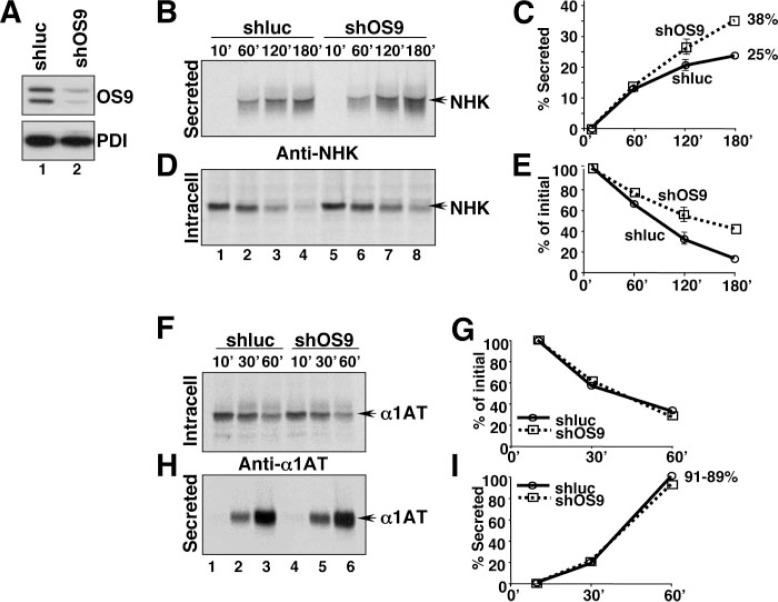
Consequences of OS-9 down-regulation on secretion and degradation of NHK and on secretion of α 1-antitrypsin. A, comparison by immunoblot of OS-9.1 and OS-9.2 content in cells exposed to an inactive small interfering RNA (lane 1) and to a small interfering RNA targeting the 3′ untranslated region of the OS-9 gene (lane 2). PDI serves as a loading and specificity control. B, secretion of labeled NHK from cells with normal (shluc, lanes 1– 4) or reduced (shOS9, lanes 5– 8) OS-9 levels. C, quantification of B (n = 3). D, intracellular content of labeled NHK for cells with normal (lanes 1– 4) or reduced (lanes 5– 8) OS-9 levels. E, quantification of D (n = 2). F, same as D for α1-antitrypsin. G, quantification of F. H, same as B for α1-antitrypsin. I, quantification of H.
FIGURE 4.
FIGURE 4.
Intracellular (Retention), secreted and degraded NHK after a 120-min chase has been determined in cells with normal (Mock, shluc), high (OS9, shOS9+OS9), and reduced (shOS9) OS-9 content. This figure summarizes the data shown in Figs. 2 and 3.
FIGURE 5.
FIGURE 5.
Consequences of OS-9 up-regulation and down-regulation on degradation of NHKQQQ. A, radiolabeled NHKQQQ has been immunoisolated after the indicated chase times from detergent extract of cells with normal (lanes 1–3) or elevated levels of OS-9.1 (lanes 4 – 6) or OS-9.2 (lanes 7–9). Note the co-precipitation of ectopic OS-9.1 and ectopic OS-9.2. B, quantification of intracellular NHKQQQ. C, intra-cellular content of labeled NHKQQQ for cells with normal (lanes 1–3) or reduced (lanes 4 – 6) OS-9 levels. D, quantification of C. E, NHKQQQ co-precipitates with OS-9.1 (lanes 4 – 6) and with OS-9.2 (lanes 7–9).
FIGURE 6.
FIGURE 6.
Consequences of overexpression of OS-9 with mutated MRH domain. A, consequences on the fate of NHK in OS-9.2R188A back-transfected shOS9 cells. B, quantification of A. C, secretion of labeled NHK. D, quantification of C. E, NHK co-precipitates with OS-9.2R188A (lanes 4 – 6).

References

    1. Ghaemmaghami S, Huh WK, Bower K, Howson RW, Belle A, Dephoure N, O’Shea EK, Weissman JS. Nature. 2003;425:737–741. - PubMed
    1. Brodsky JL. Biochem J. 2007;404:353–363. - PMC - PubMed
    1. Meusser B, Hirsch C, Jarosch E, Sommer T. Nat Cell Biol. 2005;7:766–772. - PubMed
    1. Molinari M. Nat Chem Biol. 2007;3:313–320. - PubMed
    1. Buschhorn BA, Kostova Z, Medicherla B, Wolf DH. FEBS Lett. 2004;577:422–426. - PubMed

Publication types

MeSH terms