. 2008 Jun;82(12):6034-8.
doi: 10.1128/JVI.00100-08. Epub 2008 Apr 16.

Basolateral entry and release of New and Old World arenaviruses from human airway epithelia

Affiliations

Basolateral entry and release of New and Old World arenaviruses from human airway epithelia

Douglas E Dylla et al. J Virol. 2008 Jun.

Abstract

Transmission of arenaviruses from rodent hosts to humans is generally thought to occur through inhalation or ingestion of dust or droplets containing viral particles. Here we demonstrate that two identified arenavirus receptors, alpha-dystroglycan (alpha-DG) and transferrin receptor 1 (TfR1), are expressed in polarized human airway epithelia. Lymphocytic choriomeningitis virus strains with high or low alpha-DG affinity and Junin virus, which binds TfR1, efficiently infected polarized epithelia only when applied to the basolateral surface or when injury compromised tight junction integrity. Viral egress from infected epithelia exhibited basolateral polarity. This study demonstrates that respiratory entry of arenaviruses occurs via basolateral receptors.


Figures
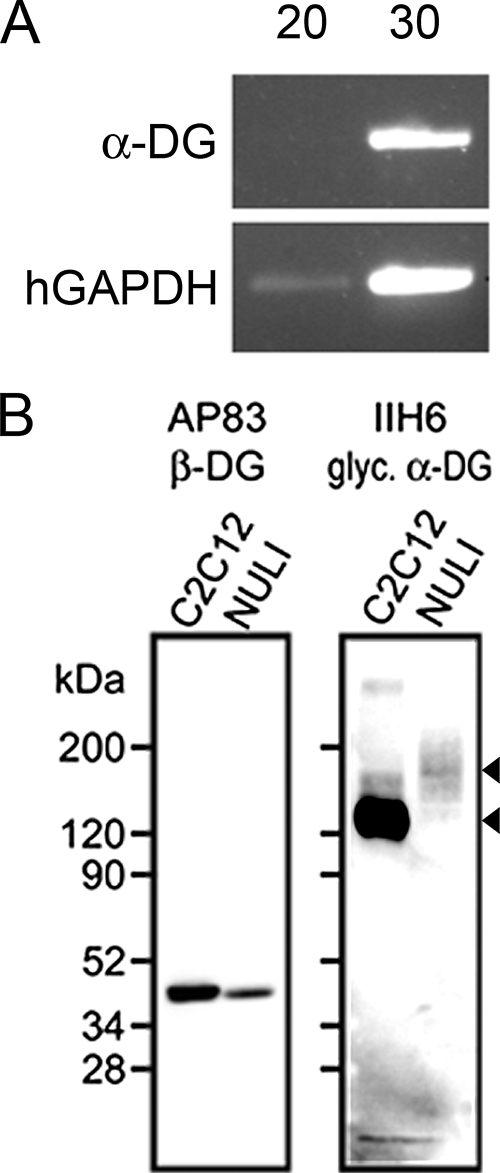
FIG. 1.
FIG. 1.
α-DG expression in human airway epithelia. (A) Reverse transcription-PCR was performed using cDNA derived from primary epithelia using primers specific for α-DG or human GAPDH (20 or 30 cycles). The human-GAPDH control confirmed mRNA was isolated properly. Results are representative of findings for three different human specimens. (B) Antibodies specific for α-DG or β-DG were used to detect protein expression in a positive-control mouse myoblast cell line (C2C12) and an immortalized human airway epithelial cell line (NuLi).
FIG. 2.
FIG. 2.
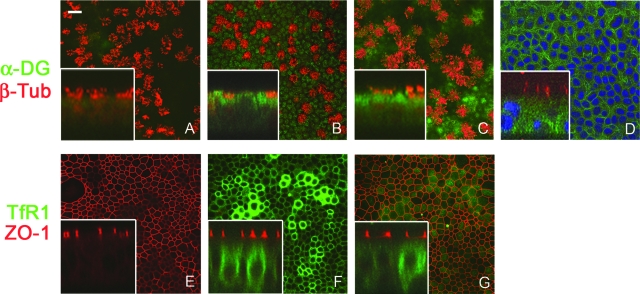
Immunolocalization of arenavirus receptors in human airway epithelia. En face (A to G) and corresponding confocal vertical sections (inset) of primary human airway epithelia following immunohistochemistry are shown. The localization of α-DG was detected by isotype control antibody (A) or α-DG IIH6 monoclonal antibody (B and C). α-DG expression is represented by a green (FITC) signal, while a red signal indicates cilium-specific β-tubulin Cy3 labeling of the apical surface. (D) TO-PRO 3 (blue) was used to label nuclei. The vertical focus in panel D lies beneath the tight junctions to display basolateral membrane labeling. Scale bar in panel A = 20 μm; n = 12 epithelia from 6 different donors. (E to G) The expression localization of TfR1 detected by secondary antibody only (E) or CD71 monoclonal antibody (F and G). TfR1 expression is represented by a green (Alexa Fluor 488) signal, while a red signal (Alexa Fluor 568) indicates tight junction boundaries detected by ZO-1 antibody. The vertical planes of focus in panels F and G differ to demonstrate unique localization; n = 10 epithelia from 5 different donors.
FIG. 3.
FIG. 3.
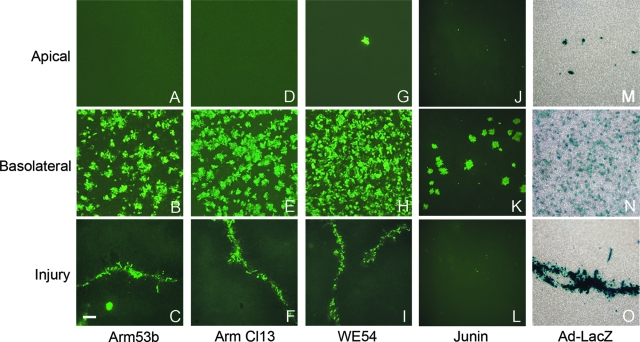
Polarity of infection by infectious arenaviruses. Well-differentiated cultures of primary human airway epithelia were analyzed to determine the polarity of virus entry following either apical or basolateral virus application. Top to bottom, the panels represent apical infection (A, D, G, J, and M), basolateral infection (B, E, H, K, and N), or apical infection following surface injury by scratching the epithelia with a pipette tip (C, F, I, L, and O). LCMV Armstrong 53b (A to C), LCMV Armstrong clone 13 (D to F), and LCMV WE54 (G to I) proteins were detected with a polyclonal antibody followed by FITC-labeled secondary antibody; n = 12 epithelia from 4 different donors. Junin protein (J to L) was detected with monoclonal antibody J3.6.2, followed by Alexa Fluor 488 secondary antibody; n = 6 epithelia from 3 different donors. As a control, Ad-LacZ (M to O) was applied and cells were stained with 5-bromo-4-chloro-3-indolyl-β-d-galactopyranoside. Scale bar (C) = 100 μm.

References

    1. Baldridge, J. R., B. D. Pearce, B. S. Parekh, and M. J. Buchmeier. 1993. Teratogenic effects of neonatal arenavirus infection on the developing rat cerebellum are abrogated by passive immunotherapy. Virology 197669-677. - PubMed
    1. Bonthius, D. J., J. Mahoney, M. J. Buchmeier, B. Karacay, and D. Taggard. 2002. Critical role for glial cells in the propagation and spread of lymphocytic choriomeningitis virus in the developing rat brain. J. Virol. 766618-6635. - PMC - PubMed
    1. Buchmeier, M. J., M. D. Bowen, and C. J. Peters. 2001. Arenaviridae: the viruses and their replication, p. 1635-1668. In D. M. Knipe and P. M. Howley (ed.), Fields virology. Lippincott Williams & Wilkins, Philadelphia, PA.
    1. Cao, W., M. D. Henry, P. Borrow, H. Yamada, J. H. Elder, E. V. Ravkov, S. T. Nichol, R. W. Compans, K. P. Campbell, and M. B. Oldstone. 1998. Identification of alpha-dystroglycan as a receptor for lymphocytic choriomeningitis virus and Lassa fever virus. Science 2822079-2081. - PubMed
    1. Chu, J. J., and M. L. Ng. 2002. Infection of polarized epithelial cells with flavivirus West Nile: polarized entry and egress of virus occur through the apical surface. J. Gen. Virol. 832427-2435. - PubMed

Publication types

MeSH terms

LinkOut - more resources