. 2008 May 21;27(10):1436-46.
doi: 10.1038/emboj.2008.80. Epub 2008 Apr 17.

Novel TCF-binding sites specify transcriptional repression by Wnt signalling

Affiliations

Novel TCF-binding sites specify transcriptional repression by Wnt signalling

Timothy A Blauwkamp et al. EMBO J. .

Abstract

Both transcriptional activation and repression have essential functions in maintaining proper spatial and temporal control of gene expression. Although Wnt signalling is often associated with gene activation, we have identified several directly repressed targets of Wnt signalling in Drosophila. Here, we explore how individual Wnt target genes are specified for signal-induced activation or repression. Similar to activation, repression required binding of Armadillo (Arm) to the N terminus of TCF. However, TCF/Arm mediated repression by binding to DNA motifs that are markedly different from typical TCF-binding sites. Conversion of the novel motifs to standard TCF-binding sites reversed the mode of regulation, resulting in Wnt-mediated activation instead of repression. A mutant form of Arm defective in activation was still functional for repression, indicating that distinct domains of the protein are required for each activity. This study suggests that the sequence of TCF-binding sites allosterically regulates the TCF/Arm complex to effect either transcriptional activation or repression.


Figures

Figure 1
Figure 1
Wnt signalling both activates and represses transcription in Kc cells. (A) qRT–PCR analysis of gene expression in Kc cells grown in the presence of dsRNA-targeting Axin (Wnt ON) or control sequences (Wnt OFF) for 7 days. Wnt signalling activated transcription of nkd and CG6234, whereas repressing the transcription of four novel Wnt targets, Ugt36Bc, Pxn, Tig, and Ugt58Fa. (B) qRT–PCR analysis of gene expression in Kc cells exposed to Wg-conditioned media (Wg-CM) or control-conditioned media (Ctrl-CM) for 6 h. (C) Both TCF and Arm were required for Wnt-mediated repression. Kc cells were treated as in (A), except that dsRNA targeting TCF or Arm was added in combination with control or Axin dsRNA (10 ng/ml each). (D) TCF has opposite functions at Wnt-repressed and Wnt-activated genes in the absence of signalling. RNAi-mediated knockdown of TCF lowered expression of all four repressed Wnt targets, but de-repressed expression of the Wnt-activated targets nkd and CG6234.
Figure 2
Figure 2
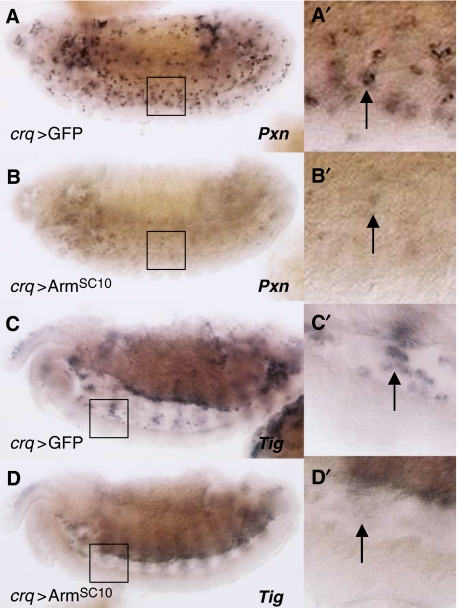
Wnt signalling represses transcription in Drosophila haemocytes. DIC images ( × 10 magnification) of stage 13 (A, B) or 14 (C, D) embryos following in situ hybridization with the indicated cRNA probes. P[UAS-GFP], P[crq79-Gal4] (crq>GFP) control embryos are compared with P[UAS-ArmSC10], P[crq79-Gal4] (crq>ArmSC10) embryos in which Wnt signalling has been activated in haemocytes. Both Pxn (compare A to B) and Tig (compare C to D) transcript levels are reduced by Wnt signalling. Insets (A′–D′) show × 40 magnification to highlight individual haemocytes migrating along the ventral boundary of the embryo. Anterior is left and dorsal is up in all images.
Figure 3
Figure 3
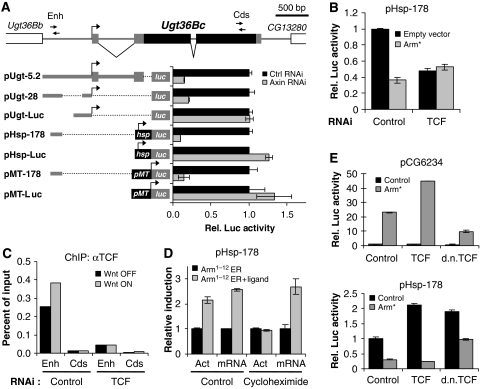
A minimal Ugt36Bc enhancer is directly repressed by Wnt signalling. A cartoon of the Ugt36Bc genomic locus is shown. Black rectangles represent Ugt36Bc coding sequences, grey rectangles represent untranslated regions, and white rectangles represent the boundaries of the upstream and downstream genes. Arrows represent the regions probed by PCR in ChIP experiments. Enh shows the WRE and Cds shows coding sequence near the 3′ end. (A) A minimal 178 bp WRE in the 5′ intergenic region of Ugt36Bc was repressed by Wnt signalling in the context of the endogenous Ugt36Bc promoter (pUgt-28), the Hsp70Bb minimal promoter (pHsp-178), and the metalothionein promoter (pMT-178). Reporters lacking the 178 bp WRE (pUgt-Luc, pHsp-Luc, and pMT-Luc) were not repressed. Luciferase activity in the Wnt OFF state was normalized to 1.0 for each reporter. (B) pHsp-178 (25 ng) was transiently transfected with pAc5.1/V5-His (empty vector) or pAcArm* (100 ng of each) into Kc cells pretreated with dsRNA targeting control sequences or TCF for 4 days. Luciferase and β-gal activities were measured 1 day after transfection. Arm* is a constitutively active form of Arm. pHsp-178 was repressed by Arm* in a TCF-dependent manner, and required TCF for full expression in the Wnt OFF state. (C) Kc cells treated with dsRNA targeting β-lactamase (Ctrl) or TCF were subjected to ChIP with TCF antibodies in the Wnt OFF and Wnt ON states (Ctrl and Axin RNAi, respectively). TCF binds the endogenous Ugt36Bc WRE (Enh) in both the absence and presence of Wnt signalling. TCF RNAi greatly reduced TCF binding at the WRE. Control sequences near the 3′ end of the Ugt36Bc coding region (Cds) were not bound by TCF. The experiment shown is representative of three independent experiments showing similar results. (D) Kc cells transfected with pAcArm1–12ER (500 ng) and pHsp178 (100 ng) were grown for 19 h before being treated for 6 h with 10 μg/ml cycloheximide and/or 400 ng/ml 17-β-estradiol (ligand). In the absence of cycloheximide, ligand activated pHsp-178 two-fold, as measured by luciferase mRNA levels and luciferase activity. In the presence of cycloheximide, ligand still activated transcription luciferase mRNA, but protein synthesis was inhibited as indicated by the lack of increased luciferase activity. ‘Act' refers to luciferase activity, ‘mRNA' refers to luciferase mRNA levels as measured by qRT–PCR. (E) Arm works through TCF to repress the 178 bp WRE. Kc cells were transfected with 50 ng pCG6234 or pHsp-178 reporters, 50 ng control or Arm* expression vector, and 200 ng control, wild-type TCF, or dominant-negative TCF (dnTCF) expression vectors. dnTCF partially disrupted Arm* activation of pCG6234 (top panel) and Arm* repression of pHsp-178 (lower panel). Wild-type TCF enhanced the Wnt responsiveness of both reporters.
Figure 4
Figure 4
Wnt-mediated repression of Ugt36Bc requires novel TCF-binding sites. (A) DNaseI protection assays were used to identify TCF-binding sites in the 178 bp WRE (see Materials and methods). Blue traces show the protection pattern in the presence GST and green traces show the protection pattern in the presence of GST–HMG. Top panel: wild-type Ugt-178 probes. Bottom panel: Ugt-178 probes with mutated TCF-binding sites. The lower green signal relative to blue signal in the boxed region indicates protection of this sequence by the HMG domain. Binding is sequence specific as protection is abolished when the sequence is mutated (bottom panel). The chromatogram region shown corresponds to the TCF site 2 region and is representative of the other two TCF-binding sites. (B) Summary of DNaseI protection assays showing the sequence and location of the three strongest GST–HMG footprints within the 178 bp WRE. Underlined regions were mutated to disrupt TCF-binding sites as described below. Bold sequences generated the loose consensus AGAWAW (W=A or T). (C) GST and GST–HMG binding to an oligo containing TCF-binding site 2 (WT) or an oligo containing a mutated site (Mut.). (D) TCF-binding sites to the 178 bp WRE were probed using TCF ChIP in Kc cell lines containing stably integrated wild-type (pMT-178) or TCF site mutant (pMT-178*123) reporters. Cloned WREs were distinguished from the endogenous Ugt36Bc WRE using PCR primers specific for vector-derived sequences adjacent to the WRE. (E) Luciferase assay in transiently transfected Kc cells. Mutation of any individual TCF site within pHsp-178 partially reduced WRE activity in the absence of Wnt signalling, and mutation of all three TCF-binding sites (pHsp-178*123) lowered activity to background levels. All activities are expressed relative to pHsp-Luc. (F) The role of the TCF-binding sites in repression was measured using the metallothionein promoter to provide activity to mutant reporters in the absence of Wnt signalling. Here, 50 ng of control, wild-type, and TCF site mutant reporters was transiently transfected with 150 ng control or Arm* expression vectors. Here, 50 μM CuSO4 was added to cells 24 h before harvesting to enhance reporter expression. Uninduced expression levels were normalized to 1.0 for each reporter. Arm* repressed the wild-type WRE (pMT-178), but not a reporter in which all three TCF sites were mutated (pMT-178*123). (G) Site-directed mutagenesis was used to convert all three footprinted sites in the pMT-178 reporter to sequences that match the traditional TCF-binding site consensus (CCTTTGATCTT) to generate pMT-178*TCF Swap. These mutations reduced the activity in Ctrl RNAi-treated cells to enhancer-less vector levels. More importantly, the TCF site swap caused a 15-fold activation by Axin RNAi.
Figure 5
Figure 5
Arm uses distinct domains for transcriptional activation and repression. (A) Kc cells were transiently transfected for 3 days with 150 ng empty vector, Arm*, or DisArmed expression vectors along with the 50 ng of the indicated reporter. DisArmed was severely compromised for transcriptional activation of all reporters, but repressed pHsp-178 nearly as well as Arm*. (B) Pxn, Tig, and Ugt36Bc are directly repressed by Wnt signalling. Kc cells were transiently transfected with 200 ng pAc-, pAcArm*, or pAcDisArmed along with 100 ng pAcIL2α expression vector. At 3 days after transfection, cells were isolated on αCD25 magnetic beads and used for real-time PCR or western blotting. (C) Western blots of whole-cell extract from cells used in (B). Arm* and DisArmed were expressed at approximately the same level, as measured by using antibodies against an N-terminal portion of Arm (top panel) and the C-terminal V5 tag (bottom panel).
Figure 6
Figure 6
DisArmed represses transcription in vivo. DIC images ( × 10 magnification) of stage 13 (AC) or 14 (DF) embryos following in situ hybridization with the indicated probes. P[UAS-GFP], P[crq79-Gal4] (crq>GFP) control embryos are compared with P[UAS-Arm*], P[crq79-Gal4] (crq>Arm*) and P[UAS-DisArmed], P[crq79-Gal4] (crq>DisArmed) embryos. DisArmed represses Pxn and Tig expression in haemocytes as efficiently as Arm*. Insets (A′F′) show × 40 magnification to highlight individual haemocytes migrating along the ventral boundary of the embryo. Anterior is left and dorsal is up in all images.
Figure 7
Figure 7
Model for allosteric regulation of TCF and arm by DNA. Our study suggests that TCF can bind two different classes of DNA sequences. When TCF is bound to traditional consensus sites resembling CCTTTGATCTT, it represses transcription in the absence of signalling. Upon Wnt stimulation, TCF/Arm activates transcription through Arm-associated co-activators. When TCF is bound to the sequences containing AGAWAW in Ugt36Bc, possibly with the aid of cofactors, it activates transcription in the absence of signalling and Wnt stimulation results in Arm-dependent transcriptional repression. The different shapes of TCF and Arm at activated and repressed genes represent potential structural differences in the complex when bound to the different classes of DNA sequence.

References

    1. Atcha FA, Syed A, Wu B, Hoverter NP, Yokoyama NN, Ting JH, Munguia JE, Mangalam HJ, Marsh JL, Waterman ML (2007) A unique DNA binding domain converts T-cell factors into strong Wnt effectors. Mol Cell Biol 27: 8352–8363 - PMC - PubMed
    1. Alfonso TB, Jones BW (2002) gcm2 promotes glial cell differentiation and is required with glial cells missing for macrophage development in Drosophila. Dev Biol 248: 369–383 - PubMed
    1. Barolo S (2006) Transgenic Wnt/TCF pathway reporters: all you need is Lef? Oncogene 25: 7505–7511 - PubMed
    1. Barolo S, Posakony JW (2002) Three habits of highly effective signaling pathways: principles of transcriptional control by developmental cell signaling. Genes Dev 16: 1167–1181 - PubMed
    1. Brand AH, Perrimon N (1993) Targeted gene expression as a means of altering cell fates and generating dominant phenotypes. Development 118: 401–415 - PubMed

Publication types

MeSH terms