Comparative Study
. 2008 Apr 18;4(4):e1000057.
doi: 10.1371/journal.pgen.1000057.

Analysis of chimpanzee history based on genome sequence alignments

Affiliations
Comparative Study

Analysis of chimpanzee history based on genome sequence alignments

Jennifer L Caswell et al. PLoS Genet. .

Abstract

Population geneticists often study small numbers of carefully chosen loci, but it has become possible to obtain orders of magnitude for more data from overlaps of genome sequences. Here, we generate tens of millions of base pairs of multiple sequence alignments from combinations of three western chimpanzees, three central chimpanzees, an eastern chimpanzee, a bonobo, a human, an orangutan, and a macaque. Analysis provides a more precise understanding of demographic history than was previously available. We show that bonobos and common chimpanzees were separated approximately 1,290,000 years ago, western and other common chimpanzees approximately 510,000 years ago, and eastern and central chimpanzees at least 50,000 years ago. We infer that the central chimpanzee population size increased by at least a factor of 4 since its separation from western chimpanzees, while the western chimpanzee effective population size decreased. Surprisingly, in about one percent of the genome, the genetic relationships between humans, chimpanzees, and bonobos appear to be different from the species relationships. We used PCR-based resequencing to confirm 11 regions where chimpanzees and bonobos are not most closely related. Study of such loci should provide information about the period of time 5-7 million years ago when the ancestors of humans separated from those of the chimpanzees.


Conflict of interest statement

The authors have declared that no competing interests exist.

Figures
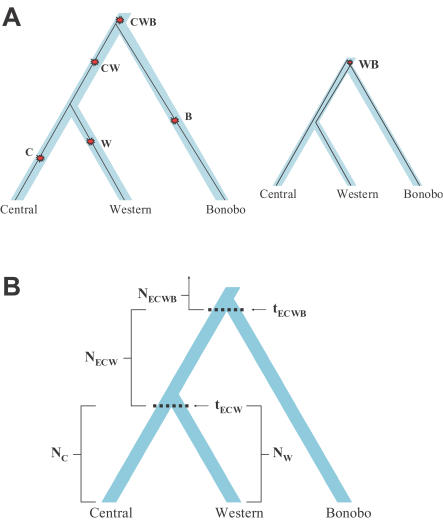
Figure 1
Figure 1. Schematic of our six-parameter model for analysis of the history of bonobos, central, and western chimpanzees.
(A) Each five-group alignment has divergent site types that correspond to a branch in the tree: the lengths of branches are estimated from the observed numbers of the corresponding types of sites. The larger tree shows five possible types of sites (using the CWBH alignment as an example), and how they would be generated by single historical mutations. The smaller tree corresponds to one of the two rarer divergent site types that can arise when the genes from the two most closely related groups (central and western chimpanzee) share a common ancestor prior to the separation of the less closely related population (bonobo). (B) In the six-parameter model of chimpanzee evolution, the separation time of central chimpanzees and western chimpanzees is tECW, the separation time of chimpanzees and bonobos is tECWB, NC and NW specify the modern effective sizes of the central and western chimpanzee populations, and NECW and NECWB the effective sizes in the two earlier epochs. Although we do not include eastern chimpanzee in this analysis, the notations for tECW, tECWB, NECW, and NECWB refer to eastern chimpanzee because eastern form a clade with central chimpanzees.
Figure 2
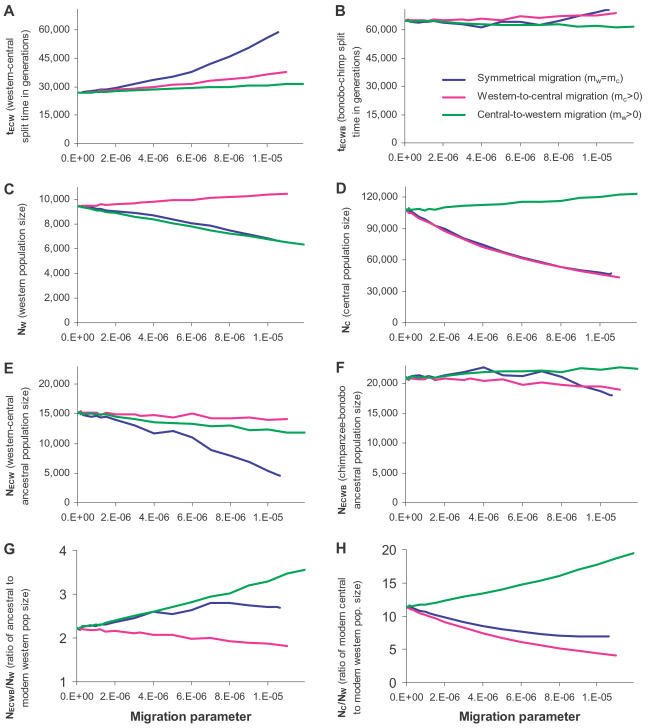
Figure 2. Inferred values of the six parameters of chimpanzee demographic history and key ratios of population sizes, for various assumptions about the migration rate per generation between western and central chimpanzees since the western-central population split.
All plots consider the full range of migration rates for which we could obtain a reasonable fit to the data (Text S7), with the values matching those in Tables 2 and 3 for the zero-migration rate scenarios. (A) In the presence of migration, central-western population separation time tECW increases relative to the zero-migration scenario, but (B) the bonobo-common chimpanzee separation time estimate tECWB is unchanged. (C,D) Migration rate has a variable effect on our estimates of western and central population size, depending on the direction of the migration, but (E) increasing migration rate always decreases our estimate of NECW, and (F) our estimate of ancestral bonobo-chimpanzee population size is unaffected by migration rate assumptions. (G) For all migration rates consistent with the data, we infer that the western population size contracted relative to the ancestral size by at least 1.8-fold (panel f divided by e), and (H) that the ratio of central to western size has been >4.1 (d divided by e).
Figure 3
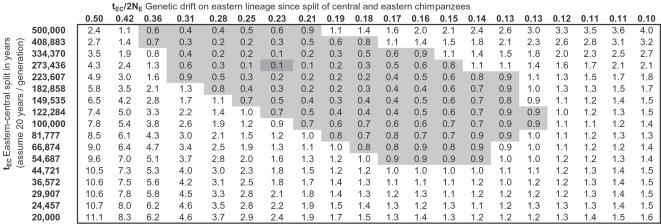
Figure 3. Inferences about parameters of eastern chimpanzee history.
We ran our computer simulation of chimpanzee history using the six demographic parameters that were the best fits to our data under the assumption of no western-central migration (Table 2). We then varied the time tEC of eastern-central separation and the modern eastern population size NE, exploring the full range of parameters consistent with three statistics of interest that we measured using data from ref. : the FST value between eastern and central chimpanzees, the ratio of eastern to central chimpanzee genetic diversity, and the average heterozygosity of SNPs discovered as polymorphic within ten eastern chimpanzees. We found an excellent fit to our data for the parameters NE = 30,078 and tEC = 13,672 generations (∼273,000 years assuming 20 years per generation). The values in the cells give -log10 of the P-value for a χ2 statistic with three degrees of freedom. We indicate the 95% credible interval (gray) as the region where this is within 0.86 of the maximum (a likelihood ratio test, which is only approximate since the three statistics that we use to assess the fit are not fully independent). This analysis implies that, with approximately 95% probability, eastern and central chimpanzees split at least 50,000 years ago.
Figure 4
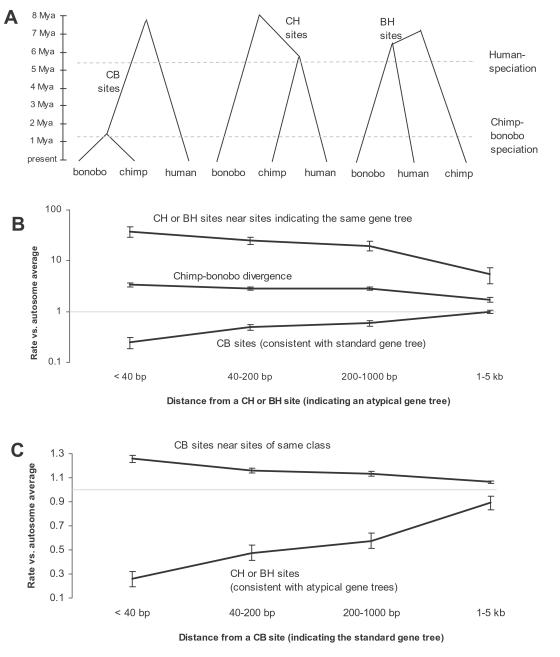
Figure 4. Genealogical trees relating chimpanzee, bonobo, human, orangutan, and macaque (CBHOM) vary in shape across the genome.
(A) The most common is on the left, but if there is incomplete lineage sorting, different tree topologies such as the two on the right can occur. These should be detectable from CH sites that cluster chimpanzee and human to the exclusion of the other species, or BH sites that cluster bonobo and human. (B) In the subset of the CBHOM data that is within 40 base pairs of a CH or BH site, we observe a ∼38-fold excess of sites of the same class, a deficiency in CB sites typical of the standard genealogy (∼25% of the average), and a ∼3.3-fold excess of sites that differ between chimpanzee and bonobo, exactly as would be expected if in these regions, chimpanzees and bonobos are not most closely related and only share a common ancestor prior to human-chimpanzee speciation. (C) By contrast, very near to CB sites typical of the standard genealogy, we observe few CH or BH sites (∼26% of the genome average). These results confirm that the majority (∼74%) of CH and BH sites are marking out genuine regions where the genealogy is different from the species relationships. All bars in this figure correspond to one standard error.
Figure 5
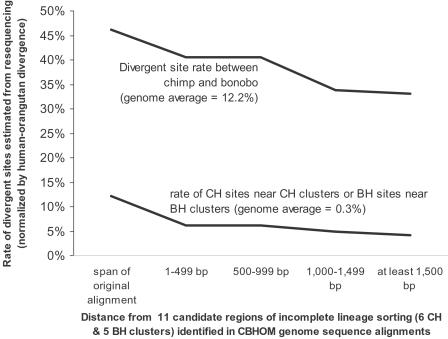
Figure 5. To validate regions of incomplete lineage sorting, we carried out laboratory-based follow-up of 11 regions where our main analysis found strong evidence in favor of a genealogy where chimpanzees and bonobos are not most closely related (likelihood ratio of >20,000:1).
We targeted up to 5 kb centered on each of these regions for PCR-based resequencing, and only analyzed divergent sites that were independent of those found in the shotgun analysis (Text S9). We found an excess of CH sites and BH sites in regions previously identified as clustering these pairs of species (∼22 times the genome average), as would be expected if these regions have the genealogies inferred in Table 4. Chimpanzee-bonobo genetic divergence divided by human-orangutan genetic divergence is 38.4%, about three times the observed genome-wide rate of 12.2%, as expected if chimpanzees and bonobos share a common ancestor so long ago that it occurred prior to human-chimpanzee speciation. Both patterns attenuate with distance, as expected if the genealogies cover only a limited physical distance span.

References

    1. Groves C. Washington D.C.: Smithsonian Institution Press; 2001. Primate taxonomy. p. 350.
    1. Gagneux P, Wills C, Gerloff U, Tautz D, Morin PA, et al. Mitochondrial sequences show diverse evolutionary histories of African hominoids. Proc Natl Acad Sci U S A. 1999;96:5077–5082. - PMC - PubMed
    1. Stone AC, Griffiths RC, Zegura SL, Hammer MF. High levels of Y-chromosome nucleotide diversity in the genus Pan. Proc Natl Acad Sci U S A. 2002;99:43–48. - PMC - PubMed
    1. Becquet C, Patterson N, Stone AC, Przeworski M, Reich D. Genetic structure of chimpanzee populations. PLoS Genet. 2007;3:e66. - PMC - PubMed
    1. Chimpanzee Sequencing and Analysis Consortium. Initial sequence of the chimpanzee genome and comparison with the human genome. Nature. 2005;437:69–87. - PubMed

Publication types