


Exercise therapy in juvenile idiopathic arthritis
- PMID: 18425929
- PMCID: PMC8903819
- DOI: 10.1002/14651858.CD005954.pub2
Exercise therapy in juvenile idiopathic arthritis
Abstract
Background: Exercise therapy is considered an important component of the treatment of arthritis. The efficacy of exercise therapy has been reviewed in adults with rheumatoid arthritis but not in children with juvenile idiopathic arthritis (JIA).
Objectives: To assess the effects of exercise therapy on functional ability, quality of life and aerobic capacity in children with JIA.
Search strategy: The Cochrane Central Register of Controlled Trials (CENTRAL), Cochrane Database of Systematic Reviews (The Cochrane Library), MEDLINE (January 1966 to April 2007), CINAHL (January 1982 to April 2007), EMBASE (January 1966 to October 2007), PEDro (January 1966 to October 2007), SportDiscus (January 1966 to October 2007), Google Scholar (to October 2007), AMED (Allied and Alternative Medicine) (January 1985 to October 2007), Health Technologies Assessment database (January 1988 to October 2007), ISI Web Science Index to Scientific and Technical Proceedings (January 1966 to October 2007) and the Chartered Society of Physiotherapy website (http://www.cps.uk.org) were searched and references tracked.
Selection criteria: Randomised controlled trials (RCTs) of exercise treatment in JIA.
Data collection and analysis: Potentially relevant references were evaluated and all data were extracted by two review authors working independently.
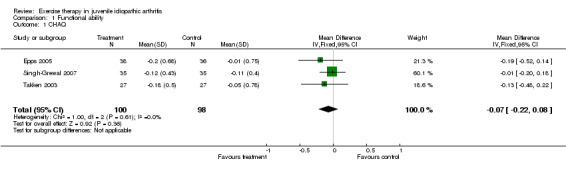
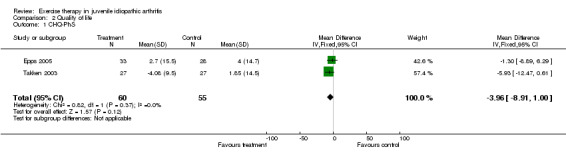
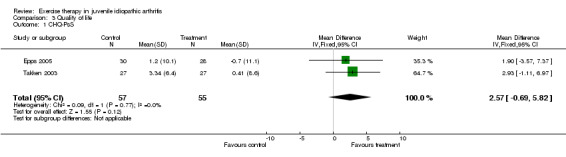
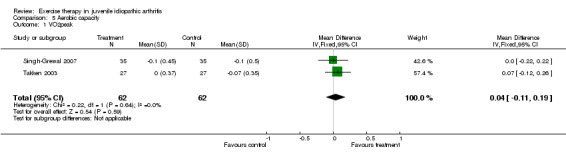
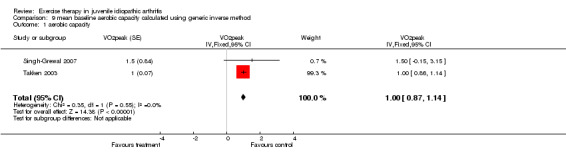
Main results: Three out of 16 identified studies met the inclusion criteria, with a total of 212 participants. All the included studies fulfilled at least seven of 10 methodological criteria. The outcome data of the following measures were homogenous and were pooled in a meta-analysis: functional ability (n = 198; WMD -0.07, 95% CI -0.22 to 0.08), quality of life (CHQ-PhS: n = 115; WMD -3.96, 95% CI -8.91 to 1.00) and aerobic capacity (n = 124; WMD 0.04, 95% CI -0.11 to 0.19). The results suggest that the outcome measures all favoured the exercise therapy but none were statistically significant. None of the studies reported negative effects of the exercise therapy.
Authors' conclusions: Overall, based on 'silver-level' evidence (www.cochranemsk.org) there was no clinically important or statistically significant evidence that exercise therapy can improve functional ability, quality of life, aerobic capacity or pain. The low number of available RCTs limits the generalisability. The included and excluded studies were all consistent about the adverse effects of exercise therapy; no short-term detrimental effects of exercise therapy were found in any study. Both included and excluded studies showed that exercise does not exacerbate arthritis. The large heterogeneity in outcome measures, as seen in this review, emphasises the need for a standardised assessment or a core set of functional and physical outcome measurements suited for health research to generate evidence about the possible benefits of exercise therapy for patients with JIA. Although the short-term effects look promising, the long-term effect of exercise therapy remains unclear.
Conflict of interest statement
None known
Figures
Update of
References
References to studies included in this review
Epps 2005 {published data only}
-
- Epps H, Ginnelly L, Utley M, Southwood T, Gallivan S, Sculpher M, Woo P. Is hydrotherapy cost effective? A randomised controlled trial of combined hydrotherapy programmes compared with physiotherapy land techniques in children with juvenile idiopathic arthritis. Health Technology Assessment 2005;9:1‐76. - PubMed
Singh‐Grewal 2007 {published data only}
-
- Singh‐Grewal D, Schneiderman‐Walker J, Wright V, Bar‐Or O, Selvadurai H, Cameron B, et al. The effects of vigorous exercise training on physical function in children with arthritis: a randomized, controlled, single‐blinded trial. Arthritis and Rheumatism 2007;57:1202‐10. - PubMed
Takken 2003 {published data only}
-
- Takken T, Net J, Kuis W, Helders PJM. Aquatic fitness training for children with juvenile idiopathic arthritis. Rheumatology 2003;42:1408‐14. - PubMed
References to studies excluded from this review
Bacon 1991 {published data only}
-
- Bacon MC, Nicholson C, Binder H, White PH. Juvenile rheumatoid arthritis. Aquatic exercise and lower‐extremity function. Arthritis and Rheumatism 1991;4:102‐5. - PubMed
Baldwin 1972 {published data only}
-
- Baldwin J. Pool therapy compared with individual home exercise therapy for juvenile rheumatoid arthritic patients. Physiotherapy 1972;58:230‐1. - PubMed
Fisher 1999 {published data only}
-
- Fisher NM, Venkatraman JT, O'Neil KM. Effects of resistance exercise on children with juvenile arthritis. Arthritis and Rheumatism 1999;42(Suppl):396.
Keller‐Marchand 2006 {published data only}
-
- Keller‐ Marchand L, Farpour‐Lambert NJ, Hans D, Rizzoli R, Hofer MF. Effects of a weight‐bearing exercise program in children with juvenile idiopathic arthritis. Medicine and Science in Sports and Exercise 2006;Suppl(5):93‐4.
Klepper 1999 {published data only}
-
- Klepper SE. Effects of an eight‐week physical conditioning program on disease signs and symptoms in children with chronic arthritis. Arthritis Care and Research 1999;12:52‐60. - PubMed
Latzka 1982 {published data only}
-
- Latzka U, Böhler N, Lukeschitsch G, Pilz I. Österreichische therapieferien für kinder mit juveniler chronischer arthritis. Österreichische Ärztezeitung: Organ der Östereichischen Ärztekamme 1982;37:1561‐5.
Milliet 1996 {published data only}
-
- Milliet J, Carman D, Browne R. Summer camp: effects on function of children with autoimmune diseases. Arthritis Care and Reseach 1996;9:309‐14. - PubMed
Moncur 1990 {published data only}
-
- Moncur C, Marcus R, Johnson S. Pilot project of aerobic conditioning of subjects with juvenile arthritis. Arthritis Care and Research 1990;3(Suppl):149.
Singh‐Grewal 2006 {published data only}
-
- Singh‐ Grewal D, Wright V, Bar‐Or O, Feldman BM. Pilot study of fitness training and exercise testing in polyarticular childhood arthritis. Arthritis and Rheumatism 2006;55:364‐72. - PubMed
Takken 2001 {published data only}
-
- Takken T, Net J, Helders PJM. Do juvenile idiopathic arthritis patients benefit from an exercise program? A pilot study. Arthritis and Rheumatism 2001;45:81‐5. - PubMed
Tork 1989 {published data only}
-
- Tork SC, Douglas V. Arthritis water exercise program evaluation. Arthritis Care and Research 1989;2:28‐36. - PubMed
Vostrejs 1985 {published data only}
-
- Vostrejs M, Hollister JR. The effectiveness of an aquanastics program: a controlled study. Arthritis and Rheumatism 1985;28(Suppl):150.
Öberg 1994 {published data only}
-
- Öberg T, Karsnia A, Andersson Gäre B, Lagerstrand A. Physical training of children with juvenile chronic arthritis. Scandanavian Journal of Rheumatology 1994;23:92‐5. - PubMed
Additional references
Bar‐Or 2004
-
- Bar‐Or O, Rowland TW. Pediatric Exercise Medicine. Human Kinetics, 2004.
Bode 2003
-
- Bode RK, Klein‐Gitelman S, Miller ML, Lechman TS, Pachman LM. Disease activity score for children with juvenile dermatomyositis: reliability and validity evidence. Arthritis and Rheumatism 2003;49:7‐15. - PubMed
De Jong 2003
-
- Jong Z, Munneke M, Zwinderman AH, Kroon HM, Jansen A, Ronday KH. Is a long‐term high‐intensity exercise program effective and safe in patients with rheumatoid arthritis? Results of a randomized controlled trail. Arthritis and Rheumatism 2003;48:2415‐24. - PubMed
Dempster 2001
-
- Dempster H, Porepa M, Young N, Feldman BM. The Clinical Meaning of Functional Outcome Scores in Children With Juvenile Arthritis. Arthritis and Rheumatism 2001;44:1768‐74. - PubMed
Giannini 1997
-
- Giannini EH, Ruperto N, Ravelli A, Lovell DJ, Felson DT, Martini A. Preliminary definition of improvement in juvenile arthritis. Arthritis and Rheumatism 1997;40:1202‐9. - PubMed
Hakkinen 2003
-
- Hakkinen A, Hannonen P, Nyman K, Lyyski T, Hakkinen K. Effects of concurrent strength and endurance training in women with early or longstanding rheumatoid arthritis: comparison with healthy subjects. Arthritis and Rheumatism 2003;49:789‐97. - PubMed
Hakkinen 2004
-
- Hakkinen A. Effectiveness and safety of strength training in rheumatoid arthritis. Current Opinion in Rheumatology 2004;16:132‐7. - PubMed
Hakkinen 2005
-
- Hakkinen A, Pakarinen A, Hannonen P Kautiainen H, Nyman K, Kraemer WJ, Hakkinen K. Effects of prolonged combined strength and endurance training on physical fitness, body composition and serum hormones in women with rheumatoid arthritis and in healthy controls. Clinical and Experimental Rheumatology 2005;23:505‐12. - PubMed
Henderson 1995
-
- Henderson CJ, Lovell DJ, Specker BL, Campaigne BN. Physical activity in children with juvenile rheumatoid arthritis. Arthritis Care and Research 1995;8(2):114‐9. - PubMed
Higgins 2005
-
- Higgins JPT, Green S, editors. Assessing methodological qualtiy. Section 6.7.1.. Cochrane Handbook for Systematic Reviews of Interventions 4.2.5 [updated May 2005]. Chichester, UK: John Wiley & Sons, Ltd..
Huber 2001
-
- Huber AM, Hicks JE, Lachenbruch PA, Perez MD, Zemel LS, Rennebohm RM, et al. Juvenile Dermatomyositis Disease Activity Collaborative Study Group. Validation of the Childhood Health Assessment Questionnaire in the juvenile idiopathic myopathies. The Journal of Rheumatology 2001;28:1106‐11. - PubMed
Kirchheimer 1993
-
- Kirchheimer JC, Wanivenhaus A, Engel A. Does sport negatively influence joint scores in patients with juvenile rheumatoid arthritis. An 8‐year prospective study. Rheumatology International 1993;12:239‐42. - PubMed
Klepper 1991
-
- Klepper SE. Effects of an eight‐week physical conditioning program on disease signs and symptoms in children with chronic arthritis. Arthritis Care and Research 1999;12:52‐60. - PubMed
Landgraf 1996
-
- Landgraf MA, Abetz L, Ware JE. The CHQ user's manual. First edition, editor Boston MA. New England Medical Center, 1996.
Lovell 1989
-
- Lovell DJ, Howe S, Shear E, Hartner S, McGirr G, Schulte M. Development of a disability measurement tool for juvenile rheumatoid arthritis. The Juvenile Arthritis Functional Assessment Scale. Arthritis and Rheumatism 1989;32:1390‐5. - PubMed
Omeract 1997
-
- OMERACT. OMERACT III. Outcome measures in arthritis clinical trials. Cairns, Australia, April 16‐19, 1996. Proceedings. The Journal of Rheumatology 1997;24:763‐802. - PubMed
Petty 2004
-
- Petty RE, Southwood TR, Manners P, Baum J, Glass DN, Goldenberg J, et al. International League of Associations for Rheumatology Classification of Juvenile Idiopathic Arthritis: Second revision, Edmonton, 2001. The Journal of Rheumatology 2004;31:390‐2. - PubMed
Ravelli 2007
-
- Ravelli A, Martini A. Juvenile idiopathic arthritis. Lancet 2007;369:767‐78. - PubMed
Ruperto 1999
-
- Ruperto N, Ravelli A, Migliavacca D, Viola S, Pistorio A, Duarte C, et al. Responsiveness of clinical measures in children with oligoarticular juvenile chronic arthritis. The Journal of Rheumatology 1999;26:1827‐30. - PubMed
Sherrington 2000
-
- Sherrington C, Herbert RD, Maher CG, Moseley AM. PEDro. A database of randomized trials and systematic reviews in physiotherapy. Manual Theory 2000;5:223‐6. - PubMed
Sing 1994
-
- Singh G, Athreya BH, Fries JF, Goldsmith DP. Measurement of health status in children with juvenile rheumatoid arthritis. Arthritis and Rheumatism 1994;37:1761‐9. - PubMed
Takken 2003b
Tugwell 2004
-
- Tugwell P, Shea B, Boers M, Brooks P, Simon L, Strand V, Wells G (editors). Evidence‐based Rheumatology. London: BMJ Books, 2004.
Van den Ende 1998
-
- Ende CH, Vliet Vlieland TP, Munneke M, Hazes JM. Dynamic exercise therapy in rheumatoid arthritis: a systematic review. British Journal of Rheumatology 1998;37:677‐87. - PubMed
Verhagen 1998
-
- Verhagen AP, Vet HC, Bie RA, Kessels AG, Boers M, Bouter LM. The Delhi list: a criteria list for quality assessment of randomized clinical trials for conducting systematic reviews developed by delphi consensus. Journal of Clinical Epidemiology 1998;51:1235‐41. - PubMed
Wright 1996
-
- Wright FV, Kimber JL, Law M, Goldsmith CH, Crombie V, Dent P. The Juvenile Arthritis Functional Status Index (JASI): a validation study. Journal of Rheumatology 1996;23:1066‐79. - PubMed
Publication types
MeSH terms
LinkOut - more resources
Full Text Sources
Medical
Miscellaneous
