


Sex and the city: differences in disease- and disability-free life years, and active community participation of elderly men and women in 7 cities in Latin America and the Caribbean
- PMID: 18426599
- PMCID: PMC2387143
- DOI: 10.1186/1471-2458-8-127
Sex and the city: differences in disease- and disability-free life years, and active community participation of elderly men and women in 7 cities in Latin America and the Caribbean
Abstract
Background: The world's population is ageing, and four of the top 10 most rapidly ageing developing nations are from the region of Latin America and the Caribbean (LAC). Although an ageing population heralds likely increases in chronic disease, disability-related dependence, and economic burden, the societal contribution of the chronically ill or those with disability is not often measured.
Methods: We calculated country-specific prevalences of 'disability' (difficulty with at least one activity of daily living), 'disease' and 'co-morbidity' (presence of at least one, and at least two, of seven chronic diseases/conditions, respectively), and 'active community engagement' (using five levels of community participation, from less than weekly community contact to voluntary or paid work) in seven LAC cities. We estimated remaining life expectancy (LE) with and without disability, disease and co-morbidity, and investigated age, sex, and regional variations in disability-free LE. Finally, we modeled the association of disease, co-morbidity and disability with active community participation using an ordinal regression model, adjusted for depression.
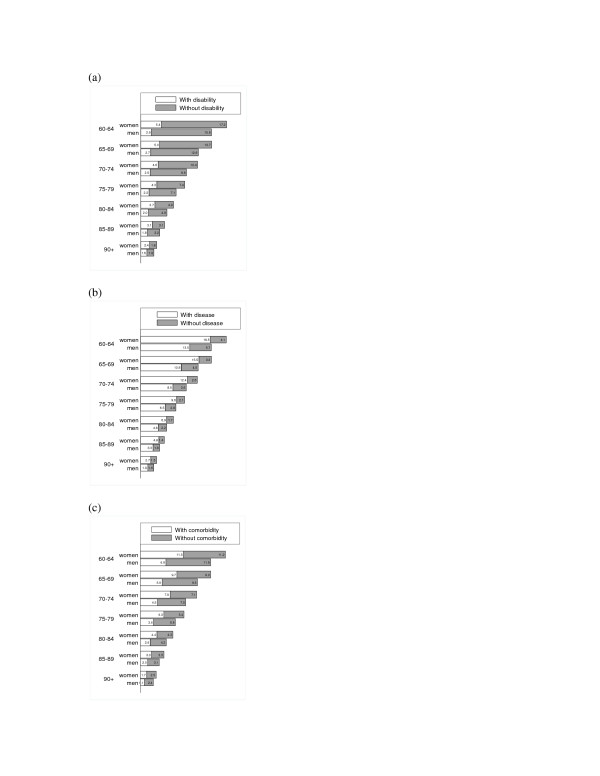
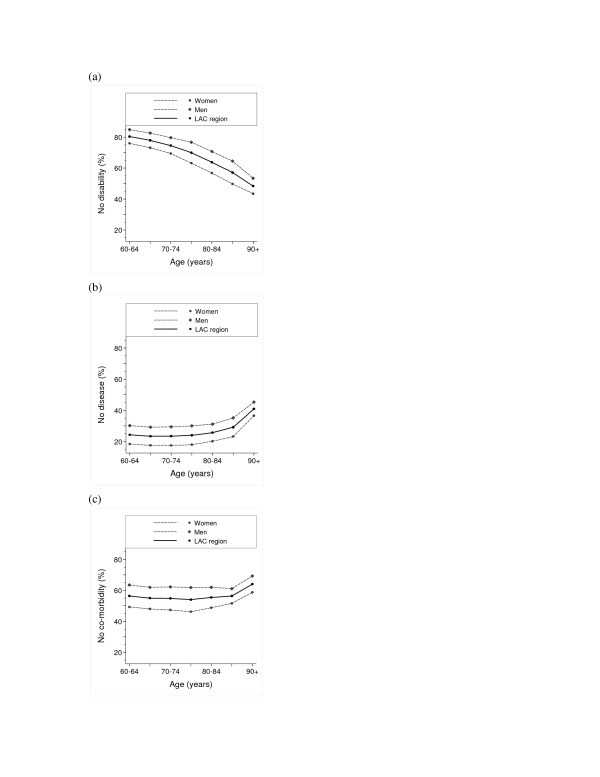
Results: Overall, 77% of the LAC elderly had at least one chronic disease/condition, 44% had co-morbidity and 19% had a disability. The proportion of disability-free LE declined between the youngest (60-64 years) and the eldest (90 years and over) age-groups for both men (from 85% to 55%) and women (from 75% to 45%). Disease-free and co-morbidity-free LE, however, remained at approximately 30% and 62%, respectively, for men (20% and 48% for women), until 80-84 years of age, then increased. Only Bridgetown's participants had statistically significantly longer disability-free LE than the regional average (IRR = 1.08; 95%CI 1.05-1.10; p < 0.001). Only Santiago's participants had disability-free LE which was shorter than the regional average (IRR = 0.94; 95%CI 0.92-0.97; p < 0.001). There was 75% active community participation overall, with more women than men involved in active help (49% vs 32%, respectively) and more men involved in voluntary/paid work (46% vs 25%, respectively). There was either no, or borderline significance in the association between having one or more diseases/conditions and active community engagement for both sexes. These associations were limited by depression (odds ratio [OR] reduced by 15-17% for men, and by 8-11% for women), and only remained statistically significant in men. However, disability remained statistically significantly associated with less community engagement after adjusting for depression (OR = 0.58, 95%CI 0.49-0.69, p < 0.001 for women and OR = 0.50, 95%CI 0.47-0.65, p < 0.001 for men).
Conclusion: There is an increasing burden of disease and disability with older age across the LAC region. As these nations cope with resulting social and economic demands, governments and civic societies must continue to develop and maintain opportunities for community participation by this increasingly frail, but actively engaged group.
Figures
References
-
- Kinsella K, Velkoff VA. In: An Aging World: 2001. Bureau USC, editor. Washington, DC, U.S. Government Printing Office; 2001. (Series P95/01-1).
-
- Brea JA. Population Bulletin. Vol. 58. Washington, D.C., Population Reference Bureau; 2003. Population dynamics in Latin America.
-
- Rowe JW, Kahn RL. Successful aging. Gerontologist. 1997;37:433–440. - PubMed
MeSH terms
LinkOut - more resources
Full Text Sources
Medical
Research Materials
