. 2008 May;59(5):1138-50.
doi: 10.1002/mrm.21558.

Single-step nonlinear diffusion tensor estimation in the presence of microscopic and macroscopic motion

Affiliations

Single-step nonlinear diffusion tensor estimation in the presence of microscopic and macroscopic motion

Murat Aksoy et al. Magn Reson Med. 2008 May.

Abstract

Patient motion can cause serious artifacts in diffusion tensor imaging (DTI), diminishing the reliability of the estimated diffusion tensor information. Studies in this field have so far been limited mainly to the correction of miniscule physiological motion. In order to correct for gross patient motion it is not sufficient to correct for misregistration between successive shots; the change in the diffusion-encoding direction must also be accounted for. This becomes particularly important for multishot sequences, whereby-in the presence of motion-each shot is encoded with a different diffusion weighting. In this study a general mathematical framework to correct for gross patient motion present in a multishot and multicoil DTI scan is presented. A signal model is presented that includes the effect of rotational and translational motion in the patient frame of reference. This model was used to create a nonlinear least-squares formulation, from which the diffusion tensors were obtained using a nonlinear conjugate gradient algorithm. Applications to both phantom simulations and in vivo studies showed that in the case of gross motion the proposed algorithm performs superiorly compared to conventional methods used for tensor estimation.


Figures

FIG. 1
FIG. 1
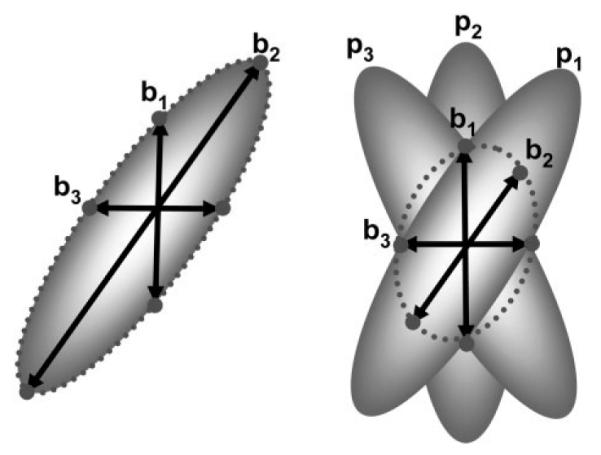
The effect of random subject rotation on tensor estimation. Let bi denote the applied diffusion encoding and let pi represent the tensor orientation, which depends on subject motion. In case of no motion, the estimated diffusion tensor (dotted line) is the same as the actual tensor (left). If there is rotational motion (right), the estimated tensor orientation will be different and the anisotropy will be lower than the actual values. The error in FA and orientation will depend on the severity of the motion and the pattern of orientation changes.
FIG. 2
FIG. 2
Flowchart of the reconstruction algorithm. Evaluation of the derivative of f(D,m) with respect to D(rρ) and m(rρ) can be carried out efficiently by using inverse and forward gridding, represented by FT1 and FT2.
FIG. 3
FIG. 3
The pulse sequence used for in vivo studies. The readout part consists of a single-shot spiral-in and an interleaved variable-density spiral-out acquisition. The spiral-in readout gives a low-resolution navigator image that can be used to estimate the amount of gross patient motion for each shot. In addition the navigator is used for coil sensitivity estimation, nonlinear phase correction, and the elimination of irreversibly corrupted k-space data. The variable-density spiral out readout makes up one interleaf of the final k-space data to form a high-resolution diffusion-weighted image.
FIG. 4
FIG. 4
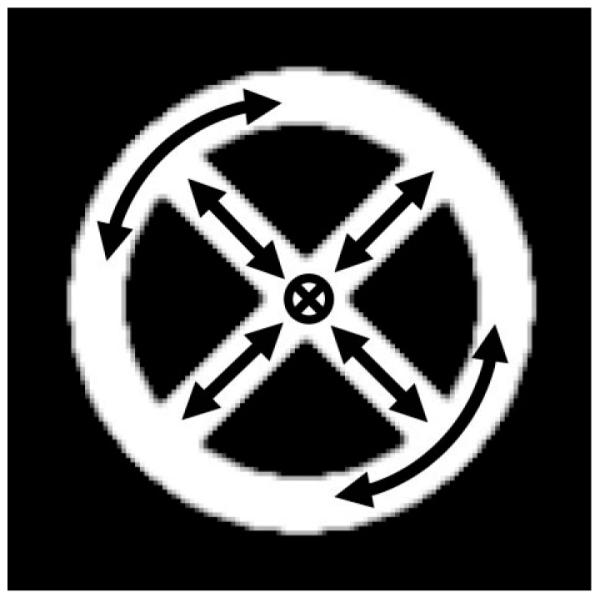
Phantom image used for computer simulations. The software phantom consists of a circular ring in which the major eigenvector of the diffusion tensor is oriented along the ring and four spokes in which the major eigenvector is oriented along the spoke (arrows). In the area where the spokes intersect, the major eigenvector is oriented out of the page. The FA value inside the phantom is 0.88.
FIG. 5
FIG. 5
The FA maps obtained from the computer simulations using the four reconstruction methods under several degrees of rotational motion and using EPI and spiral trajectories. All methods performed similar when no rotational motion was simulated (first and fourth rows). In the case of simulated rotational motion the FA maps reconstructed with methods A and B show misregistration and aliasing artifacts due to motion (e,f,i,j,q,r,u,v). These artifacts are partly reduced by the application of motion correction using method C; however, some residual artifacts still remain due to the uncorrected diffusion-encoding direction (g,k,s,w). These are removed successfully by the application of NLCG (method D), which gave a completely alias-free image (h,l,t,x).
FIG. 6
FIG. 6
Angular deviations of the major eigenvectors between reconstructed images and the reference image. If there was no simulated motion all methods performed similar (first and fourth rows). In the case of simulated motion direct reconstruction with no motion correction led to significant deviation (e,f,i,j,q,r,u,v). After the application of motion correction and reconstruction with CG-SENSE (method C) the orientation error decreased; however, some residual error remained because the change in diffusion-encoding direction was not taken into account (g,k,s,w). Motion and diffusion-encoding direction correction using NLCG significantly reduced orientation errors to ≈0.3° for all level of motion severity (fourth column).
FIG. 7
FIG. 7
The FA maps obtained from an in vivo experiment, reconstructed using the four different reconstruction methods. For all degrees of motion, images reconstructed with gridding alone leads to serious artifacts due to motion (a,e,i,m). For the case of negligible motion, reconstructions with motion correction and CG SENSE (method C) (c) and NLCG (method D) (d) give similar results compared to the image reconstructed with no motion correction (method B) (b). In the case of medium motion, motion correction with method C (g,k) removes most of the motion-related artifacts that are otherwise seen on the image reconstructed with method B (f,j). The application of method D (h) gives a similar FA map compared to method C (g) in the case of small motion. For moderate motion, some improvement in the FA map was observed by the application of method D (k,l). In the case of large motion the FA map obtained by the application of method D (p) has higher overall anisotropy compared to method C (o). Clearly, the image quality of CG-SENSE breaks down if no motion correction is applied (n).
FIG. 8
FIG. 8
The angular deviation maps between the major eigen-vectors corresponding to the reference data and to the four reconstruction schemes in the splenium of the corpus callosum. The map of the major eigenvector reconstructed with method C in the absence of motion was chosen to be the reference dataset. In the case of no motion the deviation between the eigenvectors reconstructed with NLCG and reference is on the order of 2° (first row). When there is subject motion, NLCG performs generally better than CG SENSE, as shown by the lower angular deviation from the reference (third and fourth columns).
FIG. 9
FIG. 9
Navigator images corresponding to 8 interleaves in a diffusion-weighted scan. Top row: before registration. Bottom row: after registration to a reference navigator image. The third interleaf shows significant signal loss due to motion during the application of diffusion-encoding gradients. Such k-space data can be detected and eliminated by determining a correlation coefficient value following the registration of the individual navigators with the reference navigator (third row). As a rejection threshold for a particular shot a correlation coefficient lower than the median correlation coefficient (over all navigators) –3 × standard deviations can be used.

References

    1. Moseley ME, Cohen Y, Mintorovitch J, Chileuitt L, Shimizu H, Kucharczyk J, Wendland MF, Weinstein PR. Early detection of regional cerebral ischemia in cats: comparison of diffusion and T2-weighted MRI and spectroscopy. Magn Reson Med. 1990;14:330–346. - PubMed
    1. Basser PJ, Mattiello J, LeBihan D. Estimation of the effective self-diffusion tensor from the NMR spin echo. J Magn Res Series B. 1994;103:247–254. - PubMed
    1. Pierpaoli C, Jezzard P, Basser PJ, Barnett A, Di Chiro G. Diffusion tensor MR imaging of the human brain. Radiology. 1996;201:637–648. - PubMed
    1. Bammer R, Keeling SL, Augustin M, Pruessmann KP, Wolf R, Stollberger R, Hartung HP, Fazekas F. Improved diffusion-weighted single-shot echo-planar imaging (EPI) in stroke using sensitivity encoding (SENSE) Magn Reson Med. 2001;46:548–554. - PubMed
    1. Anderson AW, Gore JC. Analysis and correction of motion artifacts in diffusion weighted imaging. Magn Reson Med. 1994;32:379–387. - PubMed

Publication types

MeSH terms

LinkOut - more resources