


Serum ferritin concentrations and body iron stores in a multicenter, multiethnic primary-care population
- PMID: 18429050
- PMCID: PMC3773165
- DOI: 10.1002/ajh.21179
Serum ferritin concentrations and body iron stores in a multicenter, multiethnic primary-care population
Abstract
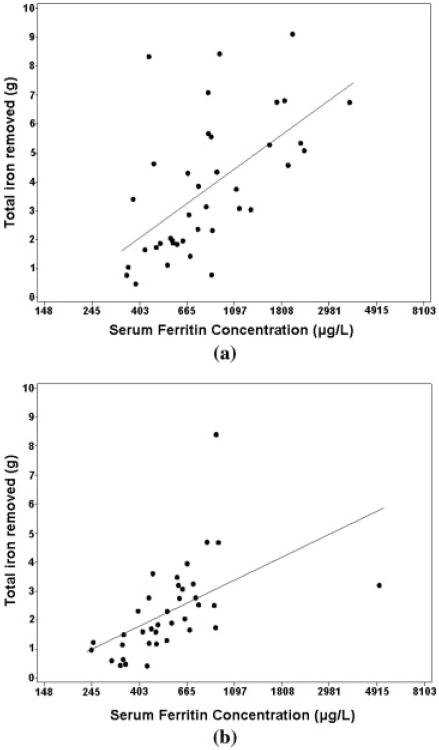
How often elevated serum ferritin in primary-care patients reflects increased iron stores (normally 0.8 g in men, 0.4 g in women) is not known. The Hereditary Hemochromatosis and Iron Overload Screening (HEIRS) study screened 101,168 primary-care participants (44% Caucasians, 27% African-Americans, 14% Asians/Pacific Islanders, 13% Hispanics, 2% others). Follow-up clinical evaluation was performed in 302 of 333 HFE C282Y homozygotes regardless of iron measures and 1,375 of 1,920 nonhomozygotes with serum ferritin >300 microg/L (men), >200 microg/L (women) and transferrin saturation >50% (men), >45% (women). Quantitative phlebotomy was conducted in 122 of 175 C282Y homozygotes and 122 of 1,102 nonhomozygotes with non-transfusional serum ferritin elevation at evaluation. The estimated prevalence in the Caucasian population of C282Y homozygotes with serum ferritin >900 microg/L at evaluation was 20 per 10,000 men and 4 per 10,000 women; this constellation was predictive of iron stores >4 g in men and >2 g in women. The estimated prevalence per 10,000 of non-C282Y homozygotes with serum ferritin >900 microg/L at evaluation was 7 among Caucasians, 13 among Hispanics, 20 among African Americans, and 38 among Asians and Pacific Islanders, and this constellation was predictive of iron stores >2 g but <4 g. In conclusion, serum ferritin >900 microg/L after initial elevations of both serum ferritin and transferrin saturation is predictive of mildly increased iron stores in multiple ethnic populations regardless of HFE genotype. Serum ferritin >900 microg/L in male C282Y homozygotes is predictive of moderately increased iron stores.
Copyright 2008 Wiley-Liss, Inc.
Figures
References
-
- Bothwell TH, Charlton RW, Cook JD, Finch CA. Iron Metabolism in Man. Oxford: Blackwell Scientific; 1979.
-
- Pootrakul P, Kitcharoen K, Yansukon P, et al. The effect of erythroid hyperplasia on iron balance. Blood. 1988;71:1124–1129. - PubMed
-
- Pietrangelo A. Hereditary hemochromatosis—A new look at an old disease. N Engl J Med. 2004;350:2383–2397. - PubMed
-
- Franchini M. Hereditary iron overload: update on pathophysiology, diagnosis, and treatment. Am J Hematol. 2006;81:202–209. review. - PubMed
-
- Feder JN, Gnirke A, Thomas W, et al. A novel MHC class I-like gene is mutated in patients with hereditary haemochromatosis. Nat Genet. 1996;13:399–408. - PubMed
Publication types
MeSH terms
Substances
Grants and funding
- N01-HC-05188/HC/NHLBI NIH HHS/United States
- N01 HC005192/HC/NHLBI NIH HHS/United States
- N01-HC-05186/HC/NHLBI NIH HHS/United States
- N01 HC005189/HL/NHLBI NIH HHS/United States
- R01-HL083328/HL/NHLBI NIH HHS/United States
- R01 HL083328/HL/NHLBI NIH HHS/United States
- N01-HC-05191/HC/NHLBI NIH HHS/United States
- N01 HC005191/HL/NHLBI NIH HHS/United States
- M01-RR000827/RR/NCRR NIH HHS/United States
- N01-HC-05189/HC/NHLBI NIH HHS/United States
- P30 CA062203/CA/NCI NIH HHS/United States
- N01 HC005185/HL/NHLBI NIH HHS/United States
- UH1 HL003679/HL/NHLBI NIH HHS/United States
- N01-HC-05190/HC/NHLBI NIH HHS/United States
- M01-RR10284/RR/NCRR NIH HHS/United States
- UH1-HL03679-05/HL/NHLBI NIH HHS/United States
- M01 RR010284/RR/NCRR NIH HHS/United States
- M01 RR000032/RR/NCRR NIH HHS/United States
- N01 HC005188/HL/NHLBI NIH HHS/United States
- M01 RR000827/RR/NCRR NIH HHS/United States
- N01 HC005186/HL/NHLBI NIH HHS/United States
- N01-HC-05185/HC/NHLBI NIH HHS/United States
- M01-RR00032/RR/NCRR NIH HHS/United States
- N01 HC005190/HL/NHLBI NIH HHS/United States
LinkOut - more resources
Full Text Sources
Medical