Review
. 2008 Jul;99(7):1293-303.
doi: 10.1111/j.1349-7006.2008.00825.x. Epub 2008 Apr 22.

Endosomal sorting complex required for transport proteins in cancer pathogenesis, vesicular transport, and non-endosomal functions

Affiliations
Review

Endosomal sorting complex required for transport proteins in cancer pathogenesis, vesicular transport, and non-endosomal functions

Nobuyuki Tanaka et al. Cancer Sci. 2008 Jul.

Abstract

Endosomal sorting complex required for transport (ESCRT) proteins form a multicomplex sorting machinery that controls multivesicular body (MVB) formation and the sorting of ubiquitinated membrane proteins to the endosomes. Being sorted to the MVB generally results in the lysosome-dependent degradation of cell-surface receptors, and defects in this machinery induce dysregulated receptor traffic and turnover. Recent lessons from gene targeting and silencing methodologies have implicated the ESCRT in normal development, cell differentiation, and growth, as well as in the budding of certain enveloped viruses. Furthermore, it is becoming apparent that the dysregulation of ESCRT proteins is involved in the development of various human diseases, including many types of cancers and neurodegenerative disorders. Here, we summarize the roles of ESCRT proteins in MVB sorting processes and the regulation of tumor cells, and we discuss some of their other functions that are unrelated to vesicular transport.


Figures
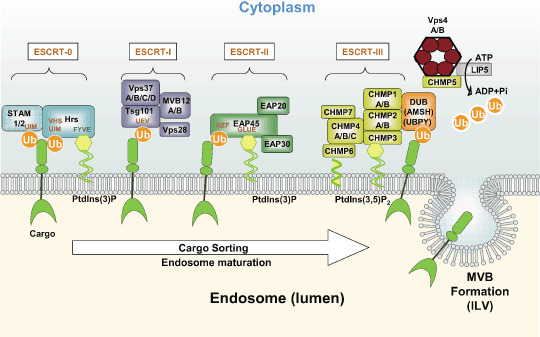
Figure 1
Figure 1
Schematic showing the functions of endosomal sorting complex required for transport (ESCRT) and ESCRT‐related proteins in endosomal sorting of ubiquitinated membrane proteins (cargo). Ubiquitinated cargo is recognized by the ESCRT‐0 complex by binding of the ubiquitin‐interacting motif (UIM) and vacuolar protein sorting (Vps) 27‐hepatocyte‐growth factor‐regulated growth factor substrate (Hrs)‐signal transducing adaptor molecule (STAM) (VHS) domains of STAM and Hrs, respectively. Hrs is anchored to the endosomal surface by the FYVE–PtdIns3P interaction. Cargo is then handed off to the ESCRT‐I complex, which is recruited via Tsg101's ubiquitin E2 variant (UEV) domain. ESCRT‐I (Tsg101) also has an affinity for ESCRT‐0 (Hrs; this interaction is not indicated in the figure). Likewise, ESCRT‐II is recruited by the Vps28–EAP45 interaction, and the Npl4‐type zinc finger (NZF)–ubiquitin (Ub) interaction. The GLUE domain is involved in the membrane binding of ESCRT‐II via PtdIns3P. ESCRT‐III associates with the membrane via the myristoylation of charged multivesicular body protein (CHMP) 6, and the association of CHMP3 with PtdIns3,5P2. ESCRT‐III is thought to be assembled on membranes as a heteromultimer. In the final steps of sorting, ubiquitins are removed from the cargo by the deubiquitinating enzymes (DUB), including association molecule with the SH3 domains of STAM (AMSH) and ubiquitin‐specific peptidase Y (UPBY), and the ESCRT complexes are dissociated by the ATPase activity of Vps4. The Vps4 complex is composed of a Vps4A–Vps4B heteromer that associates with LIP5. Deubiquitinated cargo is carried with the invaginating membrane into the multivesicular body (MVB) lumen and are thereby relocated in intraluminal vesicles (ILV). However, the requirement for deubiquitination at the end of sorting is still controversial. Not all known protein–protein interactions are indicated in the figure.
Figure 2
Figure 2
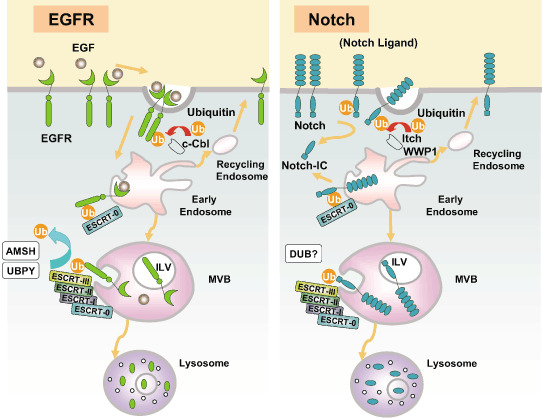
Endocytosis, endosomal sorting, and lysosome‐dependent degradation of epidermal growth factor receptor (EGFR) (left) and Notch (right). (Left) Stimulation of EGFR with epidermal growth factor (EGF) induces the activation and phosphorylation of EGFR. Ubiquitin ligases (E3) including c‐Cbl associate with the intracytoplasmic region of EGFR, which then ubiquitinates EGFR on multiple lysine residues (Ub indicates a single ubiquitin moiety attached to the EGFR). Ubiquitinated EGFR is internalized and transported to the early endosomes. Endosomal sorting complex required for transport (ESCRT)‐0 recognizes the ubiquitinated EGFR and recruits the downstream complex ESCRT‐I. (At this point, EGFR can still deliver a signal, but the signal seems to be terminated by the sequestration of the activated EGFR into the intraluminal vesicles [ILV] of the multivesicular bodies [MVB] later in the process.) The ubiquitinated EGFR is transferred to ESCRT‐II, and then to ESCRT‐III. EGFR is deubiquitinated by association molecule with the SH3 domains of STAM (AMSH) and ubiquitin‐specific peptidase Y (UBPY). The ESCRT complexes are then dissociated, and EGFR is sorted into the ILV within the MVB. Fusion of the MVB with the lysosome results in the degradation of EGFR and other MVB contents in an acid peptidase‐dependent manner. On early endosomes, some of the EGFR is deubiquitinated by UBPY and AMSH (not shown), sorted into the tubular portion of the endosomes, and recycled back to the cell surface via recycling endosomes. (Right) Notch heading for the endosome is ubiquitinated by E3 including Itch (AIP4 in human and Su[dx] in Drosophila) and WWP1, and internalized. ESCRT‐0 captures the ubiquitinated Notch, and it is handed off to ESCRT‐I, ‐II, and ‐III sequentially. Notch that is sorted into the ILV is degraded by the lysosomal acid peptidase. The Notch cellular domain (Notch‐IC) can be produced by proteolysis at the cell surface as well as on the endosomes.
Figure 3
Figure 3
Endosomal sorting complex required for transport (ESCRT) recruitment in multivesicular body (MVB) sorting and cytokinesis. Tsg101 (ESCRT‐I) and Alix are recruited to specialized sites on the membrane by their association with hepatocyte‐growth factor‐regulated growth factor substrate (Hrs) and CEP55, respectively, to carry out similar roles in the terminal membrane fission events of MVB biogenesis and cytokinesis.( 105 ) ESCRT‐III is further recruited by the interactions shown in the figure, and assembled to fulfill its functions by cooperating with vacuolar protein sorting (Vps) A and B.

References

    1. Gruenberg J, Stenmark H. The biogenesis of multivesicular endosomes. Nat Rev Mol Cell Biol 2004; 5: 317–23. - PubMed
    1. Babst M. A protein's final ESCRT. Traffic 2005; 6: 2–9. - PubMed
    1. Luzio JP, Rous BA, Bright NA, Pryor PR, Mullock BM, Piper RC. Lysosome–endosome fusion and lysosome biogenesis. J Cell Sci 2000; 113: 1515–24. - PubMed
    1. Van Der Goot FG, Gruenberg J. Oiling the wheels of the endocytic pathway. Trends Cell Biol 2002; 12: 296–9. - PubMed
    1. Murk JL, Humbel BM, Ziese U et al . Endosomal compartmentalization in three dimensions: implications for membrane fusion. Proc Natl Acad Sci USA 2003; 100: 13 332–7. - PMC - PubMed

Publication types

MeSH terms