Prostate cancer: is inapparent tumor at endorectal MR and MR spectroscopic imaging a favorable prognostic finding in patients who select active surveillance?
- PMID: 18430877
- PMCID: PMC3705558
- DOI: 10.1148/radiol.2472070770
Prostate cancer: is inapparent tumor at endorectal MR and MR spectroscopic imaging a favorable prognostic finding in patients who select active surveillance?
Abstract
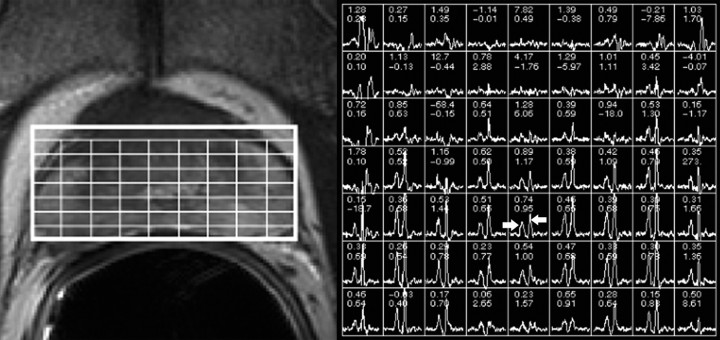
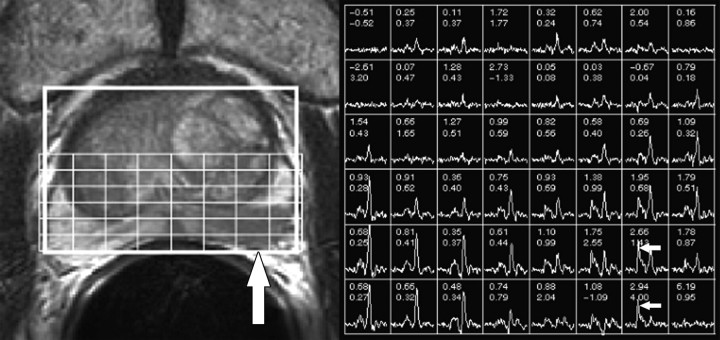
Purpose: To retrospectively determine whether inapparent tumor at endorectal magnetic resonance (MR) imaging and MR spectroscopic imaging is a favorable prognostic finding in prostate cancer patients who select active surveillance for management.
Materials and methods: Committee on Human Research approval was obtained and compliance with HIPAA regulations was observed, with waiver of requirement for written consent. Ninety-two men (mean age, 64 years; range, 43-85 years) were retrospectively identified who had biopsy-proved prostate cancer, who had undergone baseline endorectal MR imaging and MR spectroscopic imaging, and who had selected active surveillance for management. Their mean baseline serum prostate-specific antigen (PSA) level was 5.5 ng/mL, and the median Gleason score was 6. Two readers with 10 and 3 years of experience independently reviewed all MR images and determined whether tumor was apparent on the basis of evaluation of established morphologic and metabolic findings. Another investigator compiled data about baseline clinical stage, biopsy findings, and serum PSA measurements. Multiple logistic regression analysis was used to investigate the relationship between the clinical parameters and tumor apparency at MR imaging and the biochemical outcome.
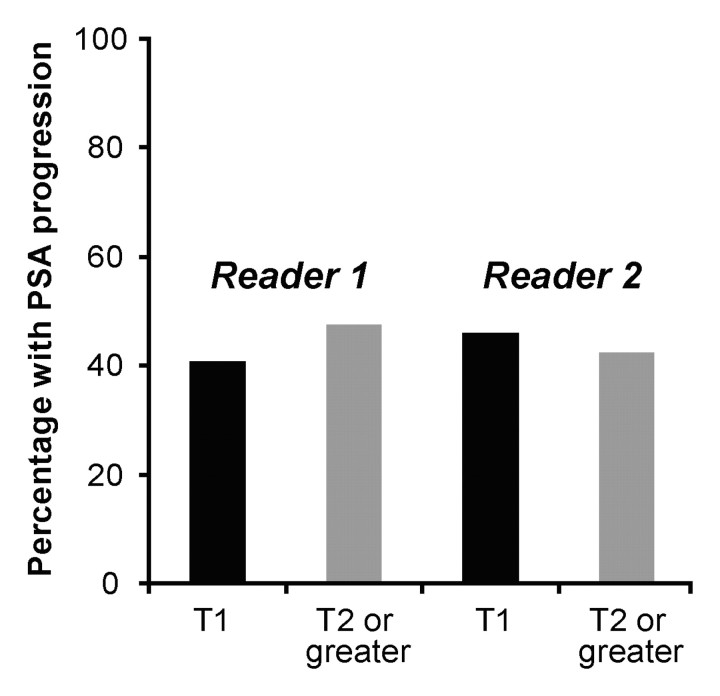
Results: At baseline MR imaging, readers 1 and 2 considered 54 and 26 patients, respectively, to have inapparent tumor (fair interobserver agreement; kappa = 0.30). During a mean follow-up of 4.8 years, 52 patients had a stable PSA level and 40 had an increasing PSA level. In multivariate analysis, no significant association was found between the baseline clinical stage, Gleason score, serum PSA level, or the presence of apparent tumor at endorectal MR imaging and MR spectroscopic imaging for either reader and the biochemical outcome (P > .05 for all).
Conclusion: Endorectal MR imaging and MR spectroscopic imaging findings of tumor apparency or inapparency in prostate cancer patients who select active surveillance for management do not appear to be of prognostic value.
(c) RSNA, 2008.
Figures
References
-
- Sakr WA, Grignon DJ. Prostate cancer: indicators of aggressiveness. Eur Urol 1997;32(suppl 3):15–23. - PubMed
-
- Kattan MW, Eastham JA, Wheeler TM, et al. Counseling men with prostate cancer: a nomogram for predicting the presence of small, moderately differentiated, confined tumors. J Urol 2003;170:1792–1797. - PubMed
-
- Wu H, Sun L, Moul JW, et al. Watchful waiting and factors predictive of secondary treatment of localized prostate cancer. J Urol 2004;171:1111–1116. - PubMed
-
- Liebross RH, Pollack A, Lankford SP, von Eschenbach AC, Zagars GK. Relationship of ultrasound staging and bilateral biopsy positivity to outcome in stage T1c prostate cancer treated with radiotherapy. Urology 1998;52:647–652. - PubMed
-
- Philip J, Dutta Roy S, Ballal M, Foster CS, Javlé P. Is a digital rectal examination necessary in the diagnosis and clinical staging of early prostate cancer? BJU Int 2005;95:969–971. - PubMed
Publication types
MeSH terms
Grants and funding
LinkOut - more resources
Full Text Sources
Medical
Research Materials
Miscellaneous