


doi: 10.1093/genetics/178.4.1839.
Paramutation: epigenetic instructions passed across generations
Affiliations
- PMID: 18430919
- PMCID: PMC2323780
- DOI: 10.1093/genetics/178.4.1839
Item in Clipboard
Paramutation: epigenetic instructions passed across generations
Genetics.
2008 Apr.
No abstract available
Figures
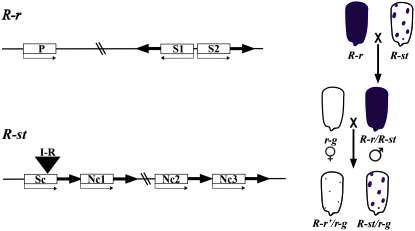
Paramutation at r1. The structures of the paramutable (R-r) and paramutagenic (R-st) alleles are diagrammed as well as the crosses and phenotypes used to monitor paramutation. The open boxes represent the r1 genes with the small arrows indicating the direction of transcription: P stands for plant and is a gene expressed in vegetative plant tissues; S1 and S2 are two genes expressed in the seed that are organized in an inverted repeat; Sc stands for self-color and is the most highly expressed gene in the R-st complex; Nc1–Nc3 stand for near colorless, three r1 genes that are expressed at low levels in R-st. I-R indicates the transposable element inserted into Sc, which is responsible for the spotted phenotype. The thick arrows in R-st represent the large repeats spanning the r1 genes. Only the repeats associated with the coding regions are shown. There are additional small, related sequences related to transposable elements that are not diagrammed, but are described in detail with primary references cited in Chandler et al. (2000). A comprehensive list of r1 haplotypes with their tissue-specific expression patterns and paramutation properties can be found in Neuffer et al. (1997).
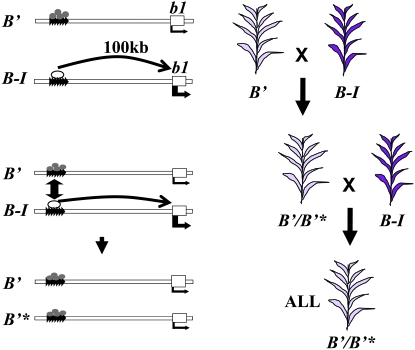
Paramutation at b1. The paramutable (B-I) and paramutagenic (B′) epialleles have identical DNA sequences, but distinct chromatin structures represented by different proteins (circles) associated with the seven tandem repeats (arrowheads) that mediate paramutation and are located 100 kbp upstream of the coding region (open box). The arrows below the gene boxes indicate the direction of transcription and the thickness of the arrows indicate the relative transcription levels observed with the two epialleles. The crosses and phenotypes used to monitor paramutation are diagrammed with B′*, indicating a B′ allele that was B-I in the previous generation. B′ and B′* are indistinguishable in their ability to paramutate B-I.
References
-
- Alleman, M., and J. Doctor, 2000. Genomic imprinting in plants: observations and evolutionary implications. Plant Mol. Biol. 43 147–161. - PubMed
-
- Alleman, M., L. Sidorenko, K. McGinnis, V. Seshadri, J. E. Dorweiler et al., 2006. An RNA-dependent RNA polymerase is required for paramutation in maize. Nature 442 295–298. - PubMed
-
- Brink, R. A., 1973. Paramutation. Annu. Rev. Genet. 7 129–152. - PubMed
Publication types
MeSH terms
Substances
LinkOut - more resources
Full Text Sources
