. 2008;9(2):521-7.
doi: 10.1208/s12249-008-9072-6. Epub 2008 Apr 2.

Embryonic chicken trachea as a new in vitro model for the investigation of mucociliary particle clearance in the airways

Affiliations

Embryonic chicken trachea as a new in vitro model for the investigation of mucociliary particle clearance in the airways

A Henning et al. AAPS PharmSciTech. 2008.

Abstract

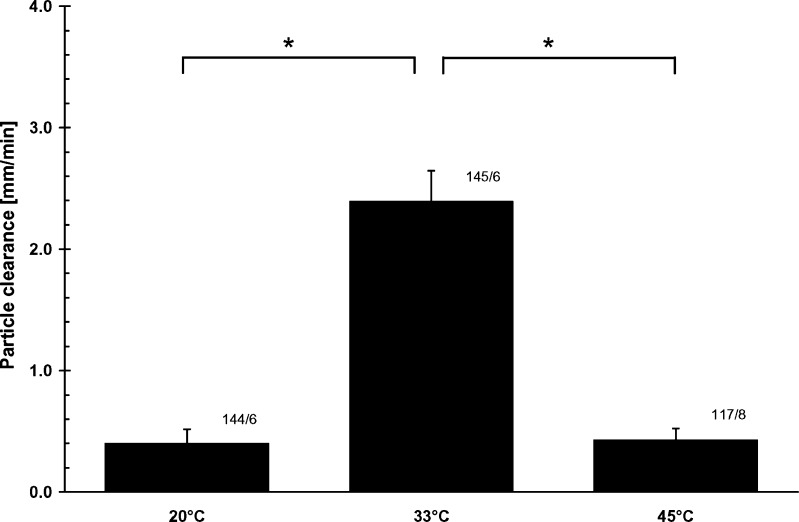
Mucociliary clearance (MC) is an important defense mechanism of the respiratory system to eliminate inhaled and possibly noxious particles from the lung. Although the principal mechanics of MC seem to be relatively clear there are still open questions regarding the long-term clearance of particles. Therefore, we have developed a new set-up based on embryonic chicken trachea (ECT) to investigate mucociliary particle clearance in more detail. ECT was placed in an incubation chamber after carbon particles were applied and tracked using optical microscopy. The aim of the study was to validate this model by investigating the impact of temperature, humidity and drugs on particle transport rates. Particles were transported reproducibly along the trachea and clearance velocity (2.39 +/- 0.25) mm/min was found to be in accordance to data reported in literature. Variation in temperature resulted in significantly reduced MC: (0.40 +/- 0.12) mm/min (20 degrees C); (0.42 +/- 0.10) mm/min (45 degrees C). Decreasing humidity (99-60%) had no significant effect on MC, whereas reduction to 20% humidity showed a significant influence on particle clearance. The use of different cilio- and muco-active drugs (propranolol, terbutalin, N-acetylcysteine) resulted in altered MC according to the pharmacological effect of the substances: a concentration dependent decrease of MC was found for Propranolol. From our results we conclude that this model can be employed to investigate MC of particles in more detail. Hence, the model may help to understand and identify decisive physico-chemical parameters for MC and to answer open questions regarding the long-term clearance phenomenon.


Figures
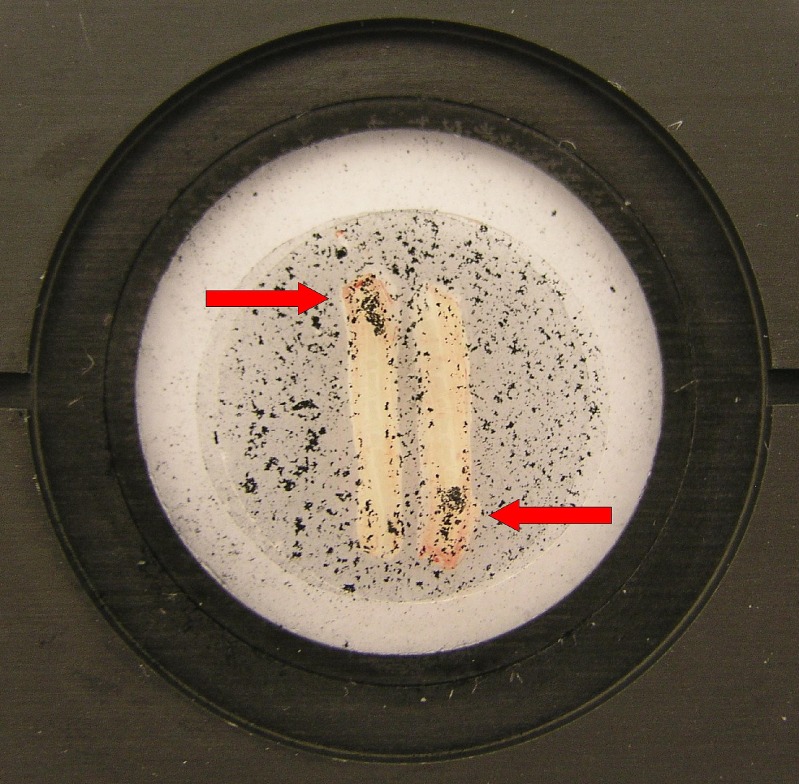
Fig. 1
Fig. 1
Tracheal half-pipes in the incubation chamber. Proof of principle experiment: Particles are transported into different but uniquely proximal direction after turning one of the tracheal half-pipes by 180°
Fig. 2
Fig. 2
Influence of temperature on mucociliary particle transport rates. Decreased (20 °C) as well as increased (45 °C) temperature resulted in significant reduction of particle transport rates. Numbers beside the bars e.g. “100/6” represent 100 particles tracked on six tracheas
Fig. 3
Fig. 3
Influence of drugs on mucociliary particle transport rates. Clearance velocity under influence of drugs was significantly changed. Terbutalin (1%) increased transport rates, whereas N-acetylcysteine (1%) and Propranolol (0.01%) reduced mucociliary particle clearance. Influence of Propranolol (0.1%) and Propranolol (1%) totally inhibited particle transport. Numbers beside the bars e.g. “100/6” represent 100 particles tracked on six tracheas
Fig. 4
Fig. 4
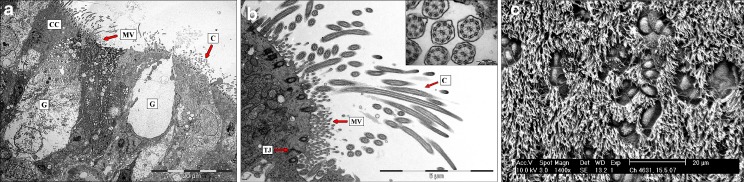
a TEM image (overview) of tracheal epithelium cross sections. CC Ciliated cells, C cilia, MV microvilli, G goblet cells. ECT morphology was found to be comparable to human tracheal tissue—all structures essentially required for mucociliary clearance are present. b TEM image of tracheal epithelium and cilia cross sections. C Cilia, MV microvilli, TJ tight junction complexes. ECT morphology was found to be comparable to human tracheal tissue—all structures essentially required for mucociliary clearance are present. Cilia ultrastructure exhibits normal (9*2 + 2) arrangement of the central axoneme—a bundle of microtubules arranged as nine outer doublets and one central pair. c SEM image of ciliated epithelium. Cilia length (5–7 μm) and cilia density was found to be comparable to the human airway epithelium. Mucus producing goblet cells are present and exhibit characteristic morphology
Fig. 5
Fig. 5
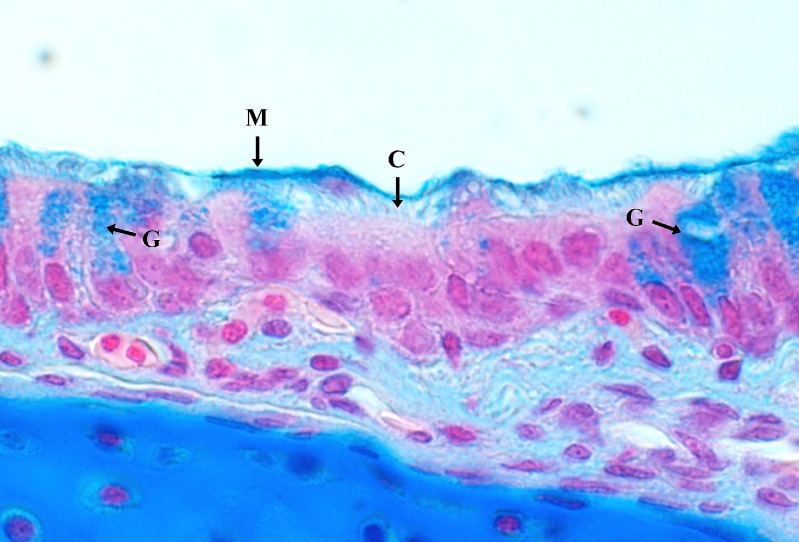
Alcian blue staining of paraffin embedded tracheal tissue. A mucus layer (M) and goblet cells (G) are present and exhibit characteristic staining. Cilia (C) on ciliated cells. (×100, cross section)

References

    1. Corkery K. Inhalable drugs for systemic therapy. Resp. Care. 2000;45(7):831–835. - PubMed
    1. Oberdörster G., Oberdörster E., Oberdörster J. Nanotoxicology: an emerging discipline evolving from studies of ultrafine particles. Environ. Health Persp. 2005;113(7):823–839. doi: 10.1289/ehp.7339. - DOI - PMC - PubMed
    1. Groneberg D. A., Witt C., Wagner U., Chung K. F., Fischer A. Fundamentals of pulmonary drug delivery. Resp. Med. 2003;97(4):382–387. doi: 10.1053/rmed.2002.1457. - DOI - PubMed
    1. Brand P., Rieger C., Beinert T., Heyder J. Aerosol derived airway morphometry in healthy subjects. Eur. Resp. J. 1995;8(10):1639–1646. doi: 10.1183/09031936.95.08101639. - DOI - PubMed
    1. Scheuch G., Gebhart J., Heigwer G., Stahlhofen W. New device for human inhalation studies with small aerosol boluses. J. Aerosol Sci. 1989;20(8):1293–1296. doi: 10.1016/0021-8502(89)90820-3. - DOI

Publication types

MeSH terms

LinkOut - more resources