Psychiatric morbidity in survivors of the acute respiratory distress syndrome: a systematic review
- PMID: 18434495
- PMCID: PMC10885706
- DOI: 10.1097/PSY.0b013e31816aa0dd
Psychiatric morbidity in survivors of the acute respiratory distress syndrome: a systematic review
Abstract
Objective: Acute lung injury (ALI), including its more severe subcategory, acute respiratory distress syndrome (ARDS), is a critical illness associated with considerable morbidity and mortality. Our objective was to summarize data on the prevalence of depressive, posttraumatic stress disorder (PTSD), and other anxiety syndromes amongst survivors of ALI/ARDS, potential risk factors for these syndromes, and their relationships to quality of life.
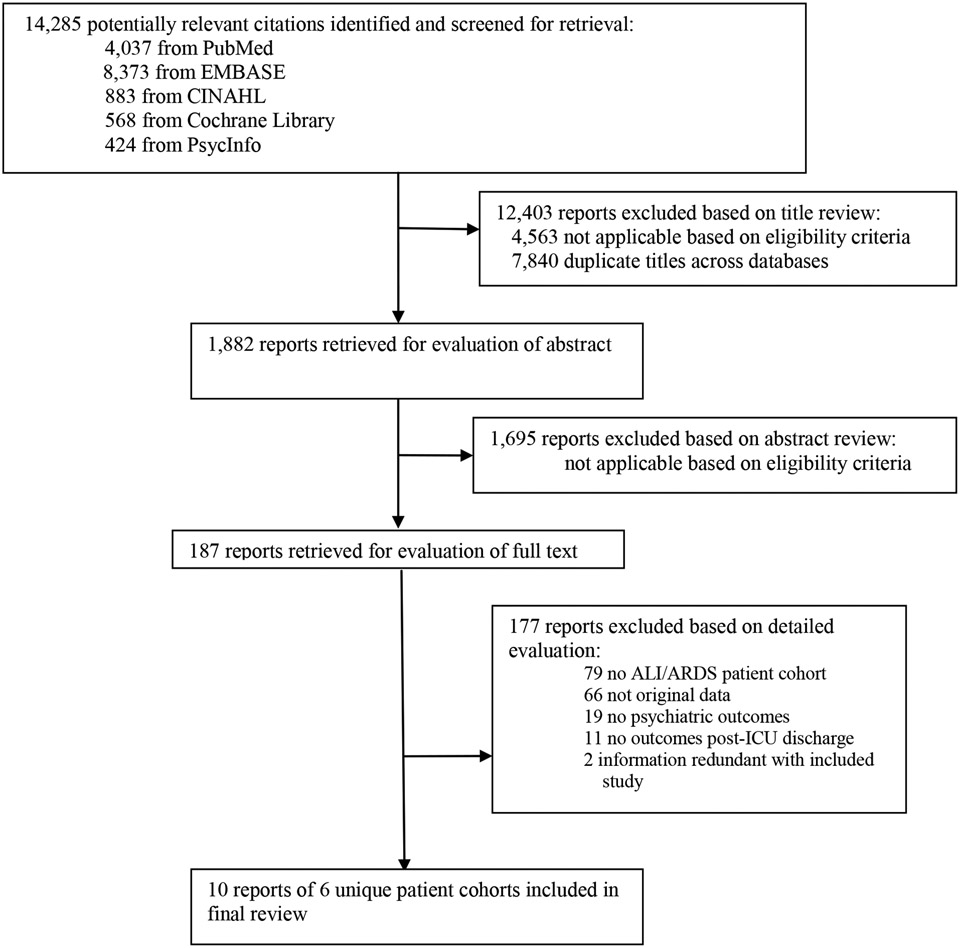
Methods: We conducted a systematic literature review using Medline, EMBASE, Cochrane Library, CINAHL, and PsycINFO. Eligible studies reported data on psychiatric morbidity at least once after intensive care treatment of ALI/ARDS.
Results: Ten observational studies met inclusion criteria (total n = 331). Using questionnaires, the point prevalence of "clinically significant" symptoms of depression ranged from 17% to 43% (4 studies); PTSD, 21% to 35% (4 studies); and nonspecific anxiety, 23% to 48% (3 studies). Studies varied in terms of instruments used, thresholds for clinical significance, baseline psychiatric history exclusions, and timing of assessments (range = 1 month to 8 years). Psychiatrist-diagnosed PTSD prevalence at hospital discharge, 5 years, and 8 years were 44%, 25%, and 24%, respectively. Three studies prospectively assessed risk factors for post-ALI/ARDS PTSD and depressive symptoms; significant predictors included longer durations of mechanical ventilation, intensive care unit stay, and sedation. All four studies that examined relationships between psychiatric symptoms and quality of life found significant negative associations.
Conclusions: The prevalence of psychiatric morbidity in patients surviving ARDS seems high. Future research should incorporate more in-depth diagnostic and risk factor assessments for prevention and monitoring purposes.
Figures
References
-
- Rubenfeld GD, Caldwell E, Peabody E, Weaver J, Martin DP, Neff M, Stern EJ, Hudson LD. Incidence and outcomes of acute lung injury. N Engl J Med 2005;353:1685–1693. - PubMed
-
- Fan E, Needham DM, Stewart TE. Ventilatory management of acute lung injury and acute respiratory distress syndrome. JAMA 2005;294:2889–2896. - PubMed
-
- Milberg JA, Davis DR, Steinberg KP, Hudson LD. Improved survival of patients with acute respiratory distress syndrome (ARDS): 1983-1993. JAMA 1995;273:306–309. - PubMed
-
- Dowdy DW, Eid MP, Dennison CR, Mendez-Tellez PA, Herridge MS, Guallar E, Pronovost PJ, Needham DM. Quality of life after acute respiratory distress syndrome: a meta-analysis. Intensive Care Med 2006;32:1115–1124. - PubMed
-
- Herridge MS, Cheung AM, Tansey CM, Matte-Martyn A, Diaz-Granados N, Al-Saidi F, Cooper AB, Guest CB, Mazer CD, Mehta S, Stewart TE, Barr A, Cook D, Slutsky AS. One-year outcomes in survivors of the acute respiratory distress syndrome. N Eng J Med 2003;348:683–693. - PubMed
Publication types
MeSH terms
Grants and funding
LinkOut - more resources
Full Text Sources
Medical
Miscellaneous