


Perceptual decisions between multiple directions of visual motion
- PMID: 18434522
- PMCID: PMC6670944
- DOI: 10.1523/JNEUROSCI.5564-07.2008
Perceptual decisions between multiple directions of visual motion
Abstract
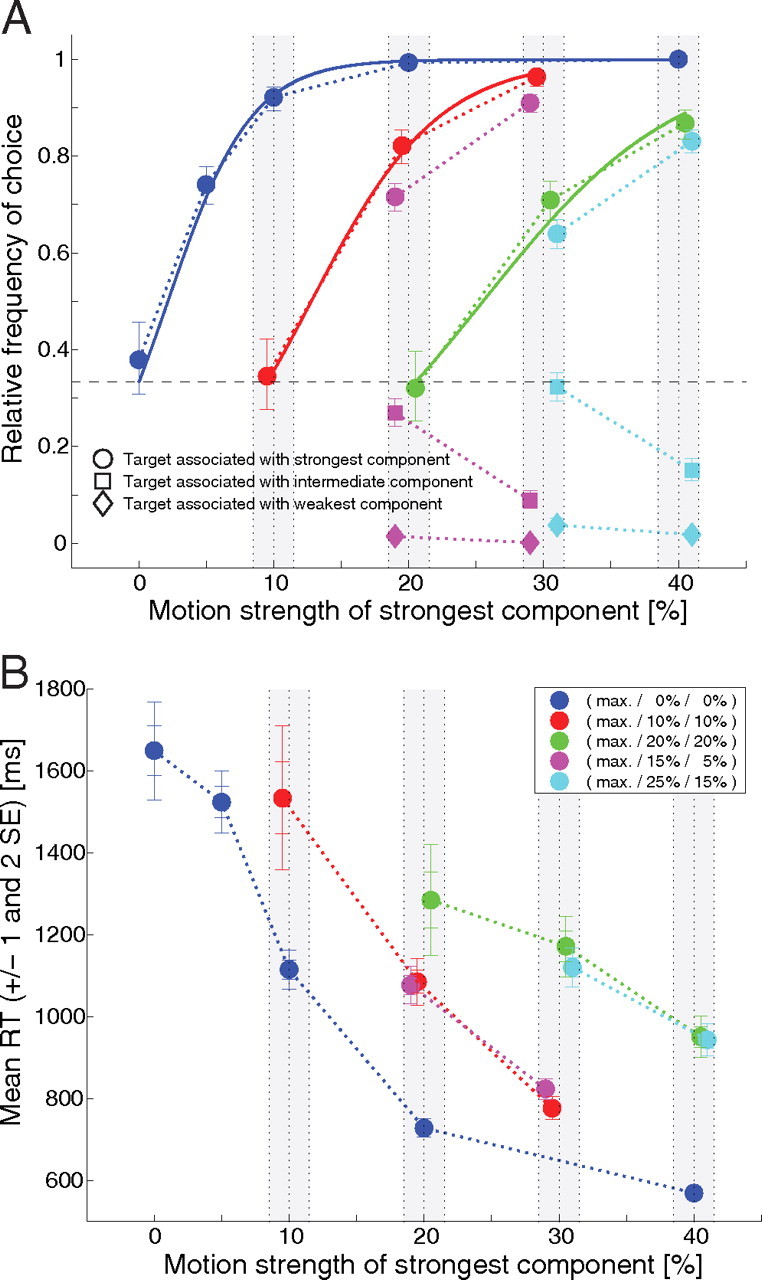
Previous studies and models of perceptual decision making have largely focused on binary choices. However, we often have to choose from multiple alternatives. To study the neural mechanisms underlying multialternative decision making, we have asked human subjects to make perceptual decisions between multiple possible directions of visual motion. Using a multicomponent version of the random-dot stimulus, we were able to control experimentally how much sensory evidence we wanted to provide for each of the possible alternatives. We demonstrate that this task provides a rich quantitative dataset for multialternative decision making, spanning a wide range of accuracy levels and mean response times. We further present a computational model that can explain the structure of our behavioral dataset. It is based on the idea of a race between multiple integrators to a decision threshold. Each of these integrators accumulates net sensory evidence for a particular choice, provided by linear combinations of the activities of decision-relevant pools of sensory neurons.
Figures



References
-
- Albright TD. Direction and orientation selectivity of neurons in visual area MT of the macaque. J Neurophysiol. 1984;52:1106–1130. - PubMed
-
- Bogacz R, Gurney K. The basal ganglia and cortex implement optimal decision making between alternative actions. Neural Comput. 2007;19:442–477. - PubMed
-
- Bogacz R, Brown E, Moehlis J, Holmes P, Cohen JD. The physics of optimal decision making: a formal analysis of models of performance in two-alternative forced-choice tasks. Psychol Rev. 2006;113:700–765. - PubMed
-
- Brainard DH. The psychophysics toolbox. Spat Vis. 1997;10:433–436. - PubMed
Publication types
MeSH terms
LinkOut - more resources
Full Text Sources
