Review
. 2008 Jun;152(3):406-14.
doi: 10.1111/j.1365-2249.2008.03659.x. Epub 2008 Apr 24.

Establishing humanized mice using stem cells: maximizing the potential

Affiliations
Review

Establishing humanized mice using stem cells: maximizing the potential

D Bernard et al. Clin Exp Immunol. 2008 Jun.

Abstract

Studies on physiology and pathology as they relate to the immune system draw heavily upon rodent models. With the increasing impetus provided by initiatives in translational medicine, the demand for ever more sophisticated, 'humanized' murine models is greater than ever. However, the design and implementation of studies in such mice is far from trivial. Here we provide a technical perspective on the increasing interest in developing humanized mice. We give examples of primary data starting with the routine procurement of human donor material, through CD34(+) cell purification prior to engraftment to injection into immunocompromised mice. Our goal is to provide practical advice to the many investigators who may be commencing or considering such studies.


Figures
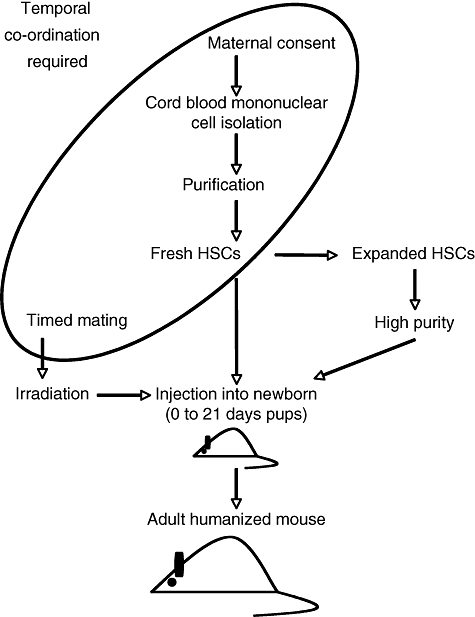
Fig. 1
Fig. 1
Temporal coordination of steps to obtain humanized mice. Schematic showing the organizational challenges in obtaining cord blood from elective Caesarean sections and obtaining and using haematopoietic stem cells to reconstitute newborn pups in order to obtain humanized adult mice. HSC, haematopoietic stem cell.
Fig. 2
Fig. 2
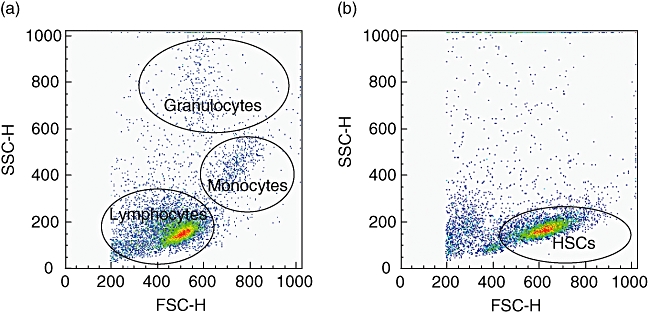
Human CD34+ cells do not share the same size and internal complexity patterns as lymphocytes. Typical forward-scatter (FSC) and side-scatter (SSC) density plot of umbilical cord blood mononuclear cells before immunomagnetic enrichment, showing lymphocytes, monocytes and granulocytes. Here, the number of haematopoietic stem cells (HSCs) is too low to allow their direct detection (a). FSC and SSC density plot of human HSCs from the positive fraction after CD34 immunomagnetic enrichment using the AutoMACS apparatus. The lymphocytes and granulocytes are almost entirely depleted (a).
Fig. 3
Fig. 3
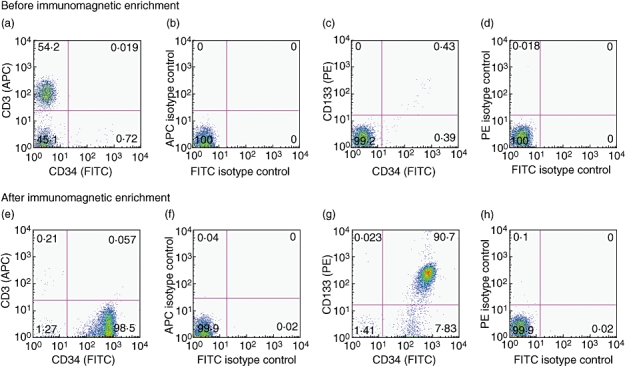
Immunomagnetic enrichment provides a good purification of CD34+ as well as CD133+ cells and depletes the CD3+ subset. Flow cytometry expression dot plots representing CD34, CD133 and CD3 surface expression before and after immunomagnetic enrichment. The numbers shown in quadrants are mean percentages. Expression of CD34 and CD3 antigens on umbilical cord blood mononuclear cells (a) and relevant isotype controls (b). Expression of CD34 and CD133 antigens on UCB mononuclear cells (c) and relevant isotype controls (d). Expression of CD34 and CD3 antigens on haematopoietic stem cells of the positive fraction following a Posseld2 immunomagnetic purification programme (e) and relevant isotype controls (f). Expression of CD34 and CD133 antigens on HSCs of the positive fraction after immunomagnetic enrichment (g) and relevant isotype controls (h). APC, antigen-presenting cell; FITC, fluorescein isothiocyanate; PE, phycoerythrin.
Fig. 4
Fig. 4
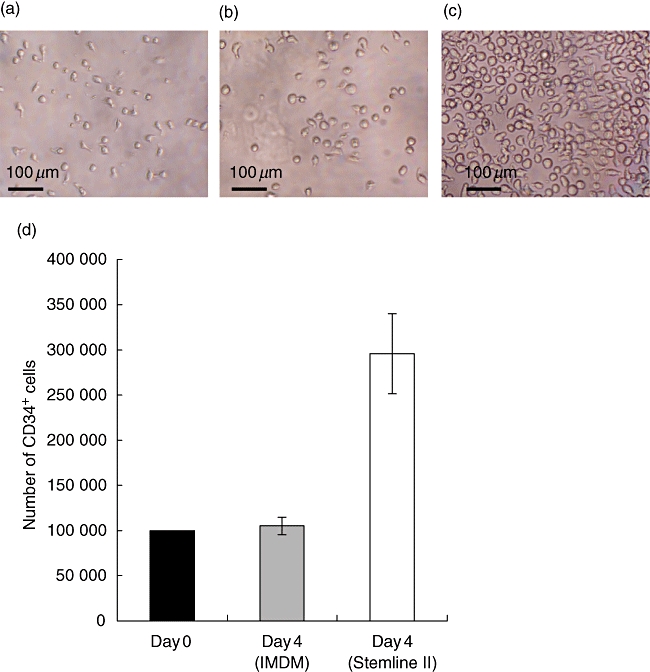
Ex vivo expansion of purified human CD34+ umbilical cord blood cells: comparison between Iscove's modified Dulbecco's medium (IMDM) and Stemline II media. Liquid culture of human CD34+ haematopoietic stem cells over 4 days in IMDM and Stemline II media stimulated with recombinant human Flk-2 ligand recombinant human thrombopoietin (10 μg/ml) and recombinant human stem cell factor (20 μg/ml). Photomicrograph of fresh CD34+ progenitors (concentration: 100 000 cells/ml). Bar represents 100 μm (a). Photomicrographs of the same CD34+ stem cells after 4 days in culture in IMDM (b) and Stemline II (c) media, both supplemented with cytokines. Cells growing in IMDM show a very low expansion after 4 days. On the contrary, CD34+ progenitors expend at least three times in Stemline II medium supplemented with the same cytokine cocktail. Histogram shows data from four different cord blood samples, showing the average number of CD34+ cells and corresponding standard deviation (d). Day 0 (▪), day 4 using IMDM (formula image) and day 4 using Stemline II (□).
Fig. 5
Fig. 5
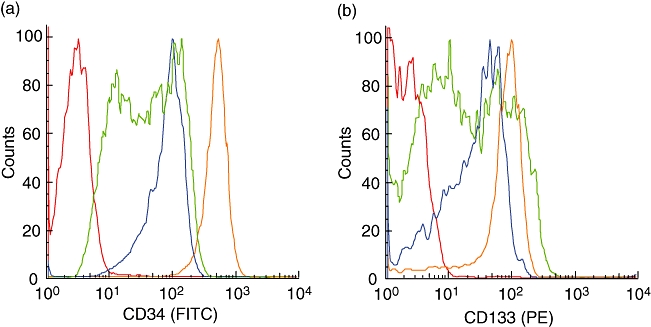
CD34+ cells difference of expression of CD34 and CD133 antigens after using Iscove's modified Dulbecco's medium (IMDM) or Stemline II media during 4 days of culture. Flow cytometry histograms. (a) Comparison of CD34 expression between fresh CD34+ cells (formula image), CD34+ after 4 days in IMDM medium (formula image) and CD34+ after 4 days in Stemline II medium (formula image). Isotype control (formula image). (b) Comparison of CD133 expression between fresh CD34+ cells (formula image), CD34+ after 4 days in IMDM medium (formula image) and CD34+ after 4 days in Stemline II medium (formula image). Isotype control (formula image). FITC, fluorescein isothiocyanate; PE, phycoerythrin.

References

    1. Serreze DV, Chen YG. Of mice and men: use of animal models to identify possible interventions for the prevention of autoimmune type 1 diabetes in humans. Trends Immunol. 2005;26:603–7. - PubMed
    1. Roep BO, Atkinson M. Animal models have little to teach us about type 1 diabetes: 1. In support of this proposal. Diabetologia. 2004;47:1650–6. - PubMed
    1. Roep BO, Atkinson M, von Herrath M. Satisfaction (not) guaranteed: re-evaluating the use of animal models of type 1 diabetes. Nat Rev Immunol. 2004;4:989–97. - PubMed
    1. Mosier DE, Gulizia RJ, Baird SM, Wilson DB. Transfer of a functional human immune system to mice with severe combined immunodeficiency. Nature. 1988;335:256–9. - PubMed
    1. Bosma GC, Custer RP, Bosma MJ. A severe combined immunodeficiency mutation in the mouse. Nature. 1983;301:527–30. - PubMed

Publication types