


Does the addition of a second antipsychotic drug improve clozapine treatment?
- PMID: 18436527
- PMCID: PMC2659302
- DOI: 10.1093/schbul/sbn030
Does the addition of a second antipsychotic drug improve clozapine treatment?
Abstract
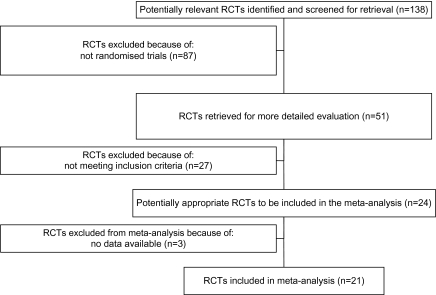
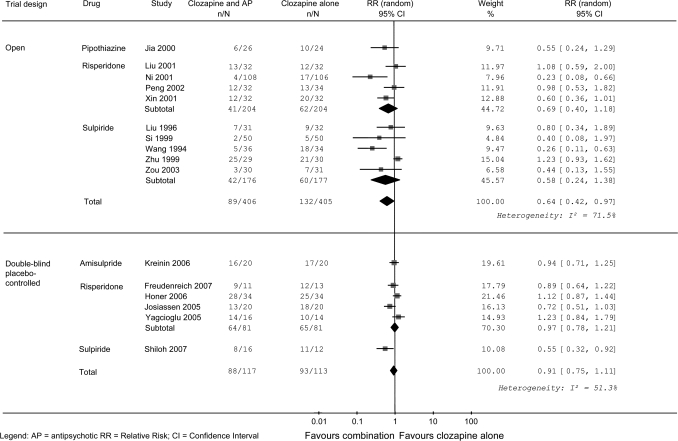
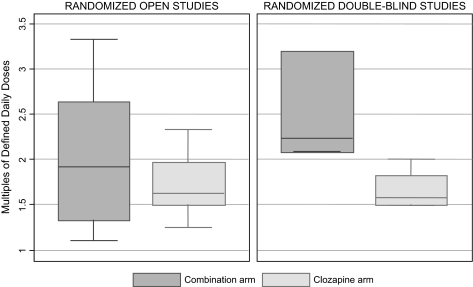
In patients with schizophrenia who do not have an optimal response to clozapine, it remains unclear if there is an evidence base to support a second antipsychotic in combination with clozapine. The present systematic review was therefore carried out to determine the efficacy of various clozapine combination strategies with antipsychotics. Relevant studies were located by searching the Cochrane Schizophrenia Group Trials Register, Medline, and Embase (up to November 2007). Only studies randomly allocating patients to clozapine plus another antipsychotic vs clozapine monotherapy were included. The search yielded 21 studies suitable for reanalysis. In 3 trials, clozapine was combined with a phenothiazine, in 8 trials with a benzamide, and in the remaining trials with risperidone. While the majority of randomized trials were not double blind, 6 studies were double-blind placebo-controlled trials. A total of 14 randomized open studies significantly favored clozapine combination strategy in terms of mean difference (random effect standardized mean difference [SMD] = -0.80, 95% confidence interval [CI] = -1.14 to -0.46); however, data extracted from 6 randomized double-blind studies did not show a statistically significant positive effect of this combination strategy in terms of mean difference (SMD = -0.12, 95% CI = -0.57 to 0.32). In terms of percentage of patients failing to show an improvement, a total of 10 randomized open studies significantly favored clozapine combination strategy (random effect relative risk [RR] = 0.64, 95% CI = 0.42 to 0.97), but data extracted from 6 randomized double-blind studies did not show a statistically significant positive effect of this combination strategy (RR = 0.91, 95% CI = 0.75 to 1.11). We conclude that the evidence base supporting a second antipsychotic in addition to clozapine in partially responsive patients with schizophrenia is weak. This weak evidence indicates modest to absent benefit.
Figures

Comment in
-
Review: limited evidence that adding a second antipsychotic improves clozapine treatment in schizophrenia.Evid Based Ment Health. 2009 Nov;12(4):112. doi: 10.1136/ebmh.12.4.112. Evid Based Ment Health. 2009. PMID: 19854774 No abstract available.
References
-
- Conley RR, Kelly DL. Management of treatment resistance in schizophrenia. Biol Psychiatry. 2001;50:898–911. - PubMed
-
- Kane J, Honigfeld G, Singer J, Meltzer H. Clozapine for the treatment-resistant schizophrenic. A double-blind comparison with chlorpromazine. Arch Gen Psychiatry. 1988;45:789–796. - PubMed
-
- Rosenheck R, Cramer J, Xu W, et al. A comparison of clozapine and haloperidol in hospitalized patients with refractory schizophrenia. Department of Veterans Affairs Cooperative Study Group on Clozapine in Refractory Schizophrenia. N Engl J Med. 1997;337:809–815. - PubMed
-
- Wahlbeck K, Cheine M, Essali A, Adams C. Evidence of clozapine's effectiveness in schizophrenia: a systematic review and meta-analysis of randomized trials. Am J Psychiatry. 1999;156:990–999. - PubMed
-
- Hennen J, Baldessarini RJ. Suicidal risk during treatment with clozapine: a meta-analysis. Schizophr Res. 2005;73(2–3):139–145. - PubMed
Publication types
MeSH terms
Substances
LinkOut - more resources
Full Text Sources
Medical
