Economic burden of schizophrenia in South Korea
- PMID: 18436996
- PMCID: PMC2526443
- DOI: 10.3346/jkms.2008.23.2.167
Economic burden of schizophrenia in South Korea
Abstract
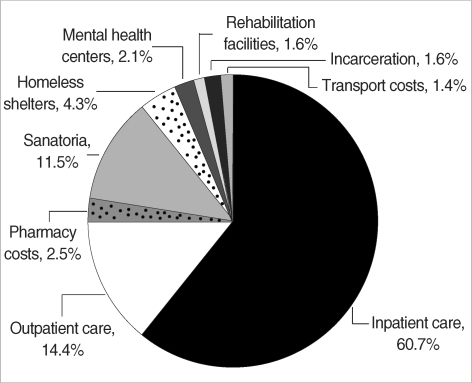
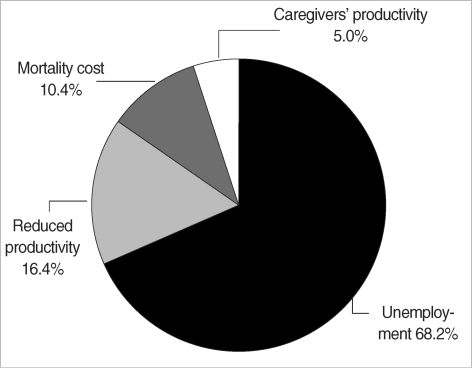
This study estimates the treated prevalence of schizophrenia and the annual costs associated with the illness in Korea in 2005, from a societal perspective. Annual direct healthcare costs associated with schizophrenia were estimated from National Health Insurance and Medical Aid records. Annual direct non-healthcare costs were estimated for incarceration, transport, community mental health centers, and institutions related to schizophrenia. Annual indirect costs were estimated for the following components of productivity loss due to illness: unemployment, reduced productivity, premature mortality, and caregivers' productivity loss using a human capital approach based on market wages. All costs were adjusted to 2005 levels using the healthcare component of the Consumer Price Index. The treated prevalence of schizophrenia in 2005 was 0.4% of the Korean population. The overall cost of schizophrenia was estimated to be $ 3,174.8 million (3,251.0 billion Won), which included a direct healthcare cost of $ 418.7 million (428.6 billion Won). Total direct non-healthcare costs were estimated to be $ 121 million (123.9 billion Won), and total indirect costs were estimated at $ 2,635.1 million (2,698.3 billion Won). Unemployment was identified as the largest component of overall cost. These findings demonstrate that schizophrenia is not rare, and that represents a substantial economic burden.
Figures
References
-
- Mental and neurological disorders. Fact sheet no. 265. 199. World Health Organization; Available from: http://www.who.int/whr/2001/media_centre/en/whr01_fact_sheet1_en.pdf. - PubMed
-
- Kessler RC, McGonagle KA, Zhao S, Nelson CB, Hughes M, Eshleman S, Wittchen HU, Kendler KS. Lifetime and 12-month prevalence of DSM-III-R psychiatric disorders in the United States. Results from the National Comorbidity Survey. Arch Gen Psychiatry. 1994;51:8–19. - PubMed
-
- Cho SJ, Cho MJ, Suh T, Hahm BJ, Hong JP, Bae JN, Lee JY, Lee DW, Park JI, Jeon HJ, Kim SJ, Kim YI. Prevalence rates of major mental disorders in mental health related facilities: nationwide 20 institutions study. J Korean Neuropsychiatr Assoc. 2004;43:749–759.
-
- Wu EQ, Birnbaum HG, Shi L, Ball DE, Kessler RC, Moulis M, Aggarwal J. The economic burden of schizophrenia in the United States in 2002. J Clin Psychiatry. 2005;66:1122–1129. - PubMed
-
- Knapp M, Mangalore R, Simon J. The global costs of schizophrenia. Schizophr Bull. 2004;30:279–293. - PubMed
MeSH terms
LinkOut - more resources
Full Text Sources
Medical