


Increasing incidence of listeriosis in France and other European countries
- PMID: 18439354
- PMCID: PMC2600261
- DOI: 10.3201/eid1405.071395
Increasing incidence of listeriosis in France and other European countries
Abstract
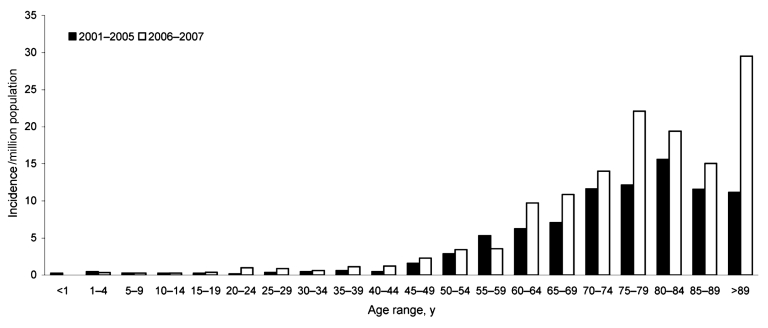
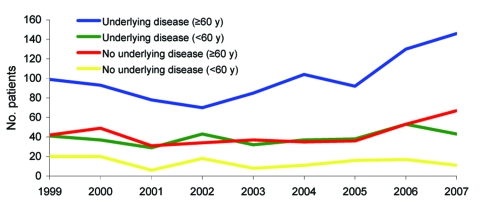
From 1999 through 2005, the incidence of listeriosis in France declined from 4.5 to 3.5 cases/million persons. In 2006, it increased to 4.7 cases/million persons. Extensive epidemiologic investigations of clusters in France have ruled out the occurrence of large foodborne disease outbreaks. In addition, no increase has occurred in pregnancy-associated cases or among persons <60 years of age who have no underlying disease. Increases have occurred mainly among persons >or=60 years of age and appear to be most pronounced for persons >or=70 years of age. In 8 other European countries, the incidence of listeriosis has increased, or remained relatively high, since 2000. As in France, these increases cannot be attributed to foodborne outbreaks, and no increase has been observed in pregnancy-associated cases. European countries appear to be experiencing an increased incidence of listeriosis among persons >or=60 years of age. The cause of this selective increased incidence is unknown.
Figures
References
-
- de Valk H, Jacquet C, Goulet V, Vaillant V, Perra A, Simon F, et al. Surveillance of Listeria infections in Europe. Euro Surveill. 2005;10:251–5. - PubMed
-
- Hedberg C. Listeria in Europe: the need for a European surveillance network is growing. Euro Surveill. 2006;11:75–6. - PubMed
-
- Goulet V, Jacquet C, Martin P, Vaillant V, Laurent E, de Valk H. Surveillance of human listeriosis in France, 2001–2003. Euro Surveill. 2006;11:79–81. - PubMed
-
- Goulet V, Jacquet C, Laurent E, Rocourt J, Vaillant V, de Valk H. Surveillance of human listeriosis in France in 1999 [in French]. Bul Epid Heb. 2001;34:161–5.
-
- Seeliger HPR, Höhne K. Serotyping of Listeria monocytogenes and related species. In: Bergan T, Norris J, editors. Methods in microbiology. New York: Academic Press; 1979. p. 31–48.
MeSH terms
LinkOut - more resources
Full Text Sources
Other Literature Sources
Medical
Research Materials