


Mitochondrial complex III deficiency associated with a homozygous mutation in UQCRQ
- PMID: 18439546
- PMCID: PMC2427202
- DOI: 10.1016/j.ajhg.2008.03.020
Mitochondrial complex III deficiency associated with a homozygous mutation in UQCRQ
Abstract
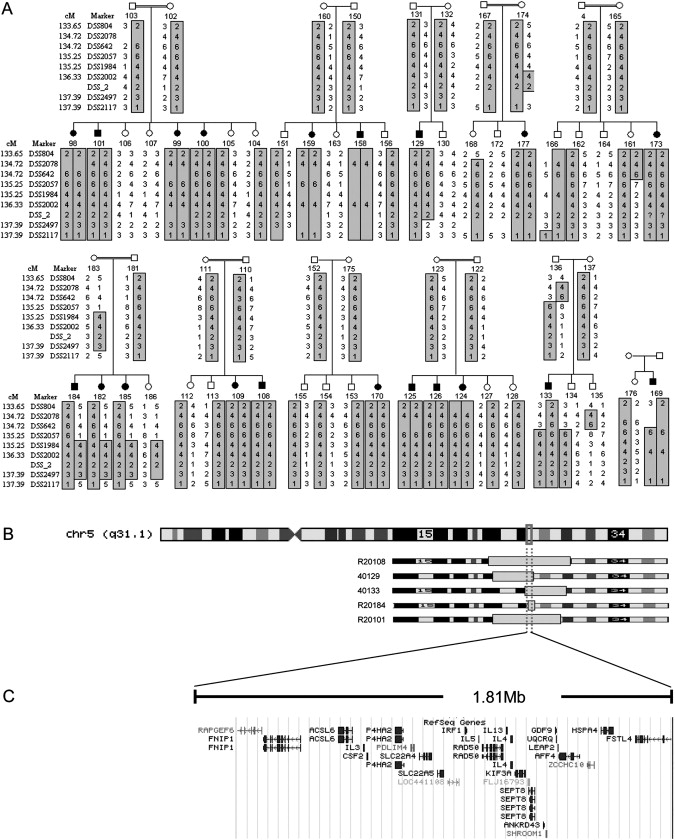
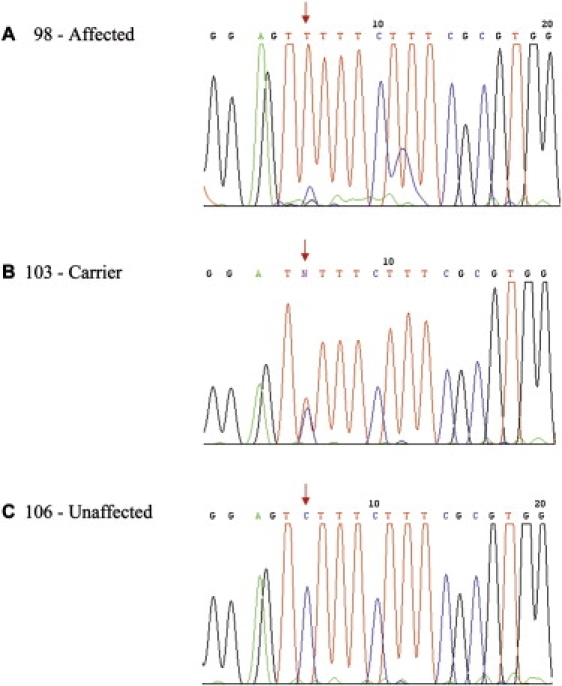
A consanguineous Israeli Bedouin kindred presented with an autosomal-recessive nonlethal phenotype of severe psychomotor retardation and extrapyramidal signs, dystonia, athetosis and ataxia, mild axial hypotonia, and marked global dementia with defects in verbal and expressive communication skills. Metabolic workup was normal except for mildly elevated blood lactate levels. Brain magnetic resonance imaging (MRI) showed increased density in the putamen, with decreased density and size of the caudate and lentiform nuclei. Reduced activity specifically of mitochondrial complex III and variable decrease in complex I activity were evident in muscle biopsies. Homozygosity of affected individuals to UQCRB and to BCSIL, previously associated with isolated complex III deficiency, was ruled out. Genome-wide linkage analysis identified a homozygosity locus of approximately 9 cM on chromosome 5q31 that was further narrowed down to 2.14 cM, harboring 30 genes (logarithm of the odds [LOD] score 8.82 at theta = 0). All 30 genes were sequenced, revealing a single missense (p.Ser45Phe) mutation in UQCRQ (encoding ubiquinol-cytochrome c reductase, complex III subunit VII, 9.5 kDa), one of the ten nuclear genes encoding proteins of mitochondrial complex III.
Figures


References
-
- Fernandez-Vizarra E., Bugiani M., Goffrini P., Carrara F., Farina L., Procopio E., Donati A., Uziel G., Ferrero I., Zeviani M. Impaired complex III assembly associated with BCS1L gene mutations in isolated mitochondrial encephalopathy. Hum. Mol. Genet. 2007;16:1241–1252. - PubMed
-
- Brown M.D., Lott M.T., Voljavec A.S., Torroni A., Wallace D.C. Mitochondrial DNA cytochrome b mutations associated with Leber's hereditary optic neuropathy and evidence for deleterious interactions between mutations. Am. J. Hum. Genet. 1991;49(Suppl.):973.
-
- Johns D.R., Neufeld M.J. Cytochrome b mutations in Leber hereditary optic neuropathy. Biochem. Biophys. Res. Commun. 1991;181:1358–1364. - PubMed
-
- Andreu A.L., Hanna M.G., Reichmann H., Bruno C., Penn A.S., Tanji K., Pallotti F., Iwata S., Bonilla E., Lach B. Exercise intolerance due to mutations in the cytochrome b gene of mitochondrial DNA. N. Engl. J. Med. 1999;341:1037–1044. - PubMed
-
- De Coo I.F.M., Renier W.O., Ruitenbeek W., Ter Laak H.J., Bakker M., Schagger H., Van Oost B.A., Smeets H.J.M. A 4-base pair deletion in the mitochondrial cytochrome b gene associated with parkinsonism/MELAS overlap syndrome. Ann. Neurol. 1999;45:130–133. - PubMed
Publication types
MeSH terms
Substances
LinkOut - more resources
Full Text Sources
Other Literature Sources
Molecular Biology Databases
