Review
. 2008;46(7):1813-27.
doi: 10.1016/j.neuropsychologia.2008.03.019. Epub 2008 Apr 8.

Role of parietal regions in episodic memory retrieval: the dual attentional processes hypothesis

Affiliations
Review

Role of parietal regions in episodic memory retrieval: the dual attentional processes hypothesis

Roberto Cabeza. Neuropsychologia. 2008.

Abstract

Although parietal cortex is frequently activated during episodic memory retrieval, damage to this region does not markedly impair episodic memory. To account for these and other findings, a new dual attentional processes (DAP) hypothesis is proposed. According to this hypothesis, dorsal parietal cortex (DPC) contributes top-down attentional processes guided by retrieval goals, whereas ventral parietal cortex (VPC) contributes bottom-up attentional processes captured by the retrieval output. Consistent with this hypothesis, DPC activity increases with retrieval effort whereas VPC activity increases with confidence in old and new responses. The DAP hypothesis can also account for the overlap of parietal activations across different cognitive domains and for opposing effects of parietal activity on encoding vs. retrieval. Finally, the DAP hypothesis explains why VPC lesions yield a memory neglect syndrome: a deficit in spontaneously reporting relevant memory details but not in accessing the same details when guided by specific questions.


Figures
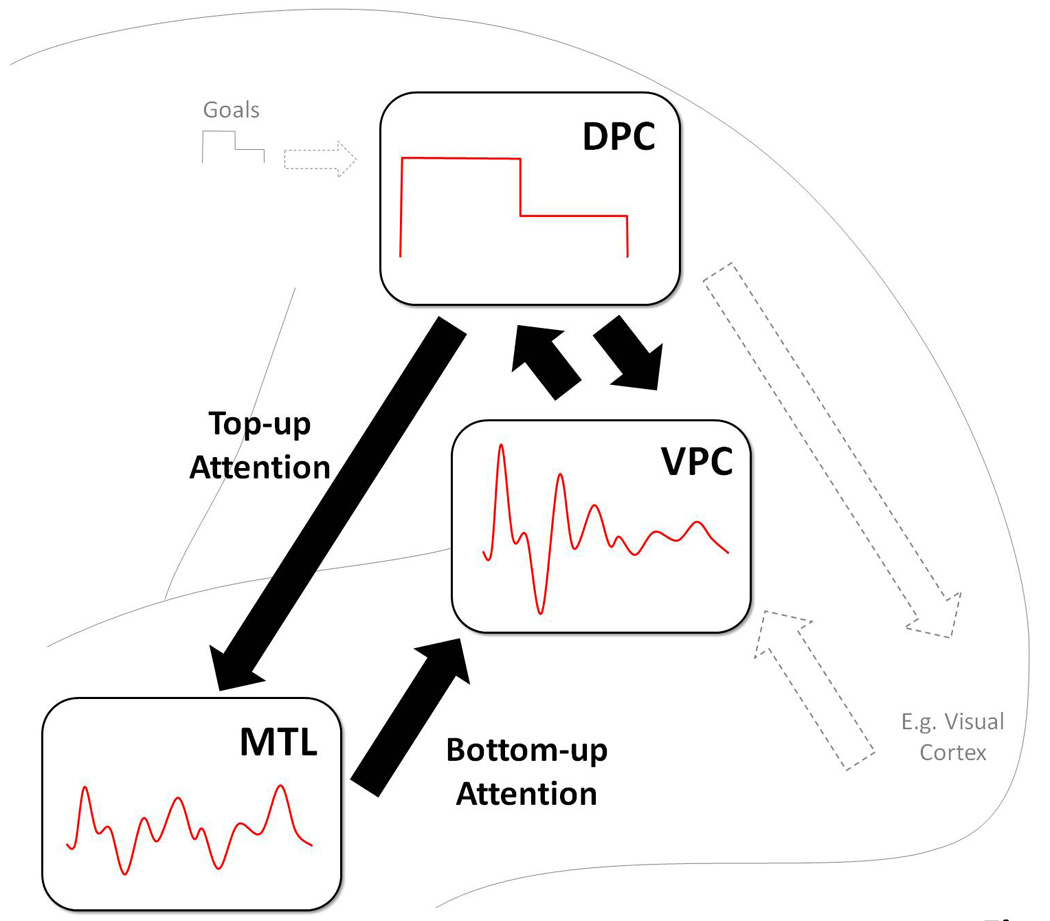
Figure 1
Figure 1
Simple graphical description of the DAP hypothesis. VPC fluctuates, continuously, tracking changes in MTL activity, which in turn reflects the recovery of episodic memories. In contrast, activity in DPC reflects top-down attentional processes guided by retrieval goals. DPC and VPC interact very closely: the goals maintained by DPC define what targets are relevant, and the targets detected by VPC can alter or change behavioral goals. The attentional processes VPC and DPC contribute to episodic retrieval are the same attentional processes these regions contribute to perception.
Figure 2
Figure 2
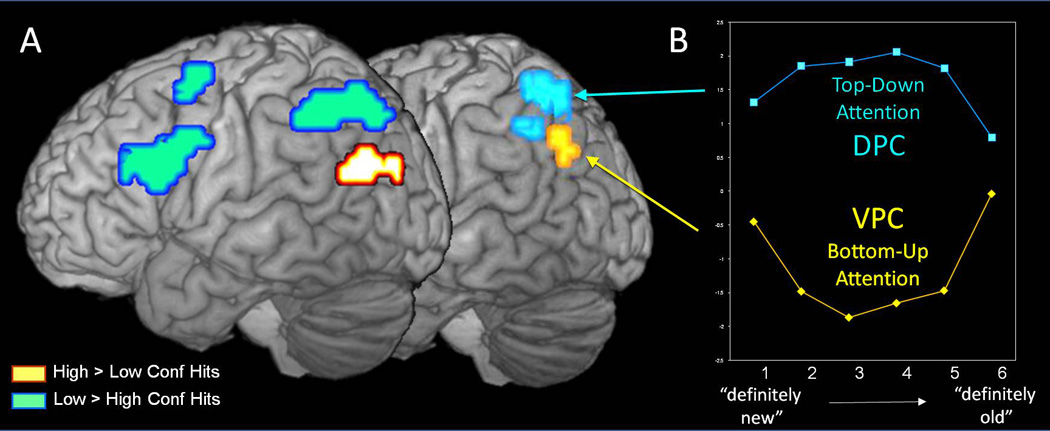
Dissociations between DPC and VPC activations during episodic retrieval that support the DAP hypothesis. A. DPC shows greater activity for low- than high-confidence hits, consistent with its involvement in top-down attention, whereas VPC shows greater activity for high- than low-confidence hits, consistent with its involvement in bottom-up attention (From Kim & Cabeza, 2007). B. The data are from an fMRI study on word recognition reported by Daselaar et al. (2006) and Fleck et al. (2006). Each trial consisted of an old/new decision and followed by confidence rating. The activations in the figure were identified by high > low (yellow activation) and low > high (blue activation) confidence contrasts at a threshold of p < 0.001, uncorrected. For display purposes, activations were masked with a parietal cortex region-of-interest (Pick Atlas ROI). The yellow activation overlaps with the activation labeled “D” in Figure 2 of Daselaar et al. (2006). The blue activation is the lateral extension of a left parietal activation reported in Table 1 of Fleck et al. (2006). The graph displays effect sizes extracted from the two activations and plotted along an oldness scale.
Figure 3
Figure 3
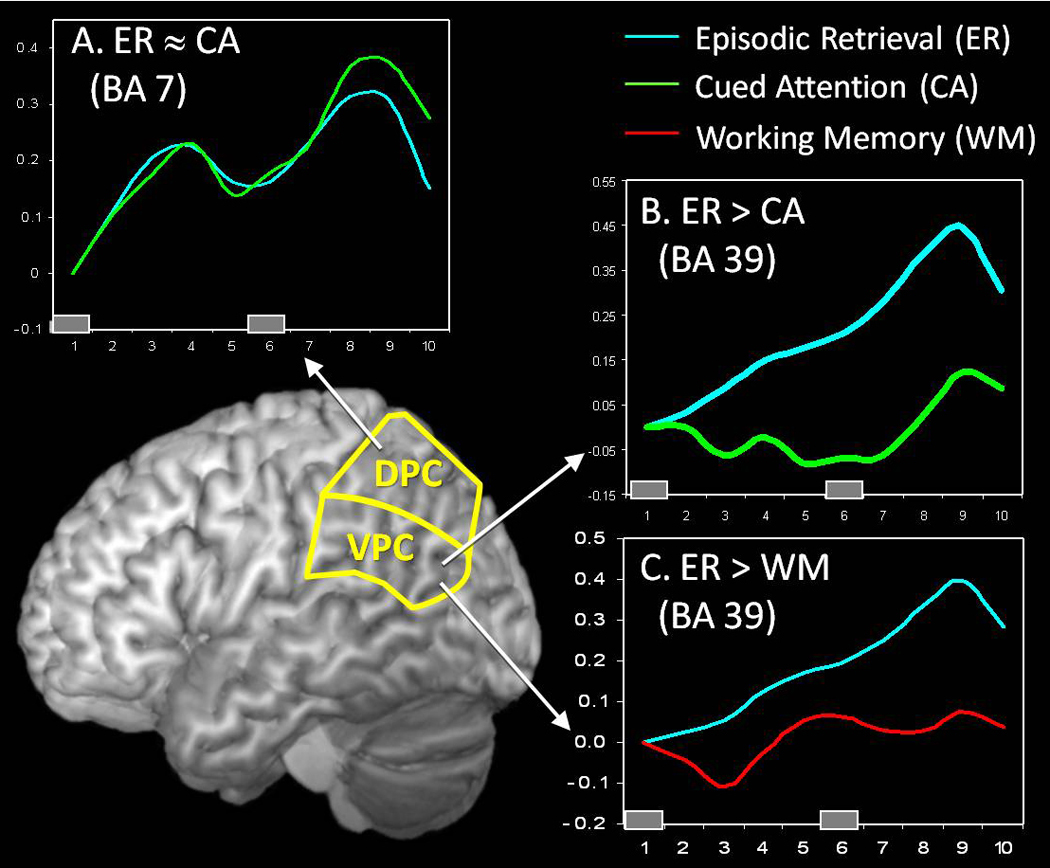
Data from a cross-function fMRI studies comparing episodic retrieval (ER), cued attention (CA), and working memory (WM) (Cabeza, Dolcos, Graham, & Nyberg, 2002; Cabeza et al., 2003) A. ER and CA tasks elicited similar DPC activations, consistent the assumption that this region mediates top-down attentional processes in both tasks. B. In contrast, the ER task but not the CA task activated VPC, consistent with the idea that this region mediates bottom-up attentional processes that are tapped by the ER task but not by the CA task. C. VPC was not activated by a multimodal verbal-spatial working memory (WM) task, inconsistent with the output buffer hypothesis.
Figure 4
Figure 4
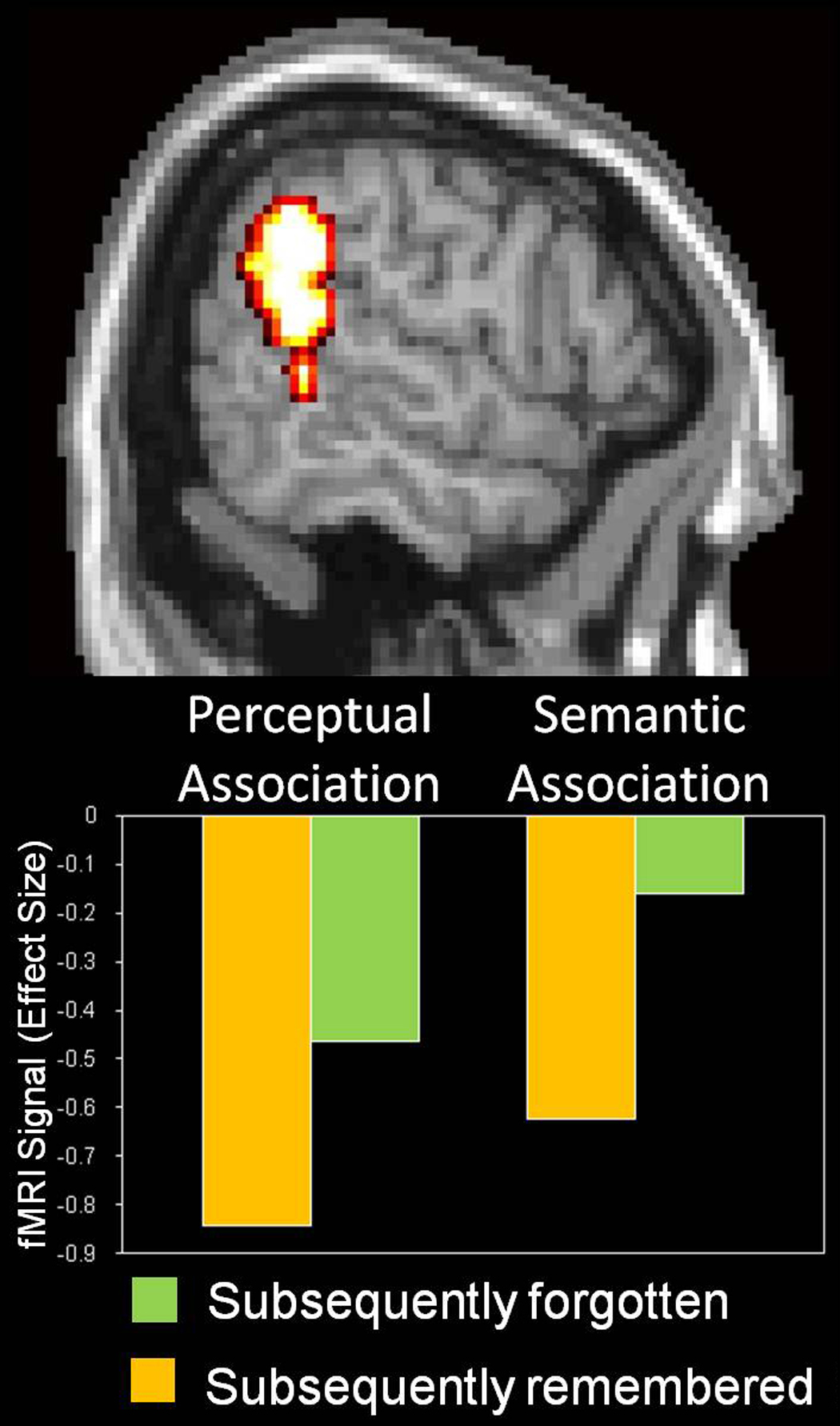
Results from an event-related fMRI study in which participants encoded semantic associations between words and perceptual associations between words and fonts (Daselaar, Prince, & Cabeza, 2004). Bilateral VPC regions (BA 39/40) showed deactivations during encoding, which were greater for items that were later remembered than for those that were later forgotten. These regions overlap with VPC regions that show the opposite pattern during retrieval, namely, greater activity for remembered than forgotten items.
Figure 5
Figure 5
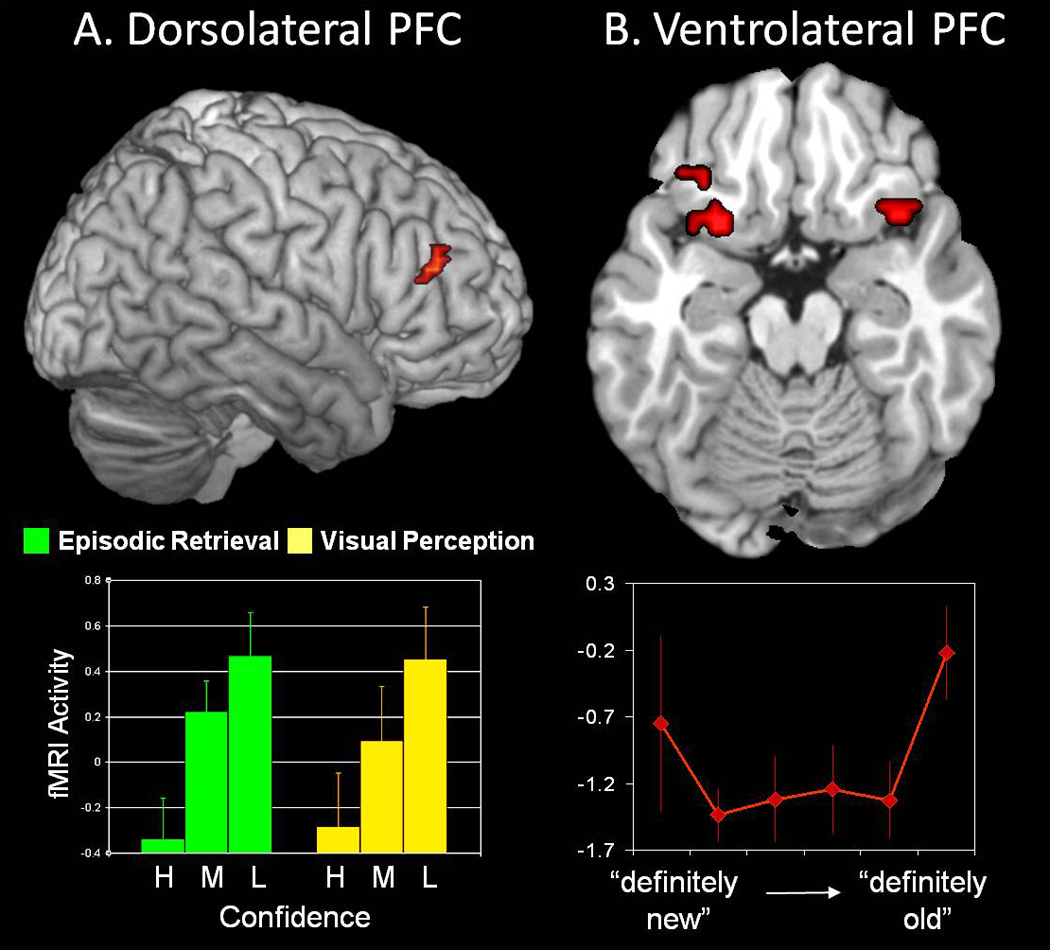
Evidence supporting a possible extension of the DAP hypothesis to the PFC. A. Consistent with the possibility that dorsal PFC regions contribute top-down attentional process to episodic retrieval, activity in a dorsolateral PFC region (BA 46/10) increased parametrically from high (H), to medium (M), to low (L) confidence during a word recognition task (Fleck, Daselaar, Dobbins, & Cabeza, 2006). The idea that this effect is related to top-down attention rather than to memory-specific operations is supported by the fact that the same region showed similar confidence effects during a visual perception task (area size comparison). B. Consistent with the possibility that ventral PFC regions contribute bottom-up attentional process to episodic retrieval, activity in a ventrolateral PFC region (BA 47) showed greater activity for highly relevant "definitely new" and "definitely old" responses in a word recognition test (Daselaar, Fleck, & Cabeza, 2006). The upright-U activation pattern in response to perceived oldness is almost identical to the one displayed by VPC in the same study (see yellow region in Figure 2-B).

References

    1. Addis DR, Moscovitch M, Crawley AP, McAndrews MP. Recollective qualities modulate hippocampal activation during autobiographical memory retrieval. Hippocampus. 2004;14(6):752–762. - PubMed
    1. Arrington CM, Carr TH, Mayer AR, Rao SM. Neural mechanisms of visual attention: Object-based selection of a region in space. Journal of Cognitive Neuroscience. 2000;12:106–117. - PubMed
    1. Baddeley A. The episodic buffer: a new component of working memory? Trends in Cognitive Sciences. 2000;4:417–423. - PubMed
    1. Berryhill ME, Phuong L, Picasso L, Cabeza R, Olson IR. Parietal lobe and episodic memory: Bilateral damage causes impaired free recall of autobiographical memory. Journal of Neuroscience. 2007;27:14415–14423. - PMC - PubMed
    1. Braver TS, Barch DM, Gray JR, Molfese DL, Snyder A. Anterior cingulate cortex and response conflict: effects of frequency, inhibition and errors. Cerebral Cortex. 2001;11(9):825–836. - PubMed

Publication types

MeSH terms