


Review
doi: 10.1016/j.ceb.2008.03.004.
Epub 2008 Apr 25.
Mechanisms involved in the regulation of histone lysine demethylases
Affiliations
- PMID: 18440794
- PMCID: PMC2674377
- DOI: 10.1016/j.ceb.2008.03.004
Item in Clipboard
Review
Mechanisms involved in the regulation of histone lysine demethylases
Curr Opin Cell Biol.
2008 Jun.
Abstract
Since the first histone lysine demethylase KDM1 (LSD1) was discovered in 2004, a great number of histone demethylases have been recognized and shown to play important roles in gene expression, as well as cellular differentiation and animal development. The chemical mechanisms and substrate specificities have already been extensively discussed elsewhere. This review focuses primarily on regulatory mechanisms that modulate demethylase recruitment and activity.
Figures
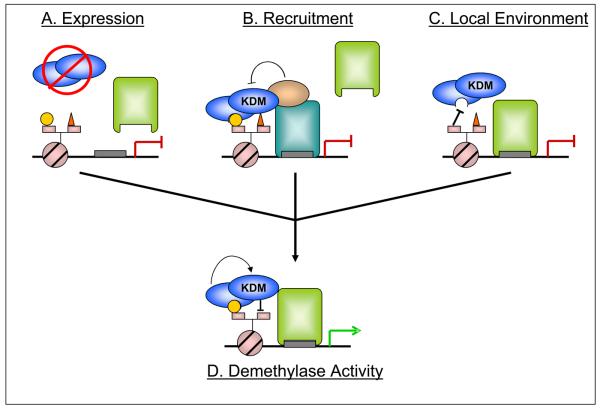
Multiple levels of regulation must coordinate to allow appropriate demethylase activity – the histone lysine demethylase (KDM - blue ovals) must be expressed, the appropriate DNA binding factor and cofactors must be present and associated, and the local chromatin environment must allow (or actively promote) complex stability. A) Regulation of the demethylase expression provides the first, most general level of regulation. B) Protein:protein interactions allow for construction of complexes with various compositions, as directed by different DNA-binding modules (blue and green rectangles indicate different DNA binding factors). In this example, KDM association via the bound transcription factor (blue rectangle) does not lead to enzymatic activity due to suppression by an associated cofactor, despite the permissive local environment. C) Local chromatin environment affects demethylase activity by recruiting and/or stabilizing the appropriate complex. Here, despite the proper complex formation, the absence of a particular modification (yellow circle) leads to dissociation of the complex. D) All these conditions, signaled by differentiation or external stimuli, coordinately regulate KDM activity (leading to loss of red triangle, representing a repressive methylation mark) and a change in transcriptional status (gene is now actively transcribed). Although a gene activating event is pictured, this model holds true for demethylases that act to repress transcription as well.
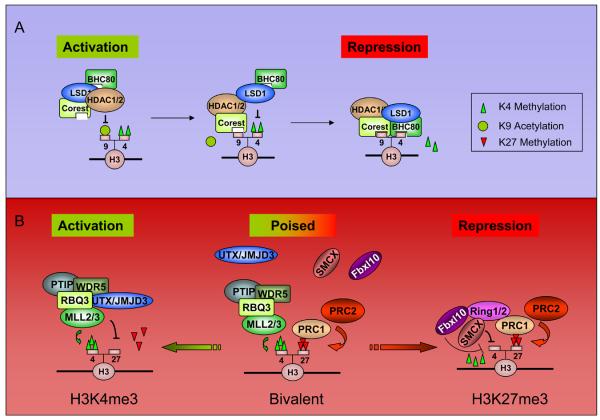
A) KDM1/LSD1-mediated H3K4me2 demethylation. A stepwise working model for KDM1/LSD1 complex is illustrated. The whole process involves HDAC-mediated deacetylation, CoREST binding, KDM1/LSD1-mediated H3K4 demethylation and BHC80 binding (H3K4me0). B) A proposed model for resolving bivalent domain to monovalent domain. In the pluripotency stage, the “bivalent domain” is established by MLL and PRC complexes, and the recruitments of H3K27 and H3K4 demethylases are absent. During differentiation, the methylase complexes are selectively kept and demethylases are differentially recruited, resulting in a H3K4me3-only or H3K27me3-only domain.
References
-
- Ruthenburg AJ, Allis CD, Wysocka J. Methylation of lysine 4 on histone H3: intricacy of writing and reading a single epigenetic mark. Mol Cell. 2007;25:15–30. - PubMed
-
- Shi Y, Lan F, Matson C, Mulligan P, Whetstine JR, Cole PA, Casero RA. Histone demethylation mediated by the nuclear amine oxidase homolog LSD1. Cell. 2004;119:941–953. This study identified the first lysine demethylase, human LSD1, and examined its role in gene repression. This finding showed that lysine methylation is enzymatically reversible and highlighted the dynamic nature of histone lysine methylation. - PubMed
-
- Tsukada Y, Fang J, Erdjument-Bromage H, Warren ME, Borchers CH, Tempst P, Zhang Y. Histone demethylation by a family of JmjC domain-containing proteins. Nature. 2006;439:811–816. The authors were the first to show demethylase activity for a second class of enzymes, the JmjC (jumonji) domain-containing proteins. Many JmjC domain proteins have since been studied, leading to the identification of multiple demethylases with varied substrate specificities and biological roles. - PubMed
-
- Godmann M, Auger V, Ferraroni-Aguiar V, Di Sauro A, Sette C, Behr R, Kimmins S. Dynamic regulation of histone H3 methylation at lysine 4 in mammalian spermatogenesis. Biol Reprod. 2007;77:754–764. - PubMed
Publication types
MeSH terms
Substances
Grants and funding
LinkOut - more resources
Full Text Sources
Other Literature Sources
