


Review
doi: 10.1093/jac/dkn175.
Epub 2008 Apr 25.
Why are there different dynamics in the selection of drug resistance in HIV and hepatitis B and C viruses?
Affiliations
- PMID: 18441341
- PMCID: PMC2574594
- DOI: 10.1093/jac/dkn175
Item in Clipboard
Review
Why are there different dynamics in the selection of drug resistance in HIV and hepatitis B and C viruses?
J Antimicrob Chemother.
2008 Jul.
Abstract
The arrival of new antiviral drugs to treat chronic hepatitis B virus (HBV) and hepatitis C virus (HCV) infections has given rise to great expectations along with concerns regarding the selection of drug-resistant variants. Many lessons learnt from HIV therapeutics can be helpful for designing adequate treatment strategies against viral hepatitis, the avoidance of sequential weak monotherapies being one of them. Although HIV, HBV and HCV share many biological features, including very rapid viral dynamics, distinctive characteristics explain why the speed of selection of drug resistance differs substantially between these viruses, being faster for HCV than for HIV and slower for HBV.
Figures
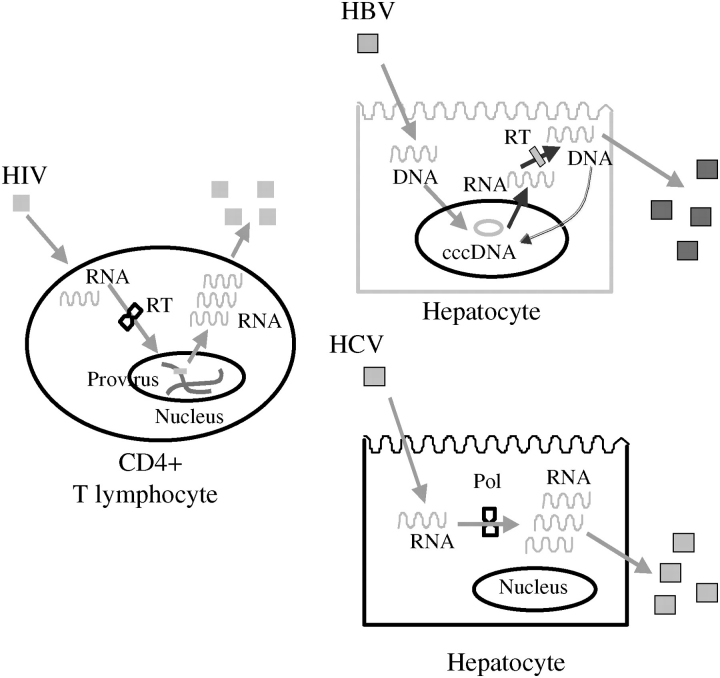
Schematic representation of the virus life cycle for HIV, HBV and HCV.
References
-
- Soriano V, Puoti M, Bonacini M, et al. Care of patients with chronic hepatitis B and HIV co-infection: recommendations from an HIV–HBV international panel. AIDS. 2005;19:221–40. - PubMed
-
- Soriano V, Puoti M, Sulkowski M, et al. Care of patients coinfected with HIV and hepatitis C virus: 2007 updated recommendations from the HCV–HIV International Panel. AIDS. 2007;21:1073–89. - PubMed
-
- Perelson A, Neumann A, Markowitz M, et al. HIV-1 dynamics in vivo: virion clearance rate, infected cell life-span, and viral generation time. Science. 1996;271:1582–6. - PubMed
-
- Neumann A, Lam N, Dahari H, et al. Hepatitis C viral dynamics in vivo and the antiviral efficacy of interferon alpha therapy. Science. 1998;282:103–7. - PubMed
-
- Tsiang M, Rooney J, Toole J, et al. Biphasic clearance kinetics of hepatitis B virus from patients during adefovir dipivoxil therapy. Hepatology. 1999;29:1863–9. - PubMed
