. 2008 May 6;105(18):6771-6.
doi: 10.1073/pnas.0708940105. Epub 2008 Apr 28.

Anemia and splenomegaly in cGKI-deficient mice

Affiliations

Anemia and splenomegaly in cGKI-deficient mice

Michael Föller et al. Proc Natl Acad Sci U S A. .

Abstract

To explore the functional significance of cGMP-dependent protein kinase type I (cGKI) in the regulation of erythrocyte survival, gene-targeted mice lacking cGKI were compared with their control littermates. By the age of 10 weeks, cGKI-deficient mice exhibited pronounced anemia and splenomegaly. Compared with control mice, the cGKI mutants had significantly lower red blood cell count, packed cell volume, and hemoglobin concentration. Anemia was associated with a higher reticulocyte number and an increase of plasma erythropoietin concentration. The spleens of cGKI mutant mice were massively enlarged and contained a higher fraction of Ter119(+) erythroid cells, whereas the relative proportion of leukocyte subpopulations was not changed. The Ter119(+) cGKI-deficient splenocytes showed a marked increase in annexin V binding, pointing to phosphatidylserine (PS) exposure at the outer membrane leaflet, a hallmark of suicidal erythrocyte death or eryptosis. Compared with control erythrocytes, cGKI-deficient erythrocytes exhibited in vitro a higher cytosolic Ca(2+) concentration, a known trigger of eryptosis, and showed increased PS exposure, which was paralleled by a faster clearance in vivo. Together, these results identify a role of cGKI as mediator of erythrocyte survival and extend the emerging concept that cGMP/cGKI signaling has an antiapoptotic/prosurvival function in a number of cell types in vivo.


Conflict of interest statement

The authors declare no conflict of interest.

Figures
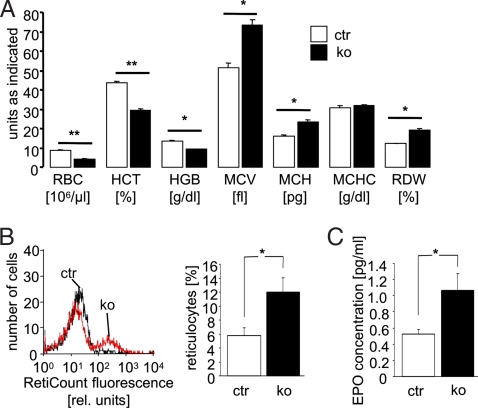
Fig. 1.
Fig. 1.
Anemia in cGKI-deficient mice. Circulating blood of 10-week-old ctr (ctr, open bars) and cGKI KO (ko, black bars) mice was analyzed. (A) Counts of RBC, HCT, and HGB concentration and MCV, MCH, MCHC, and RDW. The data shown were obtained from a litter-matched group of mice (n = 3–4) and are representative of at least three experiments with independent groups of animals. (B) Representative histogram of Retic count fluorescence (Left) and reticulocyte number (Right, n = 8). The first and the second peaks correspond to cell populations with low and high staining intensity, respectively. (C) Plasma erythropoietin concentration (n = 4). * and ** indicate significant differences between genotypes with P < 0.05 and P < 0.01, respectively. The genotypes of the ctr mice were cGKI+/+ or cGKI+/L−.
Fig. 2.
Fig. 2.
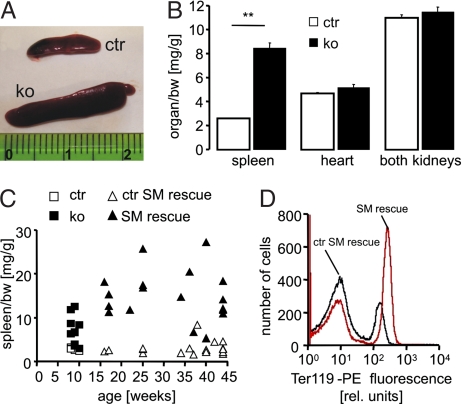
Splenomegaly associated with increased erythroid cell mass in cGKI-deficient mice. (A) Spleens and (B) organ/bw ratios of 10-week-old ctr (open bars) and KO (black bars) mice (**, P < 0.01). The data shown were obtained from a litter-matched group of mice (n = 3–4) and are representative of at least three experiments with independent groups of animals. (C) Spleen/bw ratios of individual mice at various ages. The diagram includes conventional KO mice (black boxes) and their ctr littermates (open boxes) and cGKI SM rescue mice (black triangles) and their ctrs (ctr SM rescue, open triangles). (D) Representative flow-cytometric quantification of Ter119+ spleen cells isolated from a 42-week-old cGKI SM rescue mouse and a litter-matched ctr mouse. The first and the second peaks correspond to cell populations with low and high staining intensity, respectively. The genotypes of ctr mice were cGKI+/+ or cGKI+/L−. The genotypes of ctr SM rescue mice were cGKI+/L−;SM-Iα+/− or cGKI+/L−;SM-Iβ+/−.
Fig. 3.
Fig. 3.
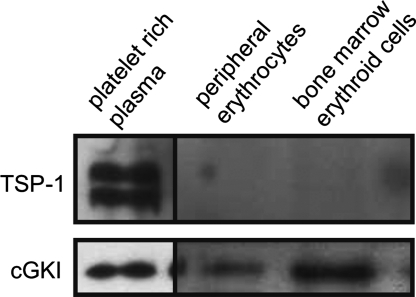
Expression of cGKI in murine erythroid cells. Western blot analysis of cGKI expression in erythroid cells from a 26-week-old wild-type mouse. Protein extracts of platelet-rich plasma (5 μg) and of Ter119+ erythroid cells isolated from peripheral blood (30 μg) or bone marrow (30 μg) were stained with an antiserum raised against cGKI (Lower) or thrombospondin-1 (TSP-1, Upper).
Fig. 4.
Fig. 4.
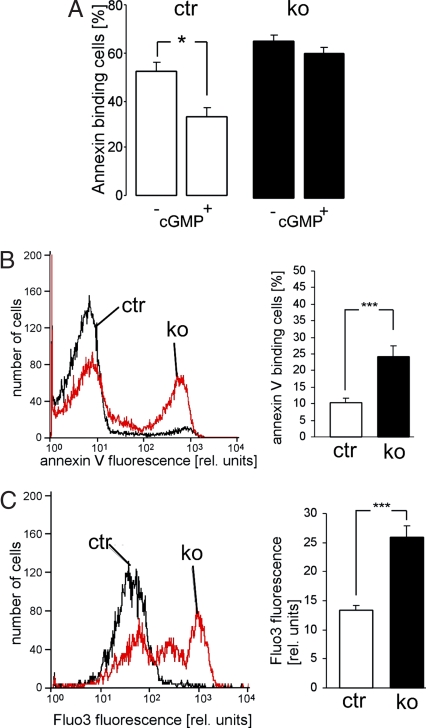
Inrceased eryptosis and intracellular Ca2+ level in cGKI-deficient (ko, black bars) erythrocytes as compared to ctr (ctr, open bars) erythrocytes. (A) Effect of cGMP on eryptosis. PS exposure of ctr and KO erythrocytes was determined by annexin V binding after a 30-min incubation with the Ca2+-ionophore ionomycin (0.1 μM) at 37°C. Before addition of ionomycin, cells were preincubated for 30 min with the guanylyl cyclase inhibitor methylene blue (20 μM) followed by additional 60 min in the absence (−) or presence (+) of 1 mM 8-bromo-cGMP (n = 11–12; *, P < 0.05). (B) Surface exposure of PS as determined by annexin V binding and (C) measurement of intracellular Ca2+ by Fluo-3 fluorescence in ctr and KO erythrocytes after incubation in Ringer solution at 37°C for 48 h. Left shows a representative flow-cytometric histogram, and Right shows the statistical analysis (n = 12; ***, P < 0.001). The first and the second peaks correspond to cell populations with low and high staining intensity, respectively. Erythrocytes were isolated from 10-week-old cGKI KO mice and their litter-matched ctrs. The genotypes of the ctr mice were cGKI+/+ or cGKI+/L−.
Fig. 5.
Fig. 5.
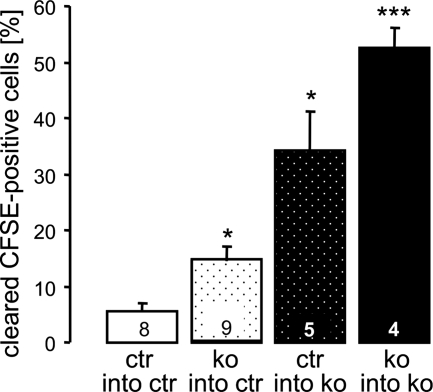
In vivo clearance of CFSE-labeled erythrocytes. Erythrocytes were isolated from and injected into 10-week-old cGKI KO mice or their litter-matched ctrs. The configuration of each transfer experiment is indicated below each bar, and the number of injected animals (n) is indicated inside each bar. The percentage of cleared CFSE-labeled cells was determined 2 days after injection (*, P < 0.05 vs. ctr; ***, P < 0.001 vs. ctr). The genotypes of the ctr mice were cGKI+/+ or cGKI+/L−.
Fig. 6.
Fig. 6.
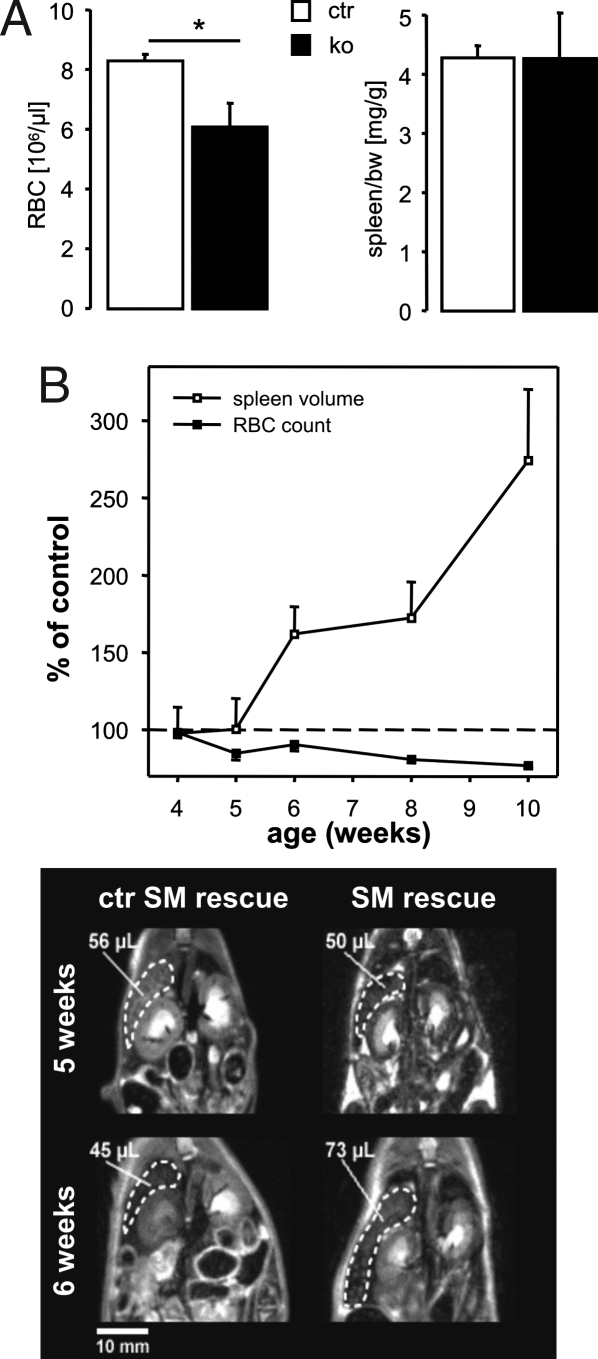
Anemia precedes splenomegaly in cGKI-deficient mice. (A) The number of RBC (n = 5) and the spleen/bw ratio (n = 10) were determined in 3- to 4-week-old ctr (ctr, open bars) and cGKI KO (ko, black bars) mice (*, P < 0.05). The genotypes of ctr mice were cGKI+/+ or cGKI+/L−. (B) Time course of the development of anemia and splenomegaly in cGKI SM rescue mice. Spleen volume was determined by noninvasive MRI. RBC count (black boxes), and spleen volume (open boxes) were longitudinally monitored from 4 to 10 weeks of age in four cGKI SM rescue mice and five litter-matched ctr mice (ctr SM rescue). For each experimental day, RBC counts and spleen volumes of the SM rescue mice were normalized to the respective mean value of the ctr animals, which was set to 100%. Note that 5-week-old SM rescue mice had already a significantly lower RBC count than ctr mice (P < 0.05) but a normal spleen volume. Lower shows representative MR images (coronal sections, top view) of individual ctr and SM rescue mice at 5 and 6 weeks of age. Spleens (broken lines) and corresponding volumes are indicated. The genotypes of the ctr SM rescue mice were cGKI+/L−;SM-Iα+/− or cGKI+/L−;SM-Iβ+/−.

References

    1. Dimmeler S, Haendeler J, Zeiher AM. Regulation of endothelial cell apoptosis in atherothrombosis. Curr Opin Lipidol. 2002;13:531–536. - PubMed
    1. Liu L, Stamler JS. NO: an inhibitor of cell death. Cell Death Differ. 1999;6:937–942. - PubMed
    1. Brune B. NO apoptosis or turning it ON? Cell Death Differ. 2003;10:864–869. - PubMed
    1. Nagai-Kusuhara A, et al. cAMP-responsive element binding protein mediates a cGMP/protein kinase G-dependent anti-apoptotic signal induced by nitric oxide in retinal neuro-glial progenitor cells. Exp Eye Res. 2007;84:152–162. - PubMed
    1. Friebe A, Koesling D. Regulation of nitric oxide-sensitive guanylyl cyclase. Circ Res. 2003;93:96–105. - PubMed

Publication types

Substances