


Subtle cues of predation risk: starlings respond to a predator's direction of eye-gaze
- PMID: 18445559
- PMCID: PMC2587789
- DOI: 10.1098/rspb.2008.0095
Subtle cues of predation risk: starlings respond to a predator's direction of eye-gaze
Abstract
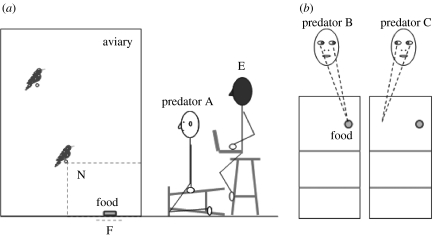
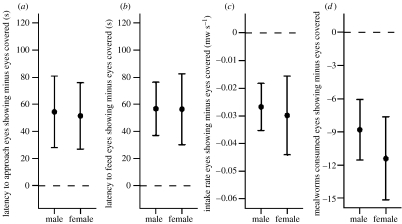
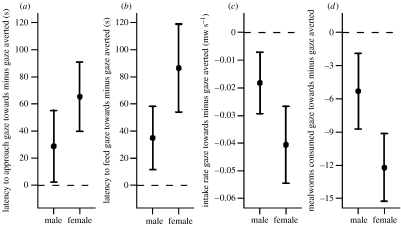
For prey animals to negotiate successfully the fundamental trade-off between predation and starvation, a realistic assessment of predation risk is vital. Prey responses to conspicuous indicators of risk (such as looming predators or fleeing conspecifics) are well documented, but there should also be strong selection for the detection of more subtle cues. A predator's head orientation and eye-gaze direction are good candidates for subtle but useful indicators of risk, since many predators orient their head and eyes towards their prey as they attack. We describe the first explicit demonstration of a bird responding to a live predator's eye-gaze direction. We present wild-caught European starlings (Sturnus vulgaris) with human 'predators' whose frontal appearance and gaze direction are manipulated independently, and show that starlings are sensitive to the predator's orientation, the presence of eyes and the direction of eye-gaze. Starlings respond in a functionally significant manner: when the predator's gaze was averted, starlings resumed feeding earlier, at a higher rate and consumed more food overall. By correctly assessing lower risk and returning to feeding activity earlier (as in this study), the animal gains a competitive advantage over conspecifics that do not respond to the subtle predator cue in this way.
Figures
References
-
- Bednekoff P.A, Lima S.L. Randomness, chaos and confusion in the study of antipredator vigilance. Trends Ecol. Evol. 1998;13:284–287. doi:10.1016/S0169-5347(98)01327-5 - DOI - PubMed
-
- Bouskila A, Blumstein D.T. Rules of thumb for predation hazard assessment: predictions from a dynamic model. Am. Nat. 1992;139:161–176. doi:10.1086/285318 - DOI
-
- Bräuer J, Call J, Tomasello M. All great ape species follow gaze to distant locations and around barriers. J. Comp. Psychol. 2005;119:145–154. doi:10.1037/0735-7036.119.2.145 - DOI - PubMed
-
- Bugnyar T, Stöwe M, Heinrich B. Ravens, Corvus corax, follow gaze direction of humans around obstacles. Proc. R. Soc. B. 2004;271:1331–1336. doi:10.1098/rspb.2004.2738 - DOI - PMC - PubMed
-
- Burger J, Gochfeld M. Discrimination of the threat of direct versus tangential approach to the nest by incubating herring and great black-backed gulls. J. Comp. Physiol. Psychol. 1981;95:676–684. doi:10.1037/h0077811 - DOI
Publication types
MeSH terms
LinkOut - more resources
Full Text Sources
Other Literature Sources
