


Review
doi: 10.1038/nrn2391.
Epub 2008 Apr 30.
A technicolour approach to the connectome
Affiliations
- PMID: 18446160
- PMCID: PMC2577038
- DOI: 10.1038/nrn2391
Item in Clipboard
Review
A technicolour approach to the connectome
Nat Rev Neurosci.
2008 Jun.
Abstract
A central aim of neuroscience is to map neural circuits, in order to learn how they account for mental activities and behaviours and how alterations in them lead to neurological and psychiatric disorders. However, the methods that are currently available for visualizing circuits have severe limitations that make it extremely difficult to extract precise wiring diagrams from histological images. Here we review recent advances in this area, along with some of the opportunities that these advances present and the obstacles that remain.
Figures
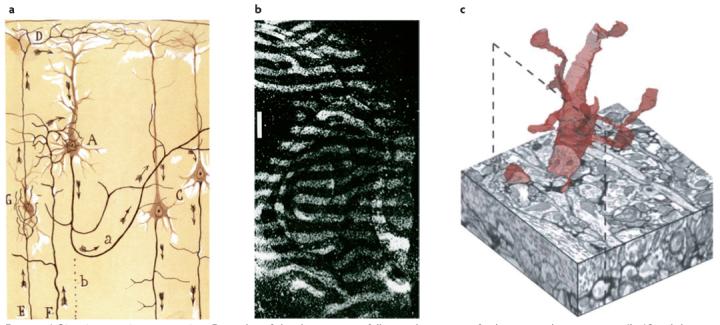
Examples of the three main approaches that have been used to study the connectivity of neurons. a | Single-cell staining by dye impregnation. The best-known of these techniques is the Golgi staining method, which was used by Ramón y Cajal to describe the principles of neuronal circuit organization. b | The introduction of diffusible or transportable labelling agents to discrete areas. In some cases the label crosses a synapse to reach a second-order target. A classical example is the identification of ocular dominance columns in the visual cortex following the injection of radioactive proline into one eye. c | Serial electron microscopy can be used to reconstruct neurons and their processes with the best attainable resolution. Shown here is a reconstruction from the adult rat barrel cortex that was segmented from a three-dimensional image stack obtained by serial block-face imaging. Part a reproduced, with permission, from REF. © (1914) Herederos de santiago Ramón y Cajal. Part b reproduced, with permission, from REF. © (1977) royal society of London. Part c reproduced, with permission, from REF. © (2006) Elsevier Sciences.
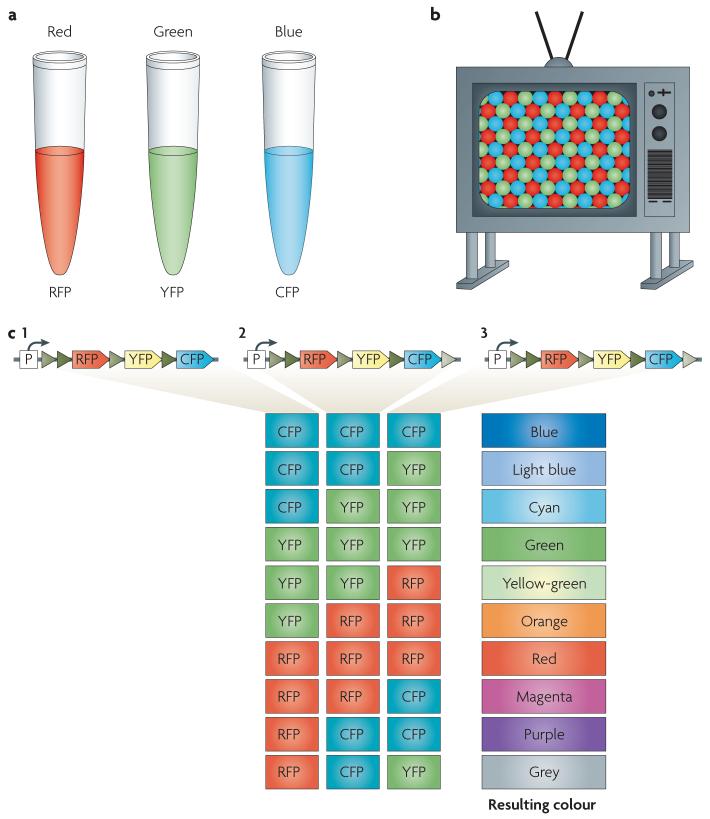
a | several spectrally distinct fluorescent proteins (XFPs) are now available, including ones that emit in red (RFP), green (YFP) and blue (CFP) frequencies. b | The combinatorial expression of red, green and blue XFPs at various levels is sufficient to encode a colour space analogous to the one that is generated by an RGB video monitor. c | An example showing how ten distinct colours can be generated by expressing a trimeric combination of three different XFPs. In Brainbow mice, this outcome would result if three copies of a trichromatic transgene (illustrated at the top of the panel; see Box 1 for details) each recombined independently (Box 1). Triangles represent lox sites (see Box 1 for details). CFP, cyan fluorescent protein; P, promoter; RFP, red fluorescent protein; YFP, yellow fluorescent protein.
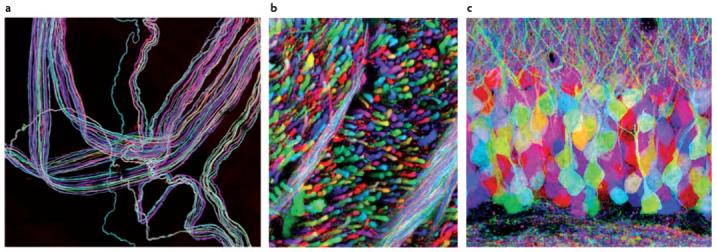
a | A motor nerve innervating ear muscle. b | An axon tract in the brainstem. c | The hippocampal dentate gyrus. In the Brainbow mice from which these images were taken, up to ∼160 colours were observed as a result of the co-integration of several tandem copies of the transgene into the mouse genome and the independent recombination of each by Cre recombinase (see FIG. 2c). The images were obtained by the superposition of separate red, green and blue channels. The image in part a is courtesy of ryan Draft.
References
-
- Sotelo C. Viewing the brain through the master hand of Ramon y Cajal. Nature Rev. Neurosci. 2003;4:71–77. - PubMed
-
- Callaway EM, Sanes JR. New technologies. Curr. Opin. Neurobiol. 2006;16:540–542. - PubMed
-
- Callahan CA, Yoshikawa S, Thomas JB. Tracing axons. Curr. Opin. Neurobiol. 1998;8:582–586. - PubMed
-
- Feinstein P, Bozza T, Rodriguez I, Vassalli A, Mombaerts P. Axon guidance of mouse olfactory sensory neurons by odorant receptors and the β2 adrenergic receptor. Cell. 2004;117:833–846. - PubMed
Publication types
MeSH terms
Substances
Grants and funding
LinkOut - more resources
Full Text Sources
Other Literature Sources
