Review
. 2008;10(1):166-77.
doi: 10.1208/s12248-008-9018-7. Epub 2008 Mar 18.

Recent advances in blood-brain barrier disruption as a CNS delivery strategy

Affiliations
Review

Recent advances in blood-brain barrier disruption as a CNS delivery strategy

Marc-André Bellavance et al. AAPS J. 2008.

Abstract

The blood-brain barrier (BBB) is a complex functional barrier composed of endothelial cells, pericytes, astrocytic endfeets and neuronal cells. This highly organized complex express a selective permeability for molecules that bear, amongst other parameters, adequate molecular weight and sufficient liposolubility. Unfortunately, very few therapeutic agents currently available do cross the BBB and enters the CNS. As the BBB limitation is more and more acknowledged, many innovative surgical and pharmacological strategies have been developed to circumvent it. This review focuses particularly on the osmotic opening of the BBB, a well-documented approach intended to breach the BBB. Since its inception by Rapoport in 1972, pre-clinical studies have provided important information on the extent of BBB permeation. Thanks to Neuwelt and colleagues, the osmotic opening of the BBB made its way to the clinic. However, many questions remain as to the detailed physiology of the procedure, and its best application to the clinic. Using different tools, amongst which MRI as a real-time in vivo characterization of the BBB permeability and CNS delivery, we attempt to better define the osmotic BBB permeabilization physiology. These ongoing studies are described, and data related to spatial and temporal distribution of a molecule after osmotic BBB breaching, as well as the window of BBB permeabilization, are discussed. We also summarize recent clinical series highlighting promising results in the application of this procedure to maximize delivery of chemotherapy in the treatment of brain tumor patients.


Figures

Fig. 1
Fig. 1
Graphical sketch illustrating the hypothesis concerning the osmotic BBB modification. The tight junctions are shown a as devoid of any anatomic space between the endothelial cells. Moreover, multi-drug resistance (MDR) gene products, such as the P-gp efflux pump, are also illustrated as they are integral to the mechanism of the barrier. The osmotic BBBD procedure induces a retraction in the cell membrane, and a physical opening b accompanied by a modification of the Ca2+ metabolism in the cell
Fig. 2
Fig. 2
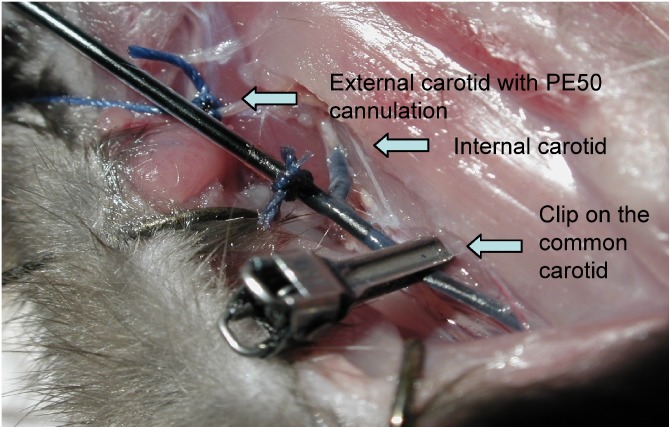
Surgical setup for BBBD. The carotid complex was exposed, and the external carotid artery was ligated and incised. A PE50 tubing was inserted in a retrograde fashion, and was positioned just above the bifurcation. The tubing was stabilized with a suture. Notice the clip on the common carotid artery, used to prevent backflow during mannitol infusion
Fig. 3
Fig. 3
Whole brain and corresponding coronal slices of samples extracted from one representative animal of each group exposed to different rates of mannitol infusion as assessed by Evans blue staining. A sequential increment in blue discoloration is obvious, peaking at 0.15 cc/s
Fig. 4
Fig. 4
Description of the steps involved in the calculation of the intensity of delivery ratio used in this study. a The albumin immunocytochemistry source image, displaying discolored areas in the treated hemisphere. b The image has been analyzed to identify pixels above a fixed threshold corresponding to the immunocytochemistry staining. These pixels are retained as the red overlay. c After having defined the pixel area of each hemisphere (green overlay is left hemisphere, whereas blue overlay is right hemisphere), the red overlay has been added to the image for final analysis. Results are expressed as number of stained pixels (red overlay) as a fraction (%) of the treated (right) hemisphere (blue overlay). Results might also have been presented as the fraction of stained pixels (red overlay) over the entire slice area (green + blue overlays)
Fig. 5
Fig. 5
An axial T1 enhanced cut, at the posterior aspect of the brain of a Wistar rat, prior (a) and after (b) BBBD. The arrow depicts the cleft area presenting the most intense increase in Gd-DTPA. It is from this area that a diffusion wave is observed
Fig. 6
Fig. 6
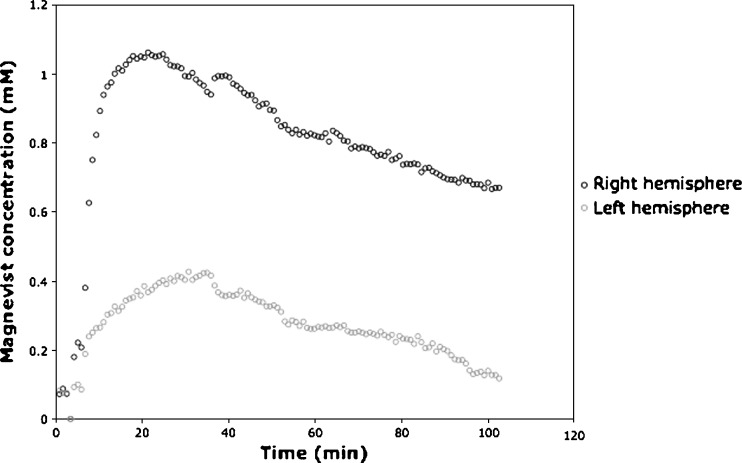
Graphic depicting the Magnevist (Gd-DTPA) concentration over time in the disrupted hemisphere (right) and the non disrupted hemisphere (left) in T1 MRI sequence acquisition. Notice the pronounced signal drop at time 3 min, immediately after BBBD, translating the increase in water content caused by the BBBD
Fig. 7
Fig. 7
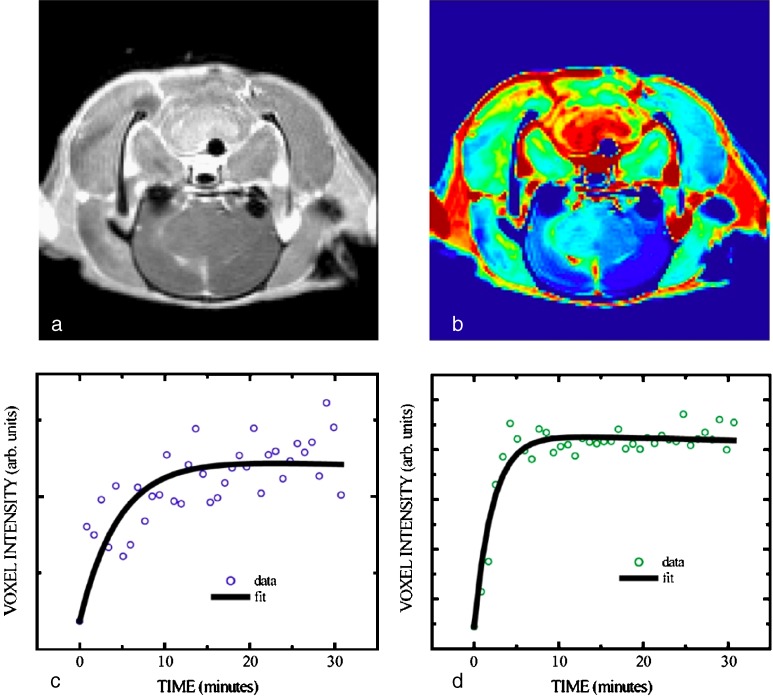
An axial T1 Gd-DTPA enhanced MRI immediately after BBBD is analyzed using an exposition map translating the area under the curve (AUC). In this animal in which the intensity of the BBBD was moderate at best, the right hemisphere present a slight change in signal intensity (a). A map of the area under the curve (AUC) produced by the permeabilization procedure is presented in (b). Mathematical function extracted for a single pixel in the white matter of the right hemisphere. The increase in intensity is studied over time (c). Mathematical function extracted for a single pixel in the subependymal region of the right hemisphere (d). This area consistently depicts the most intense signal variation after osmotic BBBD
Fig. 8
Fig. 8
Graphic depicting the Gadomer concentration over time in the disrupted hemisphere (right) in a selected region of interest of the frontal lobe. The first administration of Gadomer (600 μl of a 0.1429 mmol/ml solution at a rate of 500 μl/min) was accomplished 3 min after BBBD. A significant increase in the concentration was observed. The infusion was repeated at 150, 300 and 360 min after BBBD. Notice small increments in concentration translating the residual permeability breach of the barrier that is still open at 360 min
Fig. 9
Fig. 9
A 69 year old woman was diagnosed with poorly differentiated ovarian adenocarcinoma in May 2001, at which time she underwent extensive abdominal and gynecologic surgery, followed by six cycles of taxol/carboplatin. She presented a seizure in May 2002, and a metastatic lesion was identified in the right parietal region. She underwent a craniotomy for tumor resection, followed by eight cycles of the carboplatin regimen in conjunction with BBBD. She was considered in complete response (CR) after two cycles, and that condition was maintained until December 2005, when she relapsed in the right temporal lobe (a). BBBD treatments were resumed, and she was considered in CR after three cycles (b)
Fig. 10
Fig. 10
Kaplan–Meier survival curve (days) for the global group of metastasis patients, from study entry to death

References

    1. Fortin D. Altering the properties of the blood–brain barrier: disruption and permeabilization. Prog. Drug Res. 2003;61:125–154. - PubMed
    1. Ehrlich P. Das sauerstoff-bedürfnis des organismus. Eine Farbenanalytische Studie. Berlin: Hirschwald; 1885.
    1. Ehrlich P. Ueber die beziehungen von chemischer constitution, vertheilung, und pharmakologischen wirkung. Collected Studies on Immunity. Berlin: Wiley; 190. pp. 404–442.
    1. Goldmann E. Vitalfarbung am zentralnervensystem. Abhandl Konigl preuss Akad Wiss. 1913;1:1–60.
    1. Pardridge W. M. Blood–brain barrier delivery of protein and non-viral gene therapeutics with molecular Trojan horses. J. Control. Release. 2007;122(3):345–348. doi: 10.1016/j.jconrel.2007.04.001. - DOI - PMC - PubMed

Publication types

MeSH terms

Substances