. 2008 Apr 30;28(18):4583-91.
doi: 10.1523/JNEUROSCI.0086-08.2008.

Why we like to drink: a functional magnetic resonance imaging study of the rewarding and anxiolytic effects of alcohol

Affiliations

Why we like to drink: a functional magnetic resonance imaging study of the rewarding and anxiolytic effects of alcohol

Jodi M Gilman et al. J Neurosci. .

Abstract

People typically drink alcohol to induce euphoria or reduce anxiety, and they frequently drink in social settings, yet the effect of alcohol on human brain circuits involved in reward and emotion has been explored only sparingly. We administered alcohol intravenously to social drinkers while brain response to visual threatening and nonthreatening facial stimuli was measured using functional magnetic resonance imaging (fMRI). Alcohol robustly activated striatal reward circuits while attenuating response to fearful stimuli in visual and limbic regions. Self-ratings of intoxication correlated with striatal activation, suggesting that activation in this area may contribute to subjective experience of pleasure and reward during intoxication. These results show that the acute pharmacological rewarding and anxiolytic effects of alcohol can be measured with fMRI.


Figures
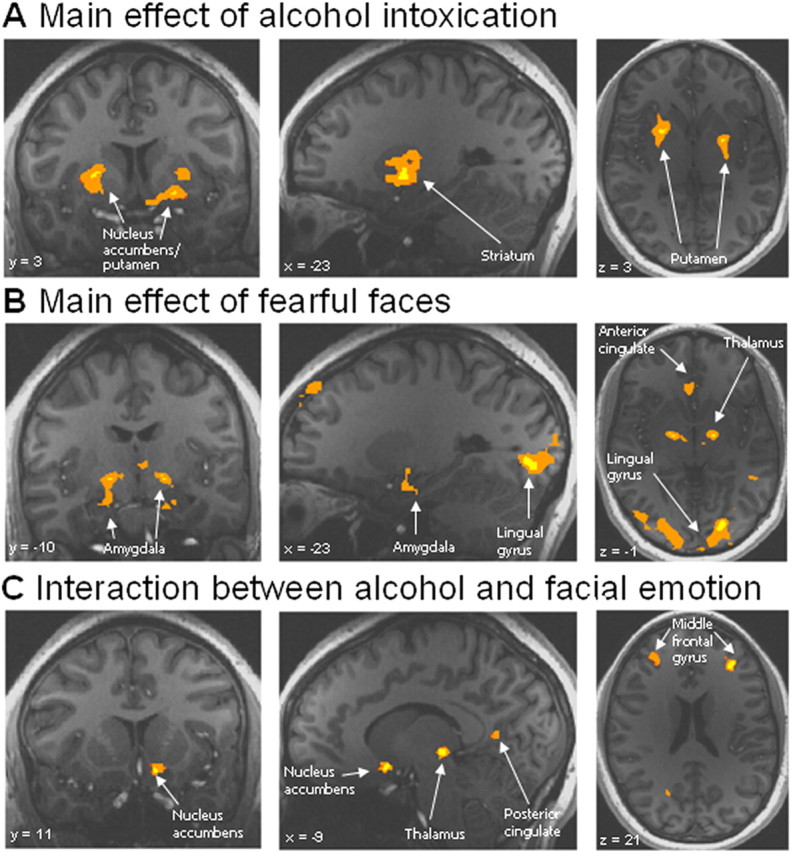
Figure 1.
Figure 1.
A–C, Main effect of alcohol (A), fearful facial emotion (B), and the interaction between them (C) on regional brain activation. Anatomical maps of t statistics were spatially normalized by warping to Talairach space and combined into a group map. Radiological convention is used to display left and right. A statistical map of the main effects of alcohol and facial emotion was computed by performing a voxelwise ANOVA of the event-related β coefficients calculated from the general linear model. In this three-factor mixed-model ANOVA, alcohol (alcohol or placebo) and emotion (fearful or neutral) were fixed factors, and subject was a random factor. Alcohol effects were seen primarily in striatal areas, whereas emotion effects were seen in limbic and visual processing areas. The color map represents the t score: in orange regions, p < 0.01, and in yellow regions, p < 0.001. For values, see Table 1.
Figure 2.
Figure 2.
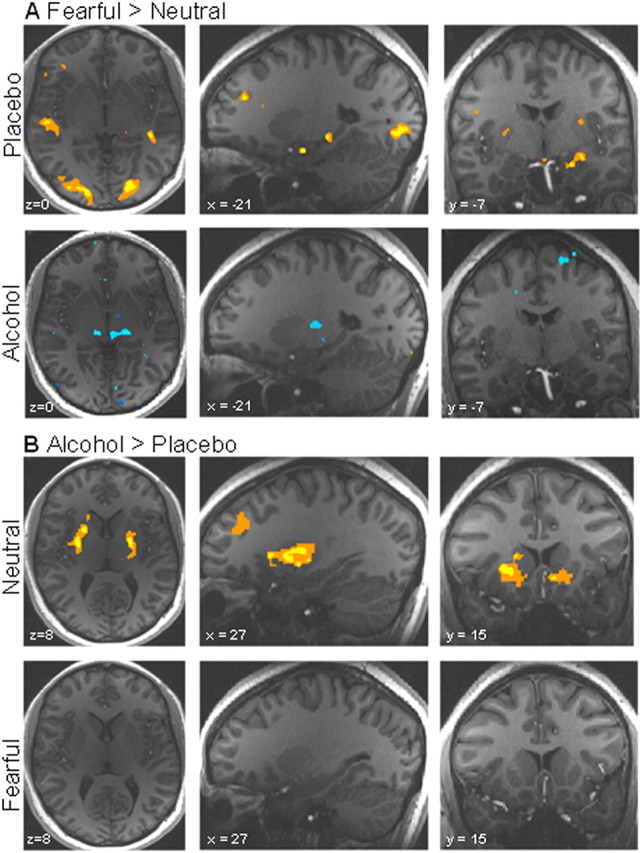
Linear contrasts between the alcohol and placebo condition under each emotion type (placebo: fearful > neutral; and alcohol: fearful > neutral), as well as linear contrasts between the fearful and neutral conditions separately under the alcohol and placebo conditions (neutral: alcohol > placebo; and fearful: alcohol > placebo). These contrasts were computed by performing voxelwise t tests between event-related β coefficients of each stimulus type. Radiological convention is used to display left and right. A, Linear contrast between fearful vs neutral faces in the placebo and the alcohol condition. Increased activation to negative faces is shown in yellow/orange (p < 0.01), whereas increased activation to neutral faces is shown in blue (p < 0.01). B, Linear contrast between alcohol and placebo in the neutral and fearful condition. Increased activation to alcohol is shown in yellow/orange (p < 0.01), whereas increased activation to placebo is shown in blue (p < 0.01). For values, see Table 2.
Figure 3.
Figure 3.
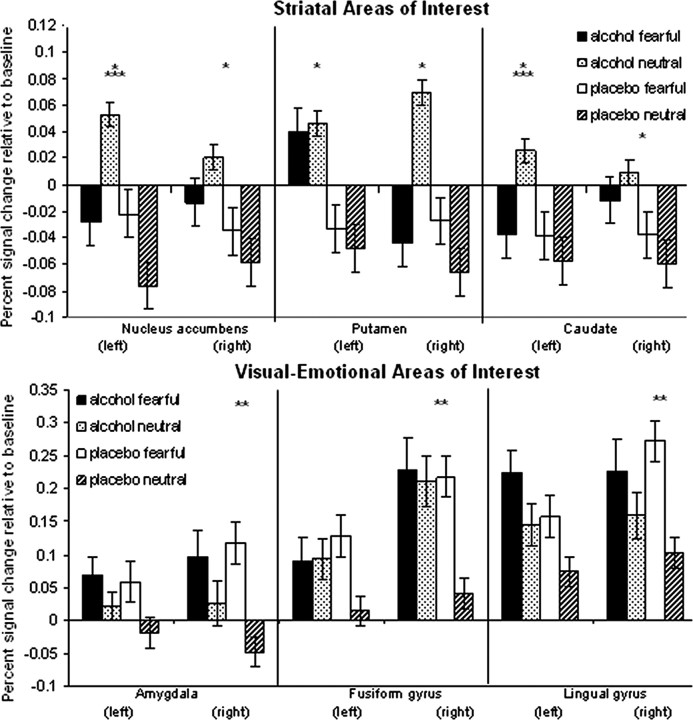
Percentage signal change in volumes of interest in each condition. Values were entered into the GLM to test for main effects of alcohol, emotion, and an interaction. *A significant main effect of alcohol; **a significant main effect of facial emotion; ***a significant interaction between alcohol and emotion. Striatal areas of interest showed significant alcohol effects, whereas visual–emotional areas showed significant effects of emotion. In the visual–emotional areas, alcohol decreased the difference between response to fearful and neutral faces. For values, see Table 3. Error bars indicate SEM.
Figure 4.
Figure 4.
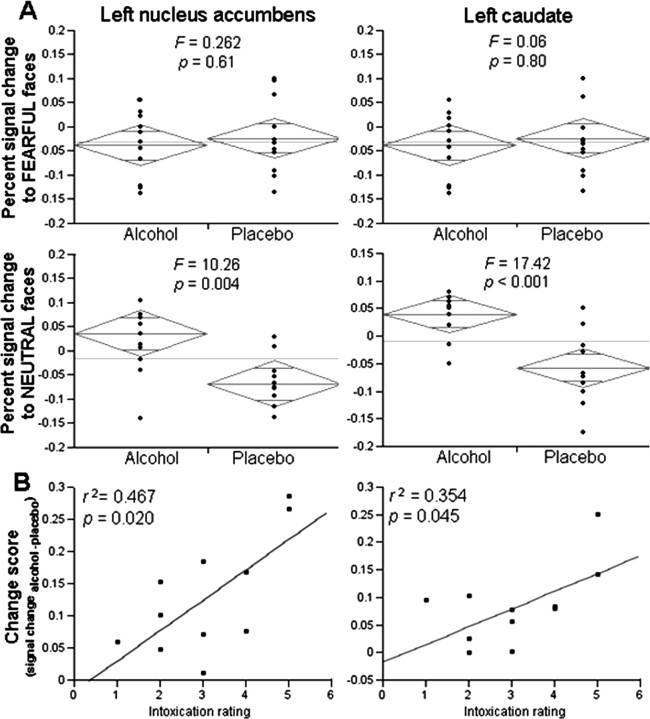
A, Where we observed significant interactions in the GLM (in the left NAcc and left caudate), we performed one-way ANOVAs. In these regions, there was a significant difference between the alcohol and the placebo condition when participants viewed the neutral faces, but no difference during the fearful face condition. B, A coefficient of association was computed between change scores, defined as percentage signal change (to the neutral faces) during the alcohol session minus percentage signal change (to the neutral faces) during the placebo session, and intoxication ratings measured by the DEQ. There was a significant association between change score and intoxication in the left NAcc and the left caudate.

References

    1. Berns GS, McClure SM, Pagnoni G, Montague PR. Predictability modulates human brain response to reward. J Neurosci. 2001;21:2793–2798. - PMC - PubMed
    1. Bjork JM, Knutson B, Fong GW, Caggiano DM, Bennett SM, Hommer DW. Incentive-elicited brain activation in adolescents: similarities and differences from young adults. J Neurosci. 2004;24:1793–1802. - PMC - PubMed
    1. Blanchard RJ, Magee L, Veniegas R, Blanchard DC. Alcohol and anxiety: ethopharmacological approaches. Prog Neuropsychopharmacol Biol Psychiatry. 1993;17:171–182. - PubMed
    1. Blekher T, Ramchandani VA, Flury L, Foroud T, Kareken D, Yee RD, Li TK, O'Connor S. Saccadic eye movements are associated with a family history of alcoholism at baseline and after exposure to alcohol. Alcohol Clin Exp Res. 2002;26:1568–1573. - PubMed
    1. Boileau I, Assaad JM, Pihl RO, Benkelfat C, Leyton M, Diksic M, Tremblay RE, Dagher A. Alcohol promotes dopamine release in the human nucleus accumbens. Synapse. 2003;49:226–231. - PubMed

Publication types

MeSH terms