Review
. 2008 May;9(5):429-34.
doi: 10.1038/embor.2008.56.

PeptideAtlas: a resource for target selection for emerging targeted proteomics workflows

Affiliations
Review

PeptideAtlas: a resource for target selection for emerging targeted proteomics workflows

Eric W Deutsch et al. EMBO Rep. 2008 May.

Abstract

A crucial part of a successful systems biology experiment is an assay that provides reliable, quantitative measurements for each of the components in the system being studied. For proteomics to be a key part of such studies, it must deliver accurate quantification of all the components in the system for each tested perturbation without any gaps in the data. This will require a new approach to proteomics that is based on emerging targeted quantitative mass spectrometry techniques. The PeptideAtlas Project comprises a growing, publicly accessible database of peptides identified in many tandem mass spectrometry proteomics studies and software tools that allow the building of PeptideAtlas, as well as its use by the research community. Here, we describe the PeptideAtlas Project, its contents and components, and show how together they provide a unique platform to select and validate mass spectrometry targets, thereby allowing the next revolution in proteomics.


Figures
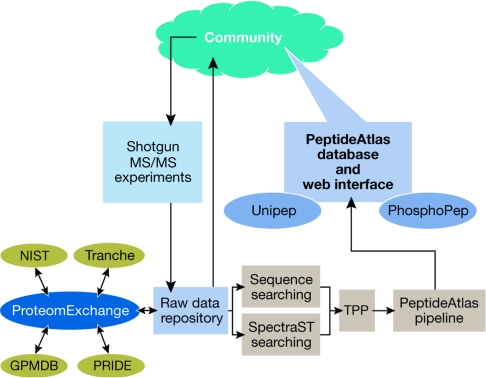
Figure 1
Figure 1
An overview of the build process of PeptideAtlas. Shotgun tandem mass spectrometry (MS/MS) experimental data are contributed by the community to the PeptideAtlas raw data repository, which is linked to other repositories by the ProteomExchange consortium. The raw data are processed through an evolving but consistent analysis and validation pipeline (Trans Proteomic Pipeline (TPP)) and loaded into the PeptideAtlas database, and made available to the community. Tranche, Global Proteome Machine Database (GPMDB), National Institute of Standards and Technology (NIST) and Protein Identifications Database (PRIDE) are currently the main participants in the ProteomExchange consortium.
Figure 2
Figure 2
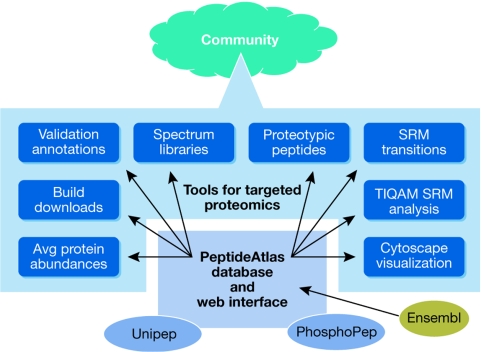
An overview of the features provided by PeptideAtlas that allow targeted proteomics workflows. PeptideAtlas and its specialized builds, Unipep (containing N-glycosylation sites) and PhosphoPep (containing phosphorylation sites), allow the community to: select proteotypic peptides for targeting; select SRM transitions for targeting; annotate and view annotations for these peptides and transitions; visualize peptides and proteins with Cytoscape; interface with Targeted Identification for Quantitative Analysis by MRM (TIQAM) for experimental design; obtain approximate protein abundances for spiking in synthetic peptides; obtain spectrum libraries for search and verification; and download PeptideAtlas builds for new projects. MRM, multiple reaction monitoring; SRM, selected reaction monitoring.
None
Eric W. Deutsch
None
Henry Lam
None
Ruedi Aebersold

References

    1. Anderson L, Hunter CL (2006) Quantitative mass spectrometric multiple reaction monitoring assays for major plasma proteins. Mol Cell Proteomics 5: 573–588 - PubMed
    1. Craig R, Beavis RC (2004) TANDEM: matching proteins with tandem mass spectra. Bioinformatics 20: 1466–1467 - PubMed
    1. Craig R, Cortens JP, Beavis RC (2004) Open source system for analyzing, validating, and storing protein identification data. J Proteome Res 3: 1234–1242 - PubMed
    1. Desiere F et al. (2004) Integration with the human genome of peptide sequences obtained by high-throughput mass spectrometry. Genome Biol 6: R9. - PMC - PubMed
    1. Desiere F, Deutsch EW, King NL, Nesvizhskii AI, Mallick P, Eng J, Chen S, Eddes J, Loevenich SN, Aebersold R (2006) The PeptideAtlas project. Nucleic Acids Res 34: D655–D658 - PMC - PubMed

Publication types