


Preventing unintended proteolysis in plant protein biofactories
- PMID: 18452504
- PMCID: PMC7159130
- DOI: 10.1111/j.1467-7652.2008.00344.x
Preventing unintended proteolysis in plant protein biofactories
Abstract
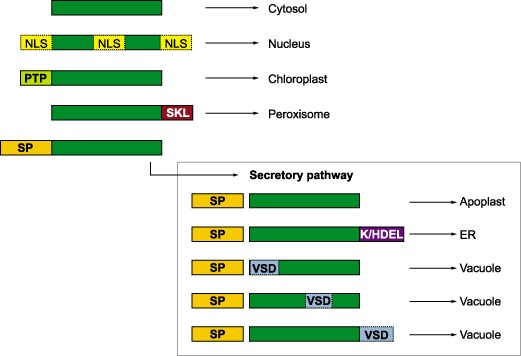
Numerous reports have been published over the last decade assessing the potential of plants as useful hosts for the heterologous expression of clinically useful proteins. Significant progress has been made, in particular, in optimizing transgene transcription and translation in plants, and in elucidating the complex post-translational modifications of proteins typical of the plant cell machinery. In this article, we address the important issue of recombinant protein degradation in plant expression platforms, which directly impacts on the final yield, homogeneity and overall quality of the resulting protein product. Unlike several more stable and structurally less complex pharmaceuticals, recombinant proteins present a natural tendency to structural heterogeneity, resulting in part from the inherent instability of polypeptide chains expressed in heterologous environments. Proteolytic processing, notably, may dramatically alter the structural integrity and overall accumulation of recombinant proteins in plant expression systems, both in planta during expression and ex planta after extraction. In this article, we describe the current strategies proposed to minimize protein hydrolysis in plant protein factories, including organ-specific transgene expression, organelle-specific protein targeting, the grafting of stabilizing protein domains to labile proteins, protein secretion in natural fluids and the co-expression of companion protease inhibitors.
Figures
References
-
- Adam, Z. and Clarke, A.K. (2002) Cutting edge of chloroplast proteolysis. Trends Plant Sci. 7, 451–456. - PubMed
-
- Amin, N. , Liu, A.D. , Ramer, S. , Aehle, W. , Meijer, D. , Metin, M. , Wong, S. , Gualfetti, P. and Schellenberger, V. (2004) Construction of stabilized proteins by combinatorial consensus mutagenesis. Prot. Eng. Design Select. 17, 787–793. - PubMed
-
- Artsaenko, O. , Kettig, B. , Fiedler, U. , Conrad, U. and During, K. (1998) Potato tubers as a biofactory for recombinant antibodies. Mol. Breed. 4, 313–319.
-
- Badri, A.M. (2006) Intégrité structurale et impact métabolique d’une forme recombinante de l’aprotinine bovine exprimée chez la pomme de terre, Solanum tuberosum (L.). PhD Thesis. Québec, QC: Université Laval.
-
- Badri, A.M. , Goulet, C. , Rivard, D. , Li, H. , Coenen, K. and Michaud, D. (2005) A SELDI‐TOF/MS procedure for the rapid detection and quantitation of recombinant proteins in transgenic plants In: Proceedings of the Conference on Plant‐Made Pharmaceuticals 2005 (Arcand F., ed.), pp. 82–83. Québec, QC: Society for Moleculture.
Publication types
MeSH terms
Substances
LinkOut - more resources
Full Text Sources
Other Literature Sources
