


The effect of acupuncture duration on analgesia and peripheral sensory thresholds
- PMID: 18452622
- PMCID: PMC2386116
- DOI: 10.1186/1472-6882-8-18
The effect of acupuncture duration on analgesia and peripheral sensory thresholds
Abstract
Background: Acupuncture provides a means of peripheral stimulation for pain relief. However, the detailed neuronal mechanisms by which acupuncture relieves pain are still poorly understood and information regarding optimal treatment settings is still inadequate. Previous studies with a short burst of unilateral electroacupuncture (EA) in the Tendinomuscular Meridians (TMM) treatment model for pain demonstrated a transient dermatomally correlated bilateral analgesic effect with corresponding peripheral modality-specific sensory threshold alterations. However, the impact of EA duration on the analgesic effect in this particular treatment model is unknown. To obtain mechanistically and clinically important information regarding EA analgesia, this current prospective cross-over study assesses the effects of EA duration on analgesia and thermal sensory thresholds in the TMM treatment model.
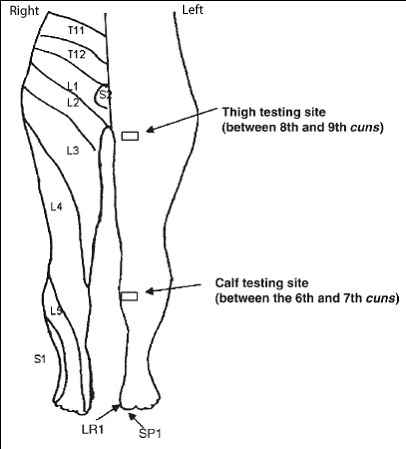
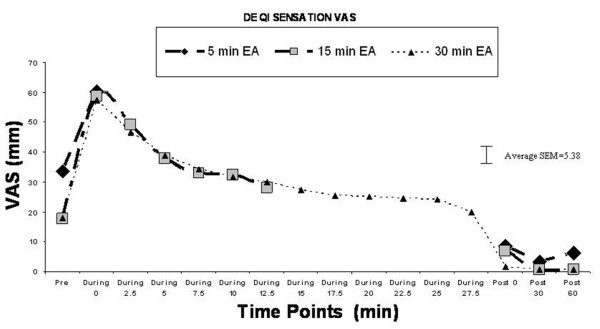
Methods: Baseline peripheral sensory thresholds were measured at pre-marked testing sites along the medial aspects (liver and spleen meridians) of bilateral lower extremities. A 5-second hot pain stimulation was delivered to the testing sites and the corresponding pain Visual Analog Scale (VAS) scores were recorded. Three different EA (5Hz) stimulation durations (5, 15 and 30 minutes) were randomly tested at least one week apart. At the last 10 seconds of each EA session, 5 seconds of subject specific HP stimulation was delivered to the testing sites. The corresponding pain and EA VAS scores of de qi sensation (tingling) during and after the EA were recorded. The measurements were repeated immediately, 30 and 60 minutes after the EA stimulation. A four-factor repeat measures ANOVA was used to assess the effect of stimulation duration, time, location (thigh vs. calf) and side (ipsilateral vs. contralateral) of EA on sensory thresholds and HP VAS scores.
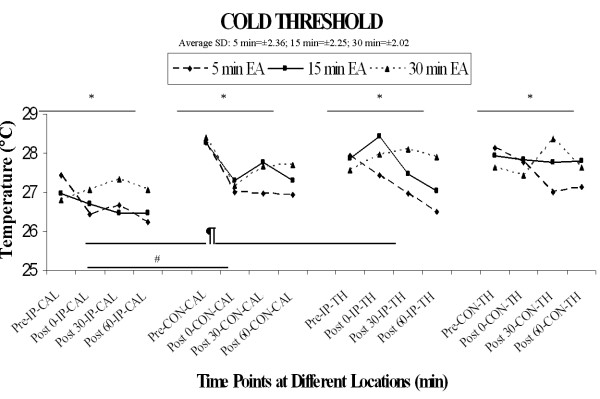
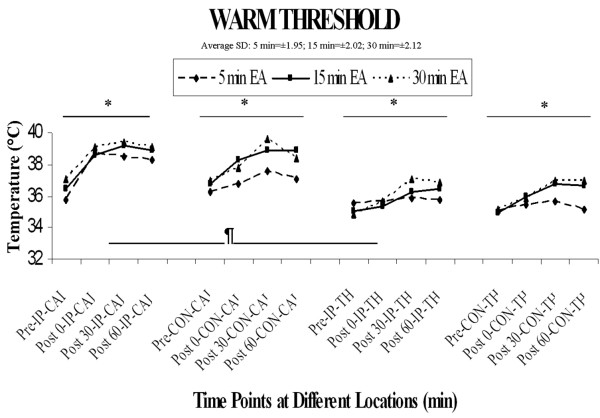
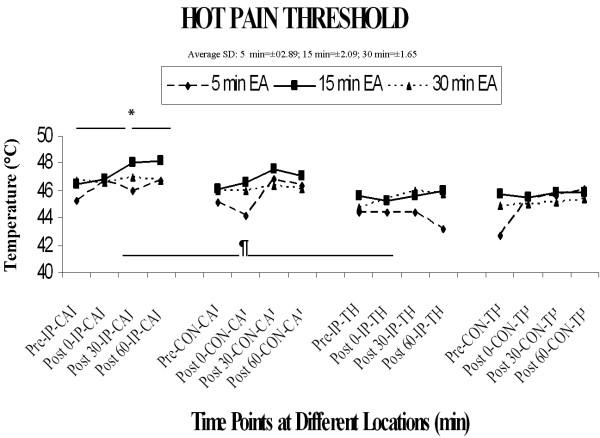
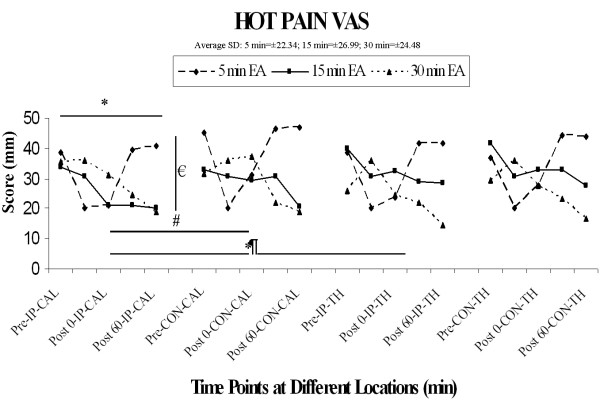
Results: A significant (P < 0.01) main effect of time and location with warm, cold and hot pain thresholds at the four testing sites without any significant difference in duration effect was observed. Similar time and location effects were observed with HP VAS with the longer durations (15 and 30 minutes) of stimulation showed a slower onset, but a more sustainable bilateral analgesic benefit than the short stimulation duration (5 minutes). The 15-minute stimulation resulted in an earlier onset of analgesic effect than the 30-minute stimulation paradigm.
Conclusion: Longer durations of EA stimulation provide a more sustainable analgesic benefit to hot noxious stimulation than a shorter duration of stimulation. The increase of cold threshold with sustained warm threshold temperature elevation as observed in the longer durations of EA suggests that as the duration of EA lengthened, there is a gradual shifting from an initial predominantly spinally mediated analgesic effect to a supraspinally mediated modulatory mechanism of thermal pain. The 15-minute stimulation appeared to be the optimal setting for treating acute pain in the lower extremities.
Figures
References
Publication types
MeSH terms
Grants and funding
LinkOut - more resources
Full Text Sources
Medical
Research Materials
Miscellaneous
