


Motives for residential mobility in later life: post-move perspectives of elders and family members
- PMID: 18453180
- PMCID: PMC2386962
- DOI: 10.2190/AG.66.2.c
Motives for residential mobility in later life: post-move perspectives of elders and family members
Abstract
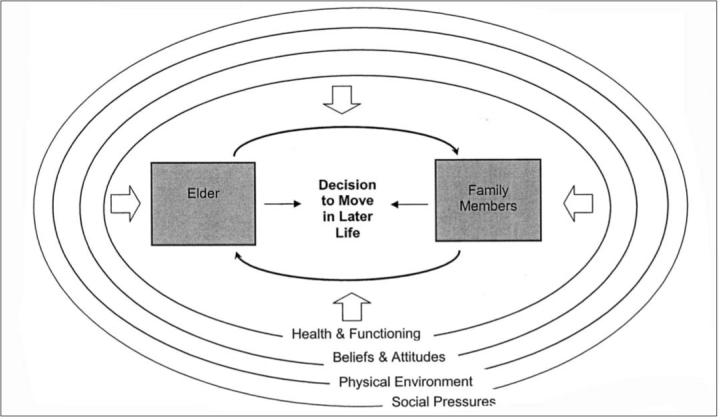
This qualitative study delineates motives for residential mobility, describes dynamics between the elder and family members during the move decision process, and locates the move decision within ecological layers of the aging context. Interviews were conducted with 30 individuals and couples (ages 60-87) who experienced a community-based move within the past year, and with 14 extended family members. Reasons for moving (from perspectives of both elders who moved and their family members) were grouped into four themes and eleven issues that influenced the move decision. These themes parallel the ecological context of individual health and functioning, beliefs and attitudes, physical environment, and social pressures. Late-life mobility is a significant life transition that is the outcome of an ongoing appraisal and reappraisal of housing fit with individual functioning, needs, and aspirations. Family members are an integral part of these decision and residential mobility processes.
Figures
References
-
- Ajzen I, Fishbein M. Understanding attitudes and predicting social behavior. Prentice-Hall; Englewood Cliffs, NJ: 1980.
-
- Arber S, Evandrou M. Ageing, independence, and the life course. Jessica Kingsley Publishers; London, UK: 1993.
-
- Bayer AH, Harper L. Fixing to stay: A national survey of housing and home modification issues. AARP; Washington, DC: 2000.
-
- Burkhauser RV, Butrica BA, Wasylenko MJ. Mobility patterns of older homeowners: Are older homeowners trapped in distressed neighborhoods? Research on Aging. 1995;17:363–384.
-
- Chen PC, Wilmoth JM. The effects of residential mobility on ADL and IADL limitations among the very old living in the community. Journal of Gerontology: Social Sciences. 2004;59B:S164–S172. - PubMed
Publication types
MeSH terms
Grants and funding
LinkOut - more resources
Full Text Sources
Medical
Miscellaneous
