


The functional theory of counterfactual thinking
- PMID: 18453477
- PMCID: PMC2408534
- DOI: 10.1177/1088868308316091
The functional theory of counterfactual thinking
Abstract
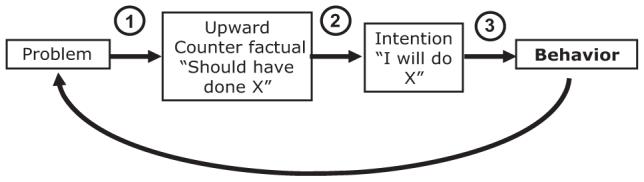
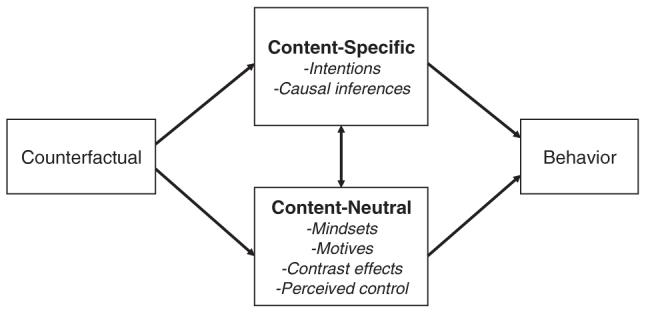
Counterfactuals are thoughts about alternatives to past events, that is, thoughts of what might have been. This article provides an updated account of the functional theory of counterfactual thinking, suggesting that such thoughts are best explained in terms of their role in behavior regulation and performance improvement. The article reviews a wide range of cognitive experiments indicating that counterfactual thoughts may influence behavior by either of two routes: a content-specific pathway (which involves specific informational effects on behavioral intentions, which then influence behavior) and a content-neutral pathway (which involves indirect effects via affect, mind-sets, or motivation). The functional theory is particularly useful in organizing recent findings regarding counterfactual thinking and mental health. The article concludes by considering the connections to other theoretical conceptions, especially recent advances in goal cognition.
Figures
References
-
- Ajzen I. The theory of planned behavior. ”Organizational Behavior and Human Decision Processes. 1991;50:179–211.
-
- Ajzen I, Fishbein M. ”Understanding attitudes and predicting social behavior. Prentice Hall; Englewood Cliffs, NJ: 1980.
-
- Amador XF, Flaum M, Andreasen NC, Strauss DH, Yale SA, Clark SC, et al. Awareness of illness in schizophrenia and schizoaffective and mood disorders. ”Archives of General Psychiatry. 1994;51:826–836. - PubMed
-
- Anderson C. The psychology of doing nothing: Forms of decision avoidance result from reason and emotion. ”Psychological Bulletin. 2003;129:139–167. - PubMed
-
- Au TK. Chinese and English counterfactuals: The Sapir-Whorf hypothesis revisited. ”Cognition. 1983;15:155–187. - PubMed
Publication types
MeSH terms
Grants and funding
LinkOut - more resources
Full Text Sources
Medical
Miscellaneous
