


Nonprice competition and quality of care in managed care: the New York SCHIP market
- PMID: 18454776
- PMCID: PMC2442245
- DOI: 10.1111/j.1475-6773.2007.00805.x
Nonprice competition and quality of care in managed care: the New York SCHIP market
Abstract
Objective: To examine the effect of nonprice competition among managed care plans on the quality of care in the New York SCHIP market.
Data sources: U.S. Census 2000; 2002 New York State Managed Care Plan Performance Report; and 2001 New York State Managed Care Annual Enrollment Report.
Study design: Each market is defined as a county, and competition is measured as the number of plans in a market. Quality of care is measured in percentages using three Consumer Assessment of Health Plans Survey and three Health Plan Employer Data and Information Set scores. Two-stage least squares is applied to address the endogeneity between competition and the quality of care, using population as an instrument.
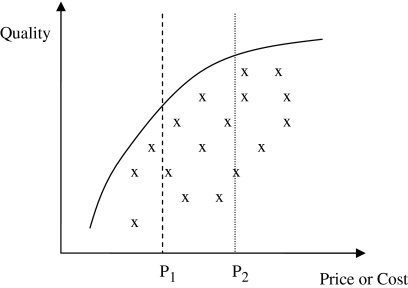
Principal findings: We find a negative association between competition and quality of care. An additional managed care plan is significantly associated with a decrease of 0.40-2.31 percentage points in four out of six quality measures. After adjusting for production cost, a positive correlation is observed between price and quality measures across different pricing regions.
Conclusions: It seems likely that pricing policy is a constraint on quality production, although it may not be interpreted as a causal relationship and further study is needed.
References
-
- Agency of Healthcare Research and Quality (AHRQ) “National Health Quality Report”. 2003. [December 3, 2005]. Available at http://www.qualitytools.ahrq.gov/qualityreport/archive/2003/download/doc....
-
- Beaulieu N D. Quality Information and Consumer Health Plan Choices. Journal of Health Economics. 2002;21(1):43–63. - PubMed
-
- Cutler D M. The Incidence of Adverse Medical Outcomes under Prospective Payment. Econometrica. 1995;63(1):29–50.
-
- Dranove D, Shanley M, Simon C. Is Hospital Competition Wasteful? RAND Journal of Economics. 1992;23(2):247–62. - PubMed
