Impact of universal varicella vaccination on 1-year-olds in Uruguay: 1997-2005
- PMID: 18456699
- PMCID: PMC2563416
- DOI: 10.1136/adc.2007.126243
Impact of universal varicella vaccination on 1-year-olds in Uruguay: 1997-2005
Abstract
Objective: Varicella vaccination was introduced at the end of 1999 into the Uruguayan immunisation schedule for children aged 12 months. Varilrix (Oka strain; GlaxoSmithKline Biologicals) has been the only vaccine used since then and coverage has been estimated to exceed 90% since the start of the universal varicella vaccination programme. We assessed the impact of the Uruguayan varicella vaccination programme during 2005, 6 years after its introduction.
Methods: Information on hospitalisations was collected from the main paediatric referral hospital and information on medical consultations for varicella was collected from two private health insurance systems in Montevideo. The proportion of hospitalisations due to varicella and the proportion of ambulatory visits for varicella since the introduction of the vaccine were compared between 1999 and 2005 and 1997 and 1999 in the following age groups: <1 year, 1-4 years, 5-9 years and 10-14 years.
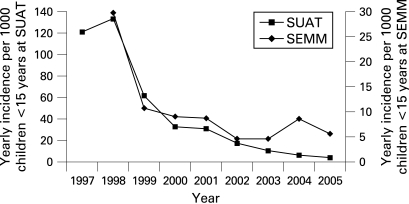
Results: By 2005, the proportion of hospitalisations due to varicella among children, was reduced by 81% overall and by 63%, 94%, 73% and 62% in the <1, 1-4, 5-9 and 10-14 years age groups, respectively. The incidence of ambulatory visits for varicella among children was reduced by 87% overall and by 80%, 97%, 81% and 65% in the <1, 1-4, 5-9 and 10-14 years age groups, respectively.
Conclusions: The burden of varicella has decreased substantially in Uruguayan children since the introduction of the varicella vaccination, including those groups outside the recommended vaccination age. It is expected to decrease further as more cohorts of children are vaccinated and herd immunity increases.
Conflict of interest statement
Figures
References
-
- Meyer PA, Seward JF, Jumaan AO, et al. Varicella mortality: trends before vaccine licensure in the United States, 1970–1994. J Infect Dis 2000;182:383–90 - PubMed
-
- Centers for Disease Control and Prevention Varicella-related deaths among children-United States, 1997. MMWR Morb Mortal Wkly Rep 1998;47:365–8 - PubMed
-
- Krause PR, Klinman DM. Efficacy, immunogenicity, safety, and use of live attenuated chickenpox vaccine. J Pediatr 1995;127:518–25 - PubMed
-
- Meurice F, De Bouver JL, Vandevoorde D, et al. Immunogenicity and safety of a live attenuated varicella vaccine (Oka/SB Bio) in healthy children. J Infect Dis 1996 Nov;174(Suppl 3):S324–9 - PubMed
-
- Sharrar RG, LaRussa P, Galea SA, et al. The postmarketing safety profile of varicella vaccine. Vaccine 2000;19:916–23 - PubMed
Publication types
MeSH terms
Substances
LinkOut - more resources
Full Text Sources
Medical