


Microvessel vascular smooth muscle cells contribute to collagen type I deposition through ERK1/2 MAP kinase, alphavbeta3-integrin, and TGF-beta1 in response to ANG II and high glucose
- PMID: 18456735
- PMCID: PMC2494762
- DOI: 10.1152/ajpheart.00341.2008
Microvessel vascular smooth muscle cells contribute to collagen type I deposition through ERK1/2 MAP kinase, alphavbeta3-integrin, and TGF-beta1 in response to ANG II and high glucose
Abstract
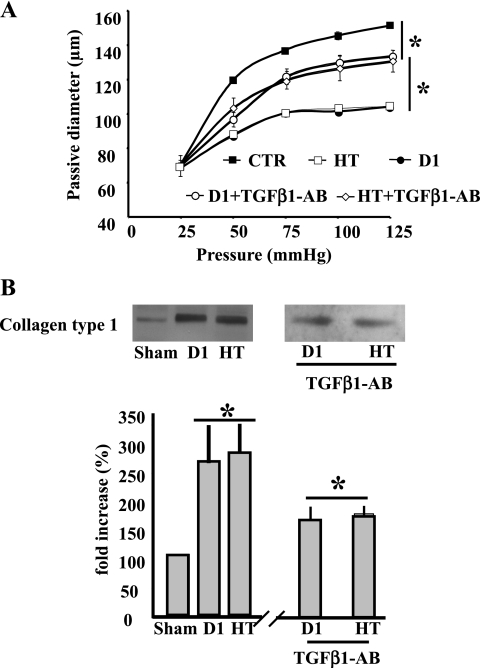
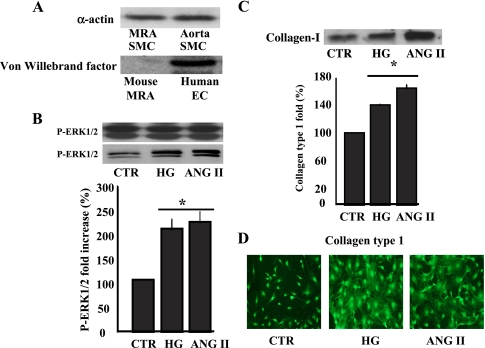
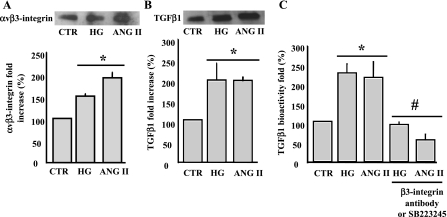
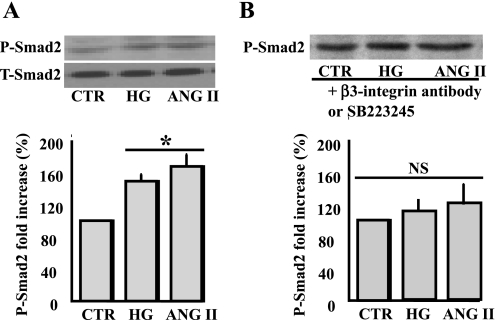
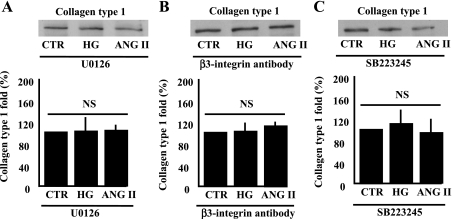
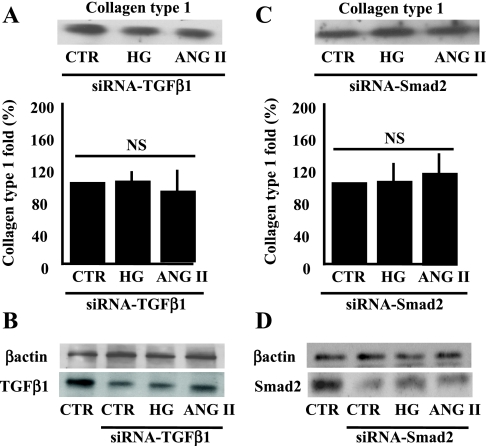
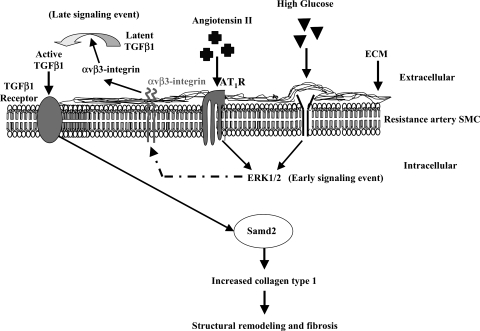
This study determines that vascular smooth muscle cell (VSMC) signaling through extracellular signal-regulated kinase (ERK) 1/2-mitogen-activated protein (MAP) kinase, alphavbeta(3)-integrin, and transforming growth factor (TGF)-beta1 dictates collagen type I network induction in mesenteric resistance arteries (MRA) from type 1 diabetic (streptozotocin) or hypertensive (HT; ANG II) mice. Isolated MRA were subjected to a pressure-passive-diameter relationship. To delineate cell types and mechanisms, cultured VSMC were prepared from MRA and stimulated with ANG II (100 nM) and high glucose (HG, 22 mM). Pressure-passive-diameter relationship reduction was associated with increased collagen type I deposition in MRA from HT and diabetic mice compared with control. Treatment of HT and diabetic mice with neutralizing TGF-beta1 antibody reduced MRA stiffness and collagen type I deposition. Cultured VSMC stimulated with HG or ANG II for 5 min increased ERK1/2-MAP kinase phosphorylation, whereas a 48-h stimulation induced latent TGF-beta1, alphavbeta(3)-integrin, and collagen type 1 release in the conditioned media. TGF-beta1 bioactivity and Smad2 phosphorylation were alphavbeta(3)-integrin-dependent, since beta(3)-integrin antibody and alphavbeta(3)-integrin inhibitor (SB-223245, 10 microM) significantly prevented TGF-beta1 bioactivity and Smad2 phosphorylation. Pretreatment of VSMC with ERK1/2-MAP kinase inhibitor (U-0126, 1 microM) reduced alphavbeta(3)-integrin, TGF-beta1, and collagen type 1 content. Additionally, alphavbeta(3)-integrin antibody, SB-223245, TGF-beta1-small-intefering RNA (siRNA), and Smad2-siRNA (40 nM) prevented collagen type I network formation in response to ANG II and HG. Together, these data provide evidence that resistance artery fibrosis in type 1 diabetes and hypertension is a consequence of abnormal collagen type I release by VSMC and involves ERK1/2, alphavbeta(3)-integrin, and TGF-beta1 signaling. This pathway could be a potential target for overcoming small artery complications in diabetes and hypertension.
Figures
References
-
- Bernadet-Monrozies P, Rostaing L, Kamar N, Durand D. The effect of angiotensin-converting enzyme inhibitors on the progression of chronic renal failure. Presse Med 31: 1714–1720, 2002. - PubMed
-
- Breindl M, Harbers K, Jaenisch R. Retrovirus-induced lethal mutation in collagen I gene of mice is associated with an altered chromatin structure. Cell 38: 9–16, 1984. - PubMed
-
- Cai L, Wang J, Li Y, Sun X, Wang L, Zhou Z, Kang YJ. Inhibition of superoxide generation and associated nitrosative damage is involved in metallothionein prevention of diabetic cardiomyopathy. Diabetes 54: 1829–1837, 2005. - PubMed
Publication types
MeSH terms
Substances
Grants and funding
LinkOut - more resources
Full Text Sources
Medical
Miscellaneous
