


Long-term effect of cued fear conditioning on REM sleep microarchitecture in rats
- PMID: 18457237
- PMCID: PMC2279752
- DOI: 10.1093/sleep/31.4.497
Long-term effect of cued fear conditioning on REM sleep microarchitecture in rats
Abstract
Study objectives: To study long-term effects of conditioned fear on REM sleep (REMS) parameters in albino rats.
Design: We have investigated disturbances in sleep architecture, including muscle twitch density as REMS phasic activity, and freezing behavior in wakefulness, upon reexposure to a conditioned stimulus (CS) on Day 1 and Day 14 postconditioning.
Subjects: Male Sprague-Dawley rats prepared for polysomnographic recordings.
Interventions: After baseline sleep recording, the animals in the experimental group received five pairings of a 5-sec tone, co-terminating with a 1-sec, 1 mAfootshock. The control rats received similar numbers of tones and shocks, but explicitly unpaired. On postconditioning days, after reexposure to tones alone, sleep and freezing behavior were recorded.
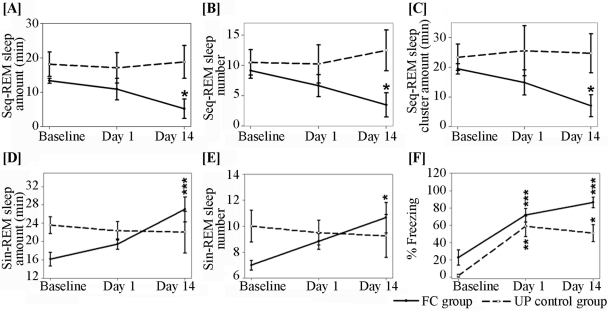
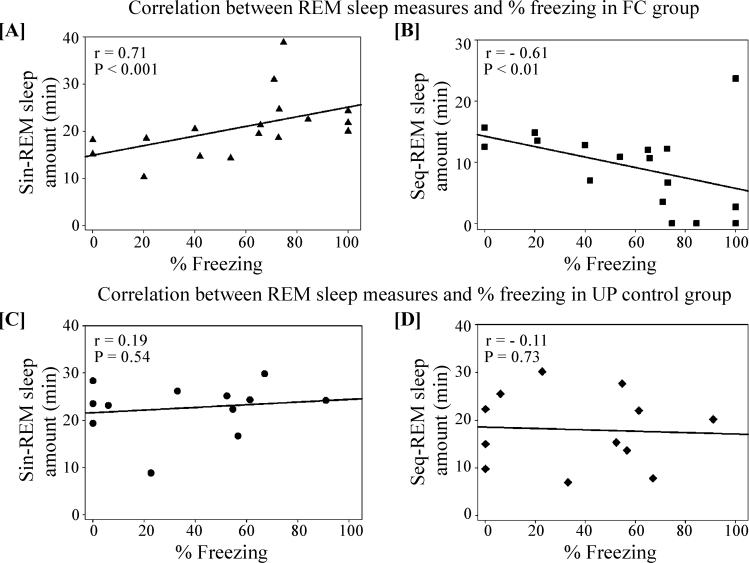
Measurements and results: Conditioned fear significantly altered REMS microarchitecture (characterized as sequential-REMS [seq-REMS: < or =3 min episode separation] and single-REMS [sin-REMS: >3 min episode separation]) on Day 14. The total amount and number of seq-REMS episodes decreased, while the total amount and number of sin-REMS episodes increased. Further, the CS induced significant increases in freezing and REMS myoclonic twitch density in the experimental group. Reexposure to the CS produced no alterations in controls.
Conclusions: The results suggest that conditioned fear causes REMS alterations, including difficulty in initiating a REMS episode as indicated by the diminution in the number of seq-REMS episodes. Another finding, the increase in phasic activity, agrees with the inference from clinical investigations that retrieval of fearful memories can be associated with the long-term REMS disturbances characteristic of posttraumatic stress disorder.
Figures

References
-
- Maren S. Neurobiology of Pavlovian fear conditioning. Annu Rev Neurosci. 2001;24:897–931. - PubMed
-
- Davis M. The role of the amygdala in fear and anxiety. Annu Rev Neurosci. 1992;15:353–75. - PubMed
-
- American Psychiatric Association. Diagnostic and Statistical Manual of Mental Disorders. Fourth Edition (DSM-IV) Arlington, VA: American Psychiatric Publishing, Inc.; 1994.
-
- Ross RJ, Ball WA, Sullivan KA, Caroff SN. Sleep disturbance as the hallmark of posttraumatic stress disorder. Am J Psychiatry. 1989;146:697–707. - PubMed
-
- Jha SK, Brennan FX, Pawlyk AC, Ross RJ, Morrison AR. REM sleep: a sensitive index of fear conditioning in rats. Eur J Neurosci. 2005;21:1077–80. - PubMed
