


Low socio-economic position is associated with poor social networks and social support: results from the Heinz Nixdorf Recall Study
- PMID: 18457583
- PMCID: PMC2424055
- DOI: 10.1186/1475-9276-7-13
Low socio-economic position is associated with poor social networks and social support: results from the Heinz Nixdorf Recall Study
Abstract
Background: Social networks and social support are supposed to contribute to the development of unequal health within populations. However, little is known about their socio-economic distribution. In this study, we explore this distribution.
Methods: This study analyses the association of two indicators of socio-economic position, education and income, with different measures of social networks and support. Cross-sectional data have been derived from the baseline examination of an epidemiological cohort study of 4.814 middle aged urban inhabitants in Germany (Heinz Nixdorf Recall Study). Bivariate and multivariate logistic regression analysis were carried out to estimate the risk of having poor social networks and support across socio-economic groups.
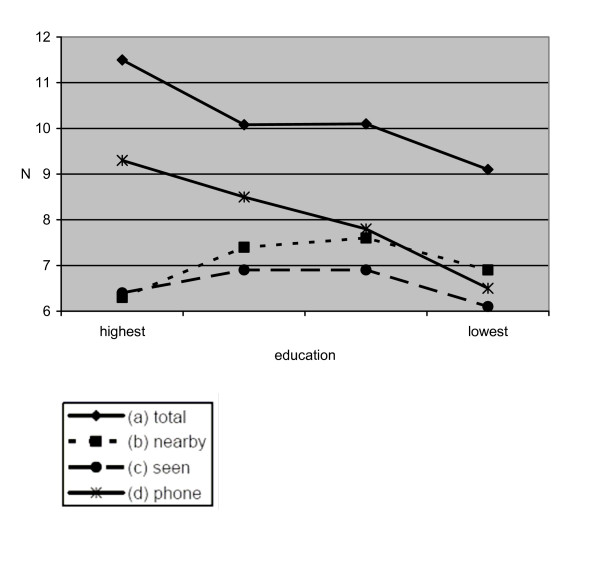
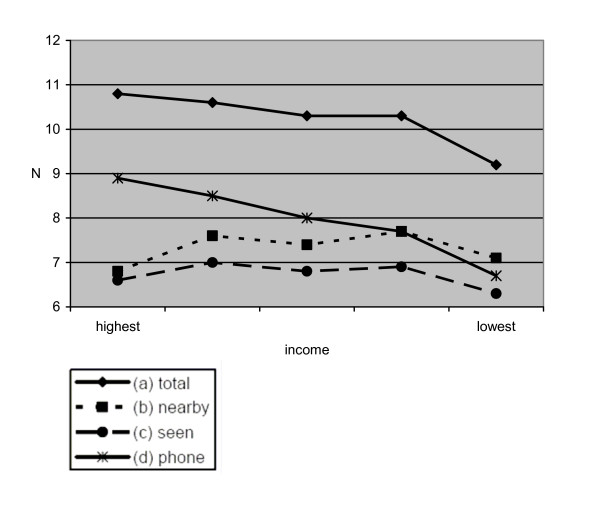
Results: Socially disadvantaged persons more often report poor social networks and social support. In multivariate analyses, based on education, odds ratios range from 1.0 (highest education) to 4.9 (lowest education) in a graded way. Findings based on income show similar effects, ranging from 1.0 to 2.5. There is one exception: no association of SEP with close ties living nearby and regularly seen was observed.
Conclusion: Poor social networks and low social support are more frequent among socio-economically disadvantaged people. To some extent, this finding varies according to the indicator chosen to measure these social constructs.
Figures
References
-
- Berkman L, Glass T. Social integration, social networks, social support, and health. In: Berkman L and Kawachi I, editor. Social Epidemiology. New York, Oxford University Press; 2000. pp. 137–173.
-
- House JS. Work, Stress, and Social Support. Reading, MA, Addison-Wesley; 1981.
-
- Siegrist J, Marmot M. Social Inequalities in Health: New Evidence and Policy Implications. Oxford, Oxford University Press; 2006.
-
- Mielck A. Social Inequalities and Health Evidence, Explanations and Implications (in German) Bern, Hans Huber; 2000.
LinkOut - more resources
Full Text Sources
