


Olfactory physiological impairment in first-degree relatives of schizophrenia patients
- PMID: 18457935
- PMCID: PMC2504534
- DOI: 10.1016/j.schres.2008.03.013
Olfactory physiological impairment in first-degree relatives of schizophrenia patients
Abstract
Background: Efforts to characterize genetic vulnerability to schizophrenia are increasingly focused on the identification of endophenotypes--neurobiological abnormalities that are evident in individuals at risk. Behavioral studies have demonstrated olfactory impairments in odor detection and identification in unaffected 1st-degree relatives of schizophrenia patients, suggesting that abnormalities in this simple sensory system may serve as candidate endophenotypes. It is unclear, however, whether these behavioral abnormalities reflect basic olfactory sensory processing deficits or nonspecific disruptions of attention and cognition.
Method: Unirhinal chemosensory olfactory evoked potentials were acquired from 14 unaffected 1st-degree relatives of schizophrenia patients and 20 healthy individuals with equivalent age and gender distributions, using 3 different concentrations of hydrogen sulfide. Subjects were also assessed behaviorally for ability to detect and identify odors.
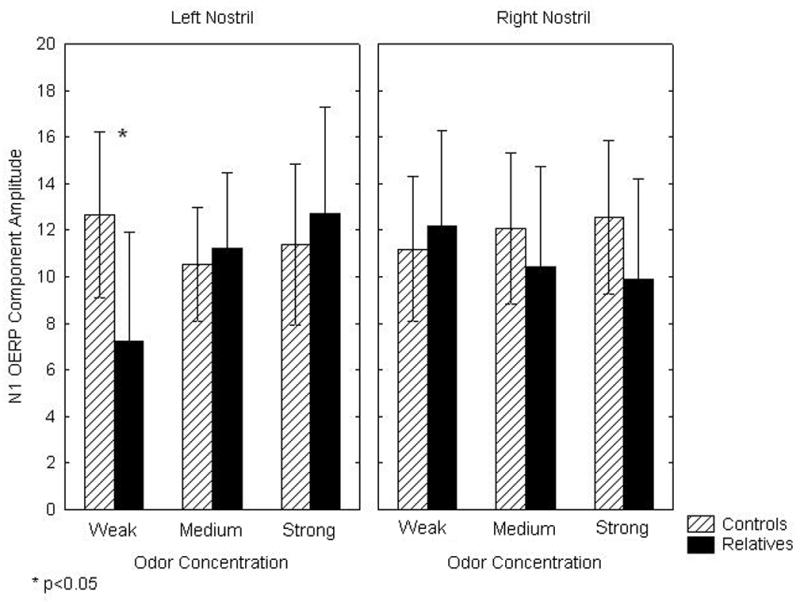
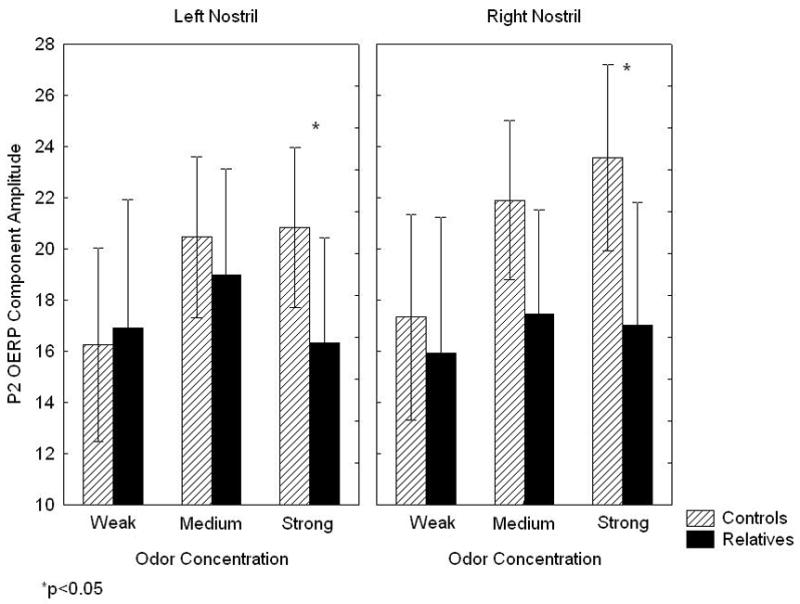
Results: Family members exhibited left nostril olfactory detection impairments and bilateral olfactory identification abnormalities. They had reduced evoked potential response amplitudes for the initial N1 component in the left nostril. The subsequent P2 evoked potential response was reduced bilaterally. The pattern and magnitude of family member deficits were comparable to those previously observed for schizophrenia patients.
Conclusion: 1st-degree relatives of schizophrenia patients exhibit specific neurophysiological impairments in early olfactory sensory processing. The presence of these neurophysiological abnormalities in both schizophrenia patients and their unaffected 1st-degree relatives suggests that these represent genetically mediated vulnerability markers or endophenotypes of the illness.
Figures

References
-
- Arnold SE, Han LY, Moberg PJ, Turetsky BI, Gur RE, Trojanowski JQ, Hahn CG. Dysregulation of olfactory receptor neuron lineage in schizophrenia. Arch Gen Psychiatry. 2001;58:829–835. - PubMed
-
- Barinaga M. Olfaction. Smell’s course is predetermined. Science. 2001;294:1269–1271. - PubMed
-
- Brewer WJ, Wood SJ, McGorry PD, Francey SM, Phillips LJ, Yung AR, Anderson V, Copolov DL, Singh B, Velakoulis D, Pantelis C. Impairment of olfactory identification ability in individuals at ultra-high risk for psychosis who later develop schizophrenia. Am J Psychiatry. 2003;160:1790–4. - PubMed
-
- Cardenas VA, Yingling CD, Jewett D, Fein G. A multichannel, model-free method for estimation of event-related potential amplitudes and its comparison with dipole source localization. J Med Eng Technol. 1995;19:88–98. - PubMed
-
- Cui L, Evans WJ. Olfactory event-related potentials to amyl acetate in congenital anosmia. Electroenceph Clin Neurophysiol. 1997;102:303–6. - PubMed
Publication types
MeSH terms
Substances
Grants and funding
LinkOut - more resources
Full Text Sources
Medical
