


Influence of and optimal insulin therapy for a low-glycemic index meal in children with type 1 diabetes receiving intensive insulin therapy
- PMID: 18458138
- PMCID: PMC2494635
- DOI: 10.2337/dc08-0331
Influence of and optimal insulin therapy for a low-glycemic index meal in children with type 1 diabetes receiving intensive insulin therapy
Abstract
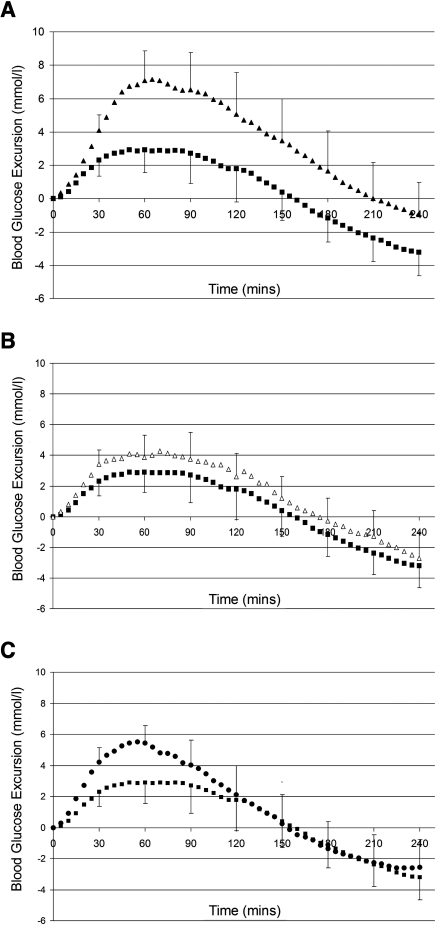
Objective: The purpose of this study was to quantify the effects of glycemic index on postprandial glucose excursion (PPGE) in children with type 1 diabetes receiving multiple daily injections and to determine optimal insulin therapy for a low-glycemic index meal.
Research design and methods: Twenty subjects consumed test breakfasts with equal macronutrient contents on 4 consecutive days; high-and low-glycemic index meals (glycemic index 84 vs. 48) were consumed with preprandial ultra-short-acting insulin, and the low-glycemic index meal was also consumed with preprandial regular insulin and postprandial ultra-short-acting insulin. Each child's insulin dose was standardized. Continuous glucose monitoring was used.
Results: The PPGE was significantly lower for the low-glycemic index meal compared with the high-glycemic index meal at 30-180 min (P < 0.02) when preprandial ultra-short-acting insulin was administered. The maximum difference occurred at 60 min (4.2 mmol/l, P < 0.0001). Regular insulin produced a 1.1 mmol/l higher PPGE at 30 min compared with ultra-short-acting insulin (P = 0.015) when the low-glycemic index meal was consumed. Postprandial ultra-short-acting insulin produced a higher PPGE at 30 and 60 min compared with preprandial administration when the low-glycemic index meal was consumed. The maximum difference was 2.5 mmol/l at 60 min (P < 0.0001).
Conclusions: Low-glycemic index meals produce a lower PPGE than high-glycemic index meals. Preprandial ultra-short-acting insulin is the optimal therapy for a low-glycemic index meal.
Figures
References
-
- Diabetes Control and Complications Trial Research Group: The relationship of glycemic exposure (HbA1c) to risk of development and progression of retinopathy in the Diabetes Control and Complications Trial. Diabetes 44:968–984, 1995 - PubMed
-
- Delahanty LM, Halford BN: Role of diet behaviours in achieving improved glycemic control in intensively treated patients in the Diabetes Control and Complications Trial. Diabetes Care 16:1453–1458, 1993 - PubMed
-
- American Diabetes Association: Nutrition recommendations and interventions for diabetes–2006: a position statement of the American Diabetes Association. Diabetes Care 29:2140–2157, 2006 - PubMed
-
- Samann A, Muhlhauser I, Bender R, Kloos C, Muller UA: Glycaemic control and severe hypoglycemia following training in flexible, intensive insulin therapy to enable dietary freedom in people with type 1 diabetes: a prospective implementation program. Diabetologia 48:1965–1970, 2005 - PubMed
-
- Mühlhauser I, Bott U, Overmann H, Wagener W, Bender R, Jörgens V, Berger M: Liberalized diet in patients with type 1 diabetes. J Intern Med 237:591–597, 1995 - PubMed
